
Object-Oriented Programming (OOP) in the C# programming language embodies a paradigm that fundamentally alters how software is conceptualized, designed, and implemented. It emphasizes the creation and manipulation of objects—self-contained entities that encapsulate data and behavior—thus enabling developers to construct modular, reusable, and maintainable systems. C# stands out among programming languages for its comprehensive support for OOP principles, making it a preferred choice for a wide spectrum of applications—from desktop utilities and web services to mobile apps and complex enterprise solutions. As a language deeply integrated into the Microsoft ecosystem, C# has evolved continuously, integrating advanced features that enhance its expressiveness, efficiency, and scalability. Recognizing the significance of this paradigm within the broader context of software engineering, it is essential to explore its core principles, language-specific implementations, advanced features, and real-world applications in granular detail.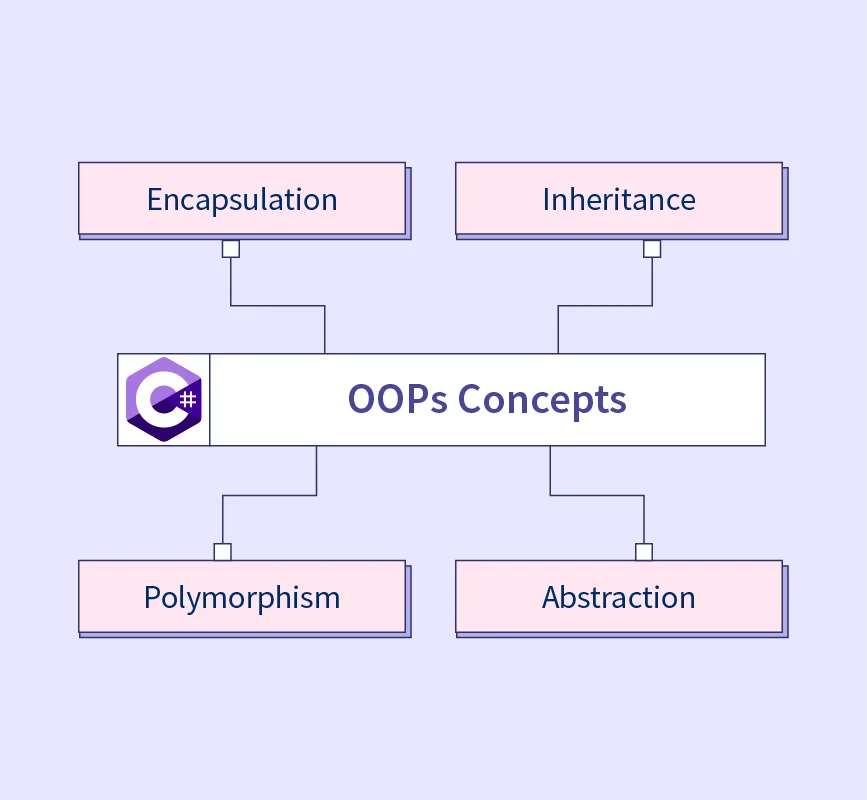
Foundational Principles of Object-Oriented Programming in C#
Encapsulation: Safeguarding Data and Behavior
Encapsulation constitutes the cornerstone of OOP, establishing a protective barrier around an object’s internal state. This principle involves bundling data (fields) and the methods (functions) that operate on that data into a single unit—an object. In C#, encapsulation is primarily achieved through classes, which serve as templates or blueprints for creating objects. The use of access modifiers such as public, private, protected, and internal directly influences the visibility and accessibility of class members, reinforcing data hiding and promoting modularity.
For example, consider a class BankAccount. Its balance should not be directly modifiable by external code; instead, it should be accessed via controlled methods, such as Deposit and Withdraw. These methods enforce business rules, validation, and security constraints, ensuring the object maintains a consistent internal state. This encapsulation reduces complexity and enhances maintainability, especially in large, collaborative projects.
Inheritance: Building Hierarchies and Promoting Code Reuse
Inheritance enables the creation of new classes that derive from existing ones, inheriting their properties and behaviors. This mechanism fosters code reuse, simplifies maintenance, and models real-world hierarchies effectively. In C#, inheritance is expressed using the colon syntax, whereby a derived class extends the base class, adding or overriding functionalities as needed.
For instance, in a vehicle management system, a base class Vehicle might encapsulate common attributes like Make, Model, and Year. Specialized classes such as Car and Truck inherit from Vehicle and introduce specific features like NumberOfDoors or PayloadCapacity. This hierarchical design simplifies code management and aligns with object-oriented modeling of real-world entities.
Polymorphism: Flexibility through Many Forms
Polymorphism, derived from Greek meaning “many forms,” allows objects of different classes to be treated uniformly through a common interface or base class. It enables dynamic method dispatch, where the actual method invoked is determined at runtime based on the object’s runtime type. C# supports polymorphism via method overloading, method overriding, interfaces, and abstract classes.
Method overloading allows multiple methods with the same name but different parameter signatures within the same class, enhancing flexibility. Method overriding, on the other hand, involves redefining a base class method in a derived class with a new implementation, marked with the override keyword. This enables behavior specialization while maintaining a consistent interface.
Interfaces and Abstract Classes as Pillars of Polymorphism
Interfaces in C# define a contract that implementing classes must fulfill, specifying a set of methods, properties, or events without providing implementation details. They promote loose coupling and facilitate polymorphism across diverse classes. Abstract classes, which may contain both implemented and abstract (unimplemented) members, serve as partial blueprints for derived classes.
For example, consider an interface IShape with a method CalculateArea(). Classes like Circle and Rectangle implement this interface, each providing their own specific calculation. This approach allows polymorphic treatment of different shape objects, simplifying algorithms that operate on collections of shapes.
Abstraction: Simplifying Complex Systems
Abstraction involves modeling complex reality by focusing on relevant features while hiding implementation details. In C#, abstraction manifests through abstract classes and interfaces. Abstract classes can contain abstract methods—methods without implementation—that derived classes are compelled to implement, thereby establishing a common interface while allowing flexibility.
This principle enables developers to design system architectures where high-level modules depend on abstractions rather than concrete implementations, promoting decoupling and scalability. For example, in a payment processing system, an abstract class PaymentMethod might define an abstract method ProcessPayment(). Concrete classes like CreditCard and PayPal implement this method, encapsulating specific payment protocols while exposing a unified interface.
Advanced Features Supporting Object-Oriented Design in C#
Properties: Controlled Access to Data
Properties in C# streamline encapsulation by combining fields with get and set accessors, allowing controlled access to an object’s internal data. They provide a clean syntax for accessing data members, enabling validation, lazy loading, or other logic to be embedded within accessors.
For example, a class User might have a private field _age. The public property Age can enforce constraints such as non-negativity:
public int Age
{
    get { return _age; }
    set
    {
        if (value >= 0)
            _age = value;
        else
            throw new ArgumentException("Age cannot be negative");
    }
}
This pattern enhances data integrity, simplifies code, and aligns with the encapsulation principle.
Indexers: Objects as Arrays
Indexers extend the concept of properties, allowing objects to be accessed via array-like syntax. By defining an indexer, a class can specify how to handle element access using square brackets, providing an intuitive interface for complex data structures.
Consider a class HttpHeaderCollection that manages HTTP headers. Implementing an indexer allows accessing headers with syntax like headers["Content-Type"]. This approach simplifies client code and enhances usability.
Generics: Type Safety and Reusability
Introduced in C# 2.0, generics allow classes, methods, and interfaces to operate on data types specified as parameters, promoting code reuse and type safety. Instead of creating multiple versions of a class for different data types, developers can define a generic class like List<T>, which can hold any type T.
For example, List<int> and List<string> are instantiations of the generic List<T> class, enabling compile-time type checking and reducing runtime errors. Generics are fundamental in building collections, algorithms, and data access layers that are both flexible and reliable.
LINQ: Declarative Data Queries
Language-Integrated Query (LINQ) revolutionizes data manipulation within C# by embedding query capabilities directly into the language syntax. LINQ supports querying collections, XML, databases, and more, using a syntax similar to SQL or functional LINQ expressions.
| Data Source | LINQ Query Example | Description |
|---|---|---|
| Collection |
var highScores = from s in scores where s > 80 select s; |
Selects scores greater than 80 from a collection. |
| XML |
var elements = from e in xmlDoc.Descendants("Item") select e;
|
Queries XML elements. |
| Database |
var query = from c in context.Customers where c.City == "London" select c; |
Retrieves customers from London. |
LINQ enhances readability, reduces boilerplate code, and integrates seamlessly with C#’s type system, facilitating efficient data operations.
Asynchronous Programming: Non-Blocking Operations
The introduction of async and await keywords in C# 5.0 enables developers to write asynchronous code that is both readable and efficient. Asynchronous programming is essential for responsive applications, especially those involving I/O-bound operations like network requests, file access, or database queries.
For example, an asynchronous method fetching data from a web API might look like:
public async Task<string> FetchDataAsync()
{
    var client = new HttpClient();
    var response = await client.GetAsync("https://api.example.com/data");
    return await response.Content.ReadAsStringAsync();
}
This pattern allows the main thread to remain responsive while waiting for external operations, improving user experience and scalability.
Design Patterns in C#: Solutions to Common Problems
Singleton Pattern
The Singleton pattern ensures that a class has only one instance and provides a global point of access to it. In C#, this is typically implemented with a static property and a private constructor, ensuring controlled instantiation. This pattern is useful for managing shared resources like configuration managers or connection pools.
public class ConfigurationManager
{
    private static readonly ConfigurationManager _instance = new ConfigurationManager();

    private ConfigurationManager()
    {
        // Initialize configuration
    }

    public static ConfigurationManager Instance
    {
        get { return _instance; }
    }

    // Configuration methods and properties
}
Observer Pattern
Supported naturally in C# through events and delegates, the Observer pattern facilitates loosely coupled communication between objects. A subject maintains a list of dependents (observers) and notifies them upon state changes, promoting modularity and reusability.
For example, a stock price ticker can notify multiple display modules of price updates using events, enabling real-time updates with minimal coupling.
Dependency Injection
Dependency Injection (DI) is a key pattern for building maintainable and testable systems. C# supports DI through constructor injection, property injection, or method injection, often facilitated by frameworks like Microsoft.Extensions.DependencyInjection or Autofac. DI promotes loose coupling by externalizing object dependencies, simplifying testing and future modifications.
Model-View-Controller (MVC)
The MVC architectural pattern divides an application into three interconnected components: Model (data and business logic), View (UI), and Controller (handles input and updates model). In C#, ASP.NET MVC and ASP.NET Core MVC provide robust frameworks for web applications, enabling separation of concerns, testability, and scalability.
Aspect-Oriented Programming (AOP)
While not natively supported in C#, AOP can be achieved using external frameworks such as PostSharp. AOP allows the modularization of cross-cutting concerns like logging, security, and transaction management, reducing clutter and improving maintainability.
Real-World Applications of C# and OOP Principles
Desktop Applications
Windows Presentation Foundation (WPF) and Windows Forms are prominent frameworks for desktop development using C#. WPF, leveraging XAML, supports sophisticated UI design, data binding, and MVVM (Model-View-ViewModel) architecture, fostering a clear separation of concerns and testability. These applications are prevalent in enterprise settings, providing rich user experiences for complex data management, automation, and productivity tools.
Web Development
ASP.NET, especially ASP.NET Core, facilitates scalable, high-performance web applications. Core features such as middleware pipelines, dependency injection, and Razor pages support modern web development practices. The use of C# in backend logic enables tight integration with databases, APIs, and cloud services, streamlining full-stack development.
Mobile Development
Xamarin extends C#’s reach to mobile platforms, enabling developers to write shared codebases for iOS and Android. Xamarin.Forms provides a unified UI layer, promoting rapid development and consistent user experiences across devices. This approach significantly reduces development time and costs compared to native development.
Game Development
The Unity engine, one of the most popular game development platforms, employs C# for scripting. Its extensive API allows for creating interactive 2D and 3D games across multiple platforms, including PC, consoles, and mobile devices. C#’s performance and ease of use make it an ideal language for game logic, AI, physics, and animation.
Enterprise Systems
Large-scale enterprise applications leverage C# for developing robust, scalable, and secure solutions. Integration with Microsoft Azure, SQL Server, and other Microsoft technologies simplifies deployment and maintenance. Such systems include financial transaction platforms, customer relationship management (CRM), enterprise resource planning (ERP), and data analytics systems.
Memory Management and Multithreading in C#
Garbage Collector
C# employs an automatic garbage collector (GC) that manages memory allocation and deallocation, alleviating the burden of manual memory handling. The GC periodically identifies and reclaims unused objects, reducing memory leaks and dangling pointers. This feature enhances robustness and simplifies development, although understanding GC behavior is crucial for performance optimization.
Multithreading and Synchronization
Modern applications often require concurrent execution to maximize hardware utilization. C# provides a comprehensive threading model, including the Thread class, thread pools, and asynchronous programming constructs. Synchronization primitives such as lock, Mutex, and Semaphore ensure thread safety when accessing shared resources, preventing race conditions and deadlocks.
The Extensive Ecosystem of C# and the .NET Framework
Beyond core language features, C# benefits from a vast ecosystem comprising the .NET Framework, .NET Core, and now .NET 5/6/7, which unify and modernize the platform. The standard library offers classes and methods for file I/O, networking, security, cryptography, diagnostics, and more, accelerating development and reducing boilerplate code.
Third-party libraries and frameworks further enrich this ecosystem, providing tools for dependency injection, logging, testing, serialization, and cloud integration. Notable examples include Entity Framework for ORM, ASP.NET Identity for authentication, and SignalR for real-time communication.
Cloud Integration and Modern Development Practices
Microsoft Azure, the leading cloud platform, seamlessly integrates with C# applications. Developers can leverage Azure services such as App Service, Functions, Cosmos DB, and Machine Learning to build scalable, resilient, and intelligent applications. Features like serverless computing, containerization with Docker, and CI/CD pipelines support modern DevOps workflows, ensuring rapid deployment and continuous improvement.
Summary and Future Outlook
Object-Oriented Programming in C# is a comprehensive paradigm that underpins the language’s ability to create complex, scalable, and maintainable software. Its core principles—encapsulation, inheritance, polymorphism, and abstraction—are supported by an extensive set of language features, from properties and indexers to generics and LINQ. The language’s support for design patterns, asynchronous programming, and architectural frameworks like MVC amplifies its versatility across domains.
As the software landscape evolves, C# continues to adapt, integrating new paradigms such as functional programming, enhancing support for cloud-native and microservices architectures, and improving developer productivity. Its integration with Azure and other cloud services ensures that C# remains at the forefront of enterprise and modern application development.
For those interested in delving deeper into the rich world of C# and Object-Oriented Programming, the platform Free Source Library offers a wealth of tutorials, code samples, and in-depth articles that cover everything from fundamental concepts to advanced design patterns, ensuring developers and students alike can master the art and science of modern software engineering.