Tesla Autopilot and Full Self-Driving (Supervised) are driver-assistance systems, not autonomous driving systems that let a driver stop paying attention. Tesla describes FSD (Supervised) as SAE Level 2 automation, and the US National Highway Traffic Safety Administration says every vehicle currently sold in the United States requires the driver’s full attention. The person in the driver’s seat remains responsible for monitoring the road and taking control.
Search interest in Tesla Autopilot often rises after software changes, crashes, recalls or announcements about robotaxis. Those stories can blur three different products: basic assistance in customer cars, the broader FSD (Supervised) feature set, and purpose-built automated vehicles such as Cybercab. This guide separates them, explains the technology’s real capabilities and limits, and shows how to evaluate safety claims from both regulators and the manufacturer.
Tesla Autopilot and FSD Supervised compared
| System | Typical capability | Driver role |
|---|---|---|
| Traffic-Aware Cruise Control | Controls speed and following distance | Continuously supervise, steer when required and remain ready to brake |
| Autosteer / Autopilot combination | Supports speed and lane-centering under suitable conditions | Continuously supervise and intervene immediately |
| FSD (Supervised) | Can navigate turns, intersections, roundabouts, lane changes and highways in supported markets | Continuously supervise; the feature does not make the vehicle autonomous |
| Automated driving system pilot | May perform the entire driving task within a defined operational domain | Rules depend on the system, vehicle and authorised deployment |
Tesla’s names have evolved, and features vary by hardware, software version, model and country. A video from another region may show functions unavailable on a viewer’s vehicle. The owner’s manual displayed in the car is more relevant than an old demonstration.
What SAE Level 2 means
SAE International defines Level 2 as simultaneous support for steering and speed while the human driver continuously supervises and intervenes as needed. The system performs part of the dynamic driving task, but responsibility for the environment and fallback remains with the driver.
At Level 3, an automated driving system can perform the full driving task within defined conditions, although a human may need to take over after a request. At Level 4, the system manages fallback within its operating domain without expecting a human to rescue it. Level 5 would perform under all road conditions a human could handle. Those distinctions are about responsibility and capability, not merely how smoothly a car drives in a promotional clip.
Tesla’s own evidence dashboard identifies FSD (Supervised) as Level 2. The word “Full” in the brand name does not override that classification. A driver cannot lawfully or safely use a phone, sleep, move out of position or assume the car will handle every rare event.
What FSD Supervised can do
According to Tesla, the system can follow a navigation route, negotiate intersections, turn left or right, navigate roundabouts, enter and leave highways, change lanes and respond to traffic controls. In supported vehicles, Autopark and Summon-related features can assist with parking or low-speed movement.
These capabilities are technically impressive because urban driving combines perception, prediction and control. The car must interpret lane geometry, lights, signs, vulnerable road users and the likely movement of other vehicles. Neural networks process camera input and software updates can change behaviour over time.
Capability is not reliability under every condition. A system can successfully complete thousands of routine maneuvers and still fail at an unusual construction layout, emergency scene or partially obscured signal. Safety depends on how often failures occur, how severe they are and whether a human can recognize and correct them in time.
Situations that demand extra caution
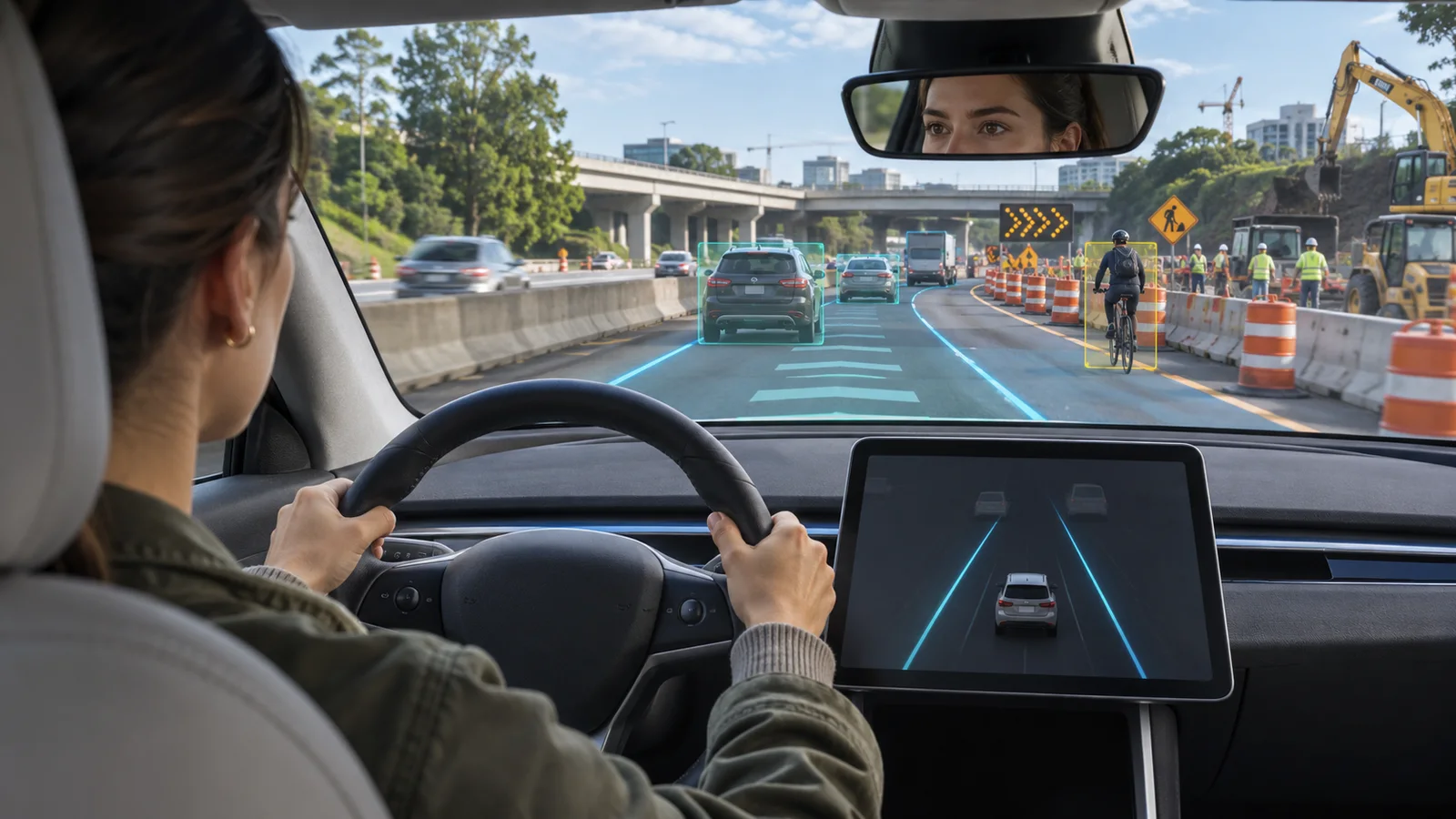
- Construction zones with temporary or conflicting markings
- Emergency vehicles, responders and unusual hand signals
- Heavy rain, snow, fog, glare or low sun
- Dirty, blocked or damaged cameras
- Narrow roads with oncoming traffic
- Complex unprotected turns and unusual intersections
- Pedestrians or cyclists emerging from occlusion
- Objects with unfamiliar shapes, loads or movement
- Road closures and recent map changes
Tesla’s owner manual explicitly warns that intervention may be required on narrow roads, in construction zones and at complex intersections. The correct response to uncertainty is not to wait and see how close the system gets. A supervising driver should take over early and smoothly.
How driver monitoring works
Current vehicles can use a cabin camera to assess attention. The system may issue visual and audible warnings when the driver repeatedly looks away or appears inattentive. Depending on configuration, the wheel can also request slight turning force. Ignoring prompts can cause a strikeout and disable the feature for the remainder of a trip; repeated misuse may lead to a temporary suspension.
Monitoring is a safeguard, not permission to multitask until warned. Detection has limits. Sunglasses, lighting, posture and occlusion can complicate interpretation, and a warning arrives after attention has already degraded. A driver should maintain a continuous visual scan and readiness independent of prompts.
Devices intended to defeat monitoring are unsafe. Tesla says circumvention violates its terms and can lead to feature disablement. More importantly, an artificial weight or blocked camera removes protection against predictable human complacency.
Why automation can make supervision difficult
Humans are poor at passively monitoring a reliable system for rare failures. When the car behaves well for long periods, attention naturally drifts and trust rises. Yet the driver may receive only seconds to understand an unusual scene and intervene. This is sometimes called the vigilance problem.
Mode confusion adds risk. A driver may misunderstand which feature is active, what it controls or why it disengaged. Clear displays, distinct alerts and consistent controls help, but users must still recognize the active mode. A blue path or steering icon should be checked after engagement; never assume a button press succeeded.
The NHTSA Autopilot recall and continuing review
In 2023, Tesla recalled vehicles equipped with Autopilot after NHTSA’s investigation concluded that the system’s controls and warnings could be insufficient to prevent foreseeable misuse. Tesla deployed an over-the-air remedy intended to improve alerts and engagement controls.
NHTSA later opened Recall Query RQ24009 to assess whether that remedy was adequate. The agency cited post-remedy crashes, preliminary testing and concerns that parts of the response could be optional or reversible. An open investigation is not a final finding that every vehicle is defective, but it signals unresolved regulatory questions that owners should follow.
Software recalls can feel less visible than a workshop repair because the fix arrives over the air. They are still safety recalls. Owners should install required updates and check the vehicle identification number at the official NHTSA recall site. A recall does not expire, and a used vehicle may have missed an update or need confirmation.
How to interpret crash statistics
Tesla publishes figures showing fewer collisions per distance driven with assistance engaged than in other driving. Those numbers are relevant, but a fair comparison requires exposure context. Autopilot may be used disproportionately on divided highways, which generally have fewer conflicts than urban streets. Vehicle age, driver population, weather and reporting definitions can differ.
Regulatory crash databases have limitations too. Reports may be incomplete, late or missing comparable mileage. A crash occurring shortly after disengagement may raise different questions from one during continuous operation. Raw counts cannot establish a per-mile risk without a reliable denominator.
The strongest safety evaluation combines controlled testing, naturalistic driving data, crash severity, exposure, independent replication and transparent definitions. Neither one dramatic video nor one aggregate rate settles the issue.
Autopilot is not Cybercab
Cybercab is a purpose-built vehicle concept intended for driverless commercial service, while Autopilot and FSD (Supervised) are features in customer vehicles that require supervision. Conflating them creates false expectations. A company can deploy a limited automated service under specified conditions while its consumer product remains Level 2.
In September 2026, NHTSA announced an Audit Query concerning Tesla’s certification of Cybercab following commercial deployment in Austin. The inquiry examines how a vehicle without traditional human controls was certified against existing federal motor vehicle safety standards. It does not transform privately owned Teslas into driverless cars.
What a geofenced automated service means
Automated services can operate within an operational design domain: a defined combination of roads, speeds, weather, time and other conditions. A system that works without a driver inside that domain may be Level 4 even though it cannot operate everywhere. Boundaries can be enforced through mapping and remote fleet control.
Consumer marketing often focuses on the range of situations a system can attempt. Regulation focuses on who is responsible when it reaches a limit. The difference between a broad Level 2 system and a narrower Level 4 service is therefore not simply which one handles more streets; it is how fallback is managed.
Safe-use checklist for owners
- Read the current owner’s manual for the exact model, region and software version.
- Keep cameras and the windshield clean and unobstructed.
- Confirm the active driving mode on the display after every engagement.
- Maintain a proper driving position with seat belt fastened.
- Keep eyes on the road and hands ready to steer.
- Do not use a handheld device or monitoring-defeat accessory.
- Take over before entering a situation you do not trust.
- Install safety updates and check open recalls by VIN.
- Report repeatable safety problems through Tesla and, where appropriate, NHTSA.
New users should practise engagement and disengagement in a low-complexity environment without experimenting in heavy traffic. A driver needs to know how braking, steering or the relevant control cancels assistance. Controls differ across model years.
Buying a used Tesla with FSD
Do not rely on a seller’s phrase “FSD capable.” Hardware capability, an active subscription and a purchased package are different. Open the vehicle’s software screen and verify the included package, current software and account status. Tesla says a previous owner’s subscription does not transfer, while an outright purchase may remain with the vehicle if it was not transferred under an eligible program.
Feature availability can also depend on hardware. Camera and computer generations affect eligibility, and a future feature is not guaranteed solely because a car was once marketed with potential capability. Obtain written documentation of what is included at sale.
Liability and insurance
Because FSD is supervised, the human driver remains responsible for controlling the vehicle under ordinary road law. A driver should not assume the manufacturer will accept liability for a traffic violation or collision simply because assistance was active. Laws and insurance contracts vary by jurisdiction.
Preserve relevant evidence after a crash: photographs, video, witness information, police reports and vehicle data where lawfully accessible. Do not speculate publicly while facts are incomplete. Serious incidents require professional legal and insurance advice.
What would demonstrate greater autonomy?
A change in marketing language alone is not enough. Meaningful evidence would include a clearly defined system level, operating domain, fallback responsibility, regulatory authorisation and instructions stating when a human is not required to supervise. Independent safety data and transparent incident reporting would make the claim more credible.
Software can evolve rapidly through over-the-air updates, but regulation, hardware and human-factors validation matter. A vehicle that improves after an update may still require supervision unless the manufacturer and authorities explicitly change the operating responsibility.
Frequently asked questions
Is Tesla Autopilot self-driving?
No. It is driver assistance. The driver must remain attentive, supervise operation and be prepared to take control at all times.
Can a driver text while FSD Supervised is active?
No. Tesla warns against handheld-device use, and traffic laws generally prohibit distracted driving. Supervision requires attention to the road.
What level of automation is FSD Supervised?
Tesla identifies it as SAE Level 2, meaning it can support steering and speed while the human continuously supervises.
Does an over-the-air update complete every recall automatically?
Many Tesla remedies are delivered remotely, but owners should confirm installation and check the VIN on the official recall database. Some issues may require service.
Is Cybercab the same system as FSD in a Model Y?
No. Cybercab is a purpose-built vehicle intended for automated service. FSD in customer vehicles is marketed as supervised driver assistance.
The bottom line
Tesla Autopilot can reduce workload and perform sophisticated maneuvers, but supervision is the central safety requirement. FSD (Supervised) remains Level 2: the driver watches the road, understands the active mode and intervenes early. Regulatory investigations show why reliable behaviour cannot be treated as proof of autonomy.
Use the exact owner’s manual, install updates, verify recalls and be skeptical of clips that omit difficult failures or exposure context. Automated driving will continue to advance, but the safest interpretation is the one both Tesla and NHTSA state today: current consumer vehicles do not replace the driver. Read our coverage of connected-car cybersecurity, the human-control problem in AI systems and the technology section.
Sources: Tesla’s FSD (Supervised) support guide, NHTSA automated-vehicle safety guidance, NHTSA Recall Query RQ24009, and NHTSA’s Cybercab audit announcement.
Safety note: This article is general information. Drivers must follow the current owner’s manual, local law and official recall instructions.