
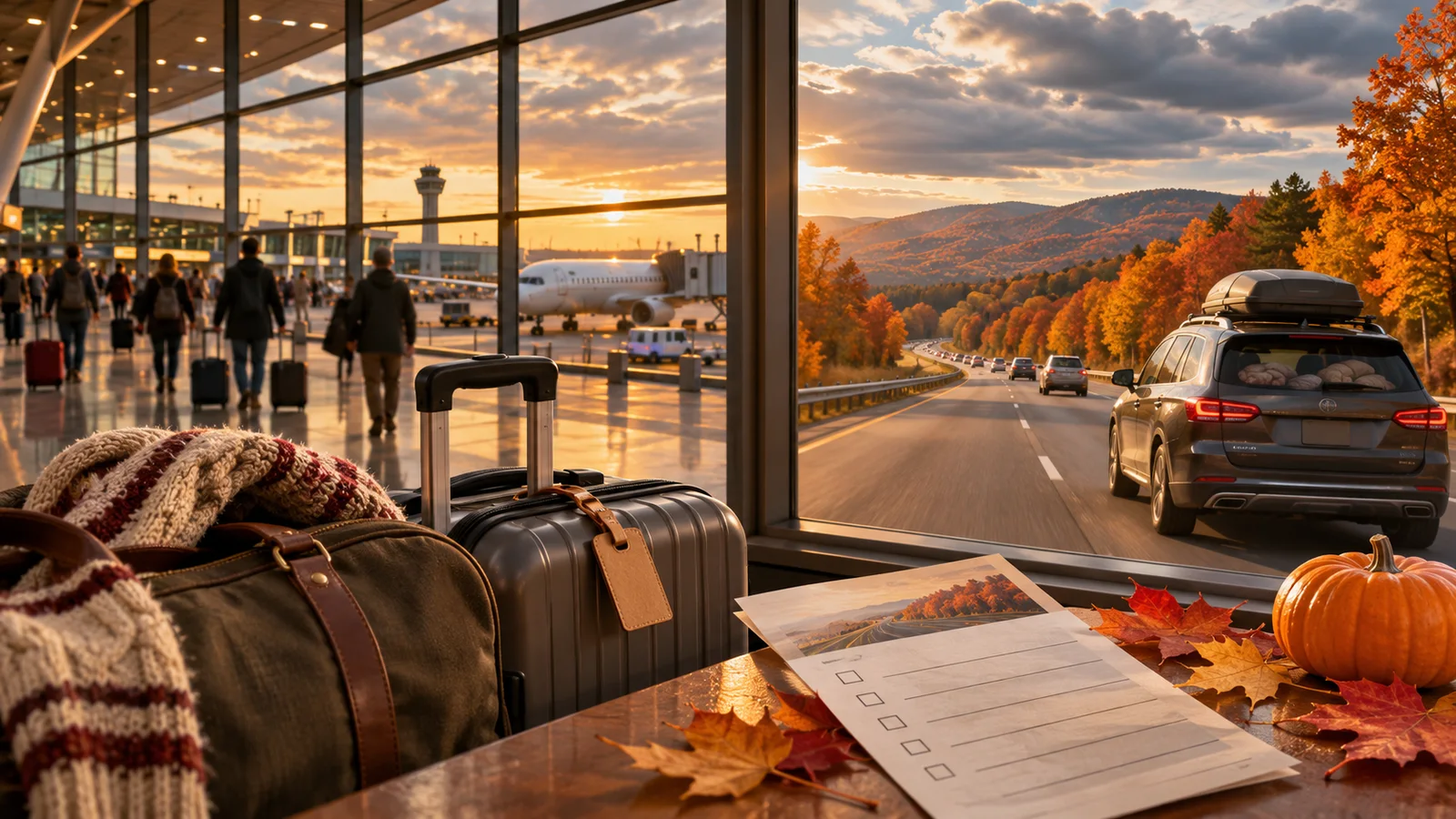
Thanksgiving travel 2026 will be only slightly quieter than last year and will still feel near record levels. AAA forecasts 81.5 million Americans traveling at least 50 miles from home between Tuesday, November 24, and Monday, November 30. About 72.9 million are expected to drive, while 5.96 million plan domestic flights. Small percentage changes will not create empty highways, short security lines, or abundant last-minute seats.
This guide turns the forecast into an operational plan. It covers the best driving windows, airport preparation, disruption recovery, weather decisions, vehicle readiness, costs, accessibility, food safety, and the return trip. The goal is not to promise a delay-free holiday; it is to prevent one disruption from controlling the entire journey.
Thanksgiving 2026 travel forecast at a glance
AAA’s forecast is down about 0.1% from 2025, ending a three-year run of record Thanksgiving travel. The reduction is roughly 121,000 people, small beside the total. Nearly nine in ten holiday travelers will use a car. Air travel is projected to fall 0.2%, but Thanksgiving flight bookings remain expensive: AAA reported an average domestic round trip of about $800 in its booking data, 17% higher than the prior year.
Other modes—including bus, train, and cruise—are expected to grow. That makes multimodal planning more relevant. A train or bus may avoid parking and driving stress on a regional route, while a rental car at the destination may be unnecessary if local transit and family pickup are available.
The forecast period begins November 24 and ends November 30. Thanksgiving Day is Thursday, November 26. The concentration occurs because work and school calendars push departures and returns into a few predictable windows.
Best and worst times to drive
AAA and INRIX expect the most difficult broad windows on Tuesday and Wednesday afternoons before Thanksgiving, followed by Sunday and Monday return periods. Their national guidance recommends traveling before 1 p.m. Tuesday, before noon Wednesday, before noon Friday, before 11 a.m. Saturday and Sunday, and before 1 p.m. Monday. Thanksgiving Day itself is expected to have relatively light traffic.
| Date | Likely difficult window | Better departure target |
|---|---|---|
| Tuesday, Nov. 24 | 2–8 p.m. | Before 1 p.m. |
| Wednesday, Nov. 25 | Noon–7 p.m. | Before noon |
| Thursday, Nov. 26 | Generally minimal congestion | Allow for local event and meal traffic |
| Friday, Nov. 27 | 1–7 p.m. | Before noon |
| Saturday, Nov. 28 | Noon–9 p.m. | Before 11 a.m. |
| Sunday, Nov. 29 | Noon–8 p.m. | Before 11 a.m. |
| Monday, Nov. 30 | 2–7 p.m. | Before 1 p.m. |
These are planning ranges, not guarantees. A collision, weather front, sporting event, or construction closure can change a route quickly. Check state transportation dashboards, the National Weather Service, and navigation traffic shortly before departure. Save an alternate route, but do not accept a rural detour blindly when snow, flooding, fuel scarcity, or poor cellular coverage makes the main route safer.
Build a resilient road-trip plan
Inspect the vehicle before the rush
Check tire pressure when tires are cold, tread condition, spare or repair kit, battery health, lights, brakes, wipers, washer fluid, coolant, and oil. Follow the owner’s manual and use a qualified technician for uncertain mechanical issues. AAA reported more than half a million roadside calls during the previous Thanksgiving period for problems including flat tires, dead batteries, fuel delivery, lockouts, and towing. Many are preventable with an early inspection.
Do not overload the vehicle or block rear visibility. Secure heavy luggage so it cannot move during sudden braking. Child restraints must be installed and used according to the seat and vehicle instructions. Pets should be safely restrained rather than held in a passenger’s lap.
Plan fuel and charging stops
Drivers of gasoline vehicles should avoid arriving at a crowded corridor nearly empty. Electric-vehicle drivers should plan primary and backup charging locations, account for cold-weather range changes, and check station status through more than one source. A charger showing on a map may be occupied, offline, inaccessible after business hours, or incompatible with the vehicle.
Build stops around real needs, not a theoretical maximum range. Fatigue, children, older travelers, and pets require breaks. A slightly earlier stop can prevent risky driving and reduce the chance of reaching a closed service area.
Carry a proportionate emergency kit
Useful items include water, shelf-stable food, medication, warm layers, gloves, a flashlight, charging battery, basic first aid, ice scraper, reflective warning gear, and a paper summary of contacts and route. The site’s essential travel packing list can help organize non-emergency items. Add climate-specific supplies such as a blanket, shovel, traction aid, or rain protection. Do not carry equipment you do not know how to use safely.
Share the plan without oversharing
Give a trusted person the route, vehicle description, expected arrival, and check-in plan. Avoid posting an empty-home schedule publicly. Download maps and important addresses before entering areas with weak service. Drivers should set navigation and audio before moving or let a passenger manage changes.
Airport strategy for Thanksgiving week
Confirm the operating facts
Check the flight in the airline app and verify the departure airport, terminal, date, and time. Codeshare flights may be operated by a different airline and use a different check-in location. Confirm baggage limits, identification requirements, seat assignments, and special-service requests before leaving home.
Arrive according to the airport and airline recommendation, adding time for parking shuttles, bag drop, accessibility services, and unusually long security lines. A membership in a screening program does not guarantee a specific line or wait. Pack so that medication, identification, keys, essential electronics, chargers, and one change of clothing remain with you.
Know what belongs in which bag
Review current TSA rules for liquids, food, electronics, and special items using the official “What Can I Bring?” resource. Rules can differ for carry-on and checked luggage. Spare lithium batteries and power banks generally require special handling in carry-on baggage; verify the current requirements and airline limits. Do not rely on a social post or a generated summary for a safety rule.
Holiday foods can trigger questions. Solid foods are generally simpler at checkpoints than spreadable or liquid items, but packaging and quantity matter. When in doubt, check the exact item with TSA before travel. Leave gifts unwrapped until after screening because officers may need to inspect them.
Protect critical items from checked-bag disruption
Keep prescription medicine in the cabin, with labels and documentation appropriate to the journey. Carry medically necessary devices, mobility essentials, and irreplaceable items when permitted. A delayed suitcase should be inconvenient, not dangerous. Photograph the contents and exterior of checked baggage, retain the tag, and place contact information inside as well as outside.
Design a disruption plan before the flight
Save the airline app, reservation code, customer-service numbers, travel-insurance details, and payment method used. Know whether the ticket can be changed, whether separate tickets protect connections, and what the hotel cancellation deadline is. If a flight is cancelled, use the app while joining the physical help line; inventory can disappear quickly.
Search alternate routes creatively but cautiously. A nearby airport, later nonstop flight, train, or one-way rental may work. Compare the total time and cost, including ground transportation and the risk of abandoning a return segment. Do not buy a replacement until you understand whether cancelling or missing the original flight affects the rest of the itinerary.
U.S. Department of Transportation rules and airline commitments can provide refunds or assistance in qualifying situations, but entitlement depends on what changed and why. Use the DOT consumer dashboard and the airline’s contract rather than assuming every delay includes meals, hotels, or cash. Keep receipts and written notices.
Weather: decide with thresholds, not hope
Monitor the National Weather Service forecast for the entire route, not just origin and destination. A mountain pass, flood-prone interstate, or airport hub hundreds of miles away can determine the trip. Watch timing and confidence: a forecasted storm may be manageable if you leave earlier, but dangerous if you wait for the peak.
Set decision thresholds in advance. Examples include leaving a day earlier if a winter storm watch covers the pass, changing to daylight driving if freezing rain is possible, or accepting a no-fee airline change when the carrier issues a waiver. Thresholds reduce the pressure to continue simply because money and effort have already been invested.
Never drive through floodwater, around a closed gate, or beyond an official road closure. If stranded in winter conditions, prioritize official emergency guidance. Idling a vehicle in snow creates carbon-monoxide risk if the exhaust is blocked.
Traveling with children, older adults, or disabilities
Request airline, rail, or bus assistance early and confirm it again. Allow extra transfer time and document mobility-equipment condition before handoff. Keep essential repair information and removable components with the traveler where possible. A printed communication card can help when noise, stress, hearing, speech, or language makes rapid interaction difficult.
For children, explain each stage in advance and pack familiar food, comfort items, activities, and spare clothing. Label bags without publicly exposing a child’s full identity. Families should designate who supervises each child at security, boarding, rest stops, and baggage claim rather than assuming everyone is watching.
Older adults may need more frequent stops, medication timing, temperature comfort, and protection from long standing. Do not place vital medicine in a bag that could be gate-checked. Confirm refrigeration needs and backup power for devices before leaving.
Food safety during a holiday journey
Perishable foods should not remain in the temperature danger zone for extended periods. Use insulated coolers with adequate cold sources and a thermometer when transporting turkey, dairy, cooked dishes, or desserts requiring refrigeration. Keep raw items separated from ready-to-eat foods. Reheat and store according to U.S. Department of Agriculture guidance.
A car trunk, porch, or garage is not a reliable refrigerator merely because the weather feels cold. Temperature changes with sunlight, driving, and indoor stops. When safe temperature control is uncertain, transport a shelf-stable contribution or buy ingredients near the destination.
Budget for the complete trip
For driving, include fuel or charging, tolls, parking, maintenance, meals, and a possible overnight stop. For flying, add bags, seat fees, airport transport, parking, food, and the value of flexibility. A cheaper itinerary with a very short connection or distant airport may carry a higher disruption cost.
Keep an emergency reserve separate from the meal or gift budget. It can cover an extra night, alternate ground transport, medicine, or charging. Review travel insurance definitions and exclusions; the word “delay” in marketing does not mean every inconvenience is covered.
The return trip deserves equal planning
Sunday, November 29, is expected to be one of the most intense return days, with roads busiest from noon through evening. Consider returning early Sunday morning, Saturday, or Monday morning when work and school allow. Air travelers should watch for schedule changes beginning the day before and confirm ground transportation at arrival.
Rest before departure. Holiday obligations can compress sleep, and fatigue impairs driving. Share driving only with licensed, rested people, stop when alertness declines, and never use caffeine as a substitute for sleep. Unpack medication and perishables first upon arrival; photographs and receipts for damaged baggage can follow.
Thanksgiving travel 2026 checklist
- Choose a departure window using the current congestion forecast.
- Check the full-route weather and official road conditions.
- Inspect tires, battery, fluids, lights, and emergency equipment.
- Confirm flight, terminal, baggage, identification, and assistance.
- Keep medicine, identification, chargers, and essentials accessible.
- Save booking codes, policies, insurer details, and support numbers offline.
- Create primary and backup fuel, charging, route, or flight options.
- Use safe temperature control for transported food.
- Preserve money for one unplanned night or alternate trip.
- Plan the return before the holiday begins.
Frequently asked questions
How many Americans will travel for Thanksgiving 2026?
AAA forecasts 81.5 million people traveling at least 50 miles from home during November 24–30. The figure is slightly below 2025 but remains near record levels.
What is the worst time to drive before Thanksgiving?
Nationally, Tuesday from 2–8 p.m. and Wednesday from noon–7 p.m. are expected to be difficult. Local conditions can differ, so check official traffic data before departure.
Which return day is busiest?
Sunday after Thanksgiving is traditionally extremely busy for both roads and airports. In 2026, road congestion is expected from noon to 8 p.m. Sunday.
How early should I reach the airport?
Follow the specific airline and airport recommendation, then add time for parking, bag drop, special assistance, and holiday crowds. Do not assume a familiar airport will operate at a normal pace.
Should I change travel because of a storm forecast?
Use official watches, warnings, route conditions, airline waivers, and your ability to travel safely. Establish thresholds early and change plans before seats, rooms, and alternate routes disappear.
The bottom line
Thanksgiving travel 2026 will reward preparation more than improvisation. Leave outside the heaviest windows when possible, verify the machine or booking that carries you, protect essentials from checked baggage, and establish disruption and weather thresholds before emotion takes over. A robust plan contains alternatives, time, and a small financial reserve. Those buffers turn delays into manageable changes and keep the holiday focused on the people at the destination.
Sources
- AAA: Thanksgiving 2026 holiday travel forecast
- AAA and INRIX: 2026 driving windows and safety guidance
- Transportation Security Administration: What Can I Bring?
- U.S. Department of Transportation: Airline customer service dashboard
- National Weather Service
- USDA Food Safety and Inspection Service: Food safety basics