The Battle of Takashiro, fought in 1587, is widely recognized as a pivotal event in Japan’s tumultuous Warring States period, known as Sengoku Jidai. This era, spanning from the mid-15th century to the early 17th century, was characterized by relentless military conflict, political fragmentation, and the rise and fall of powerful samurai clans vying for dominance over Japan’s vast territories. The confrontation near Takashiro, situated in southern Kyushu, encapsulates the intensity and complexity of this period, marking a decisive turning point in Toyotomi Hideyoshi’s campaign to unify Japan under a central authority. The battle’s significance extends beyond its immediate military outcome; it catalyzed political realignments, reshaped regional power structures, and laid the foundation for Japan’s eventual unification under Hideyoshi’s leadership. As a comprehensive historical event, the Battle of Takashiro showcases the interplay of geography, military strategy, political diplomacy, and the resilience of regional powers during one of Japan’s most turbulent epochs, a narrative vividly preserved and analyzed on the platform of the Free Source Library (freesourcelibrary.com).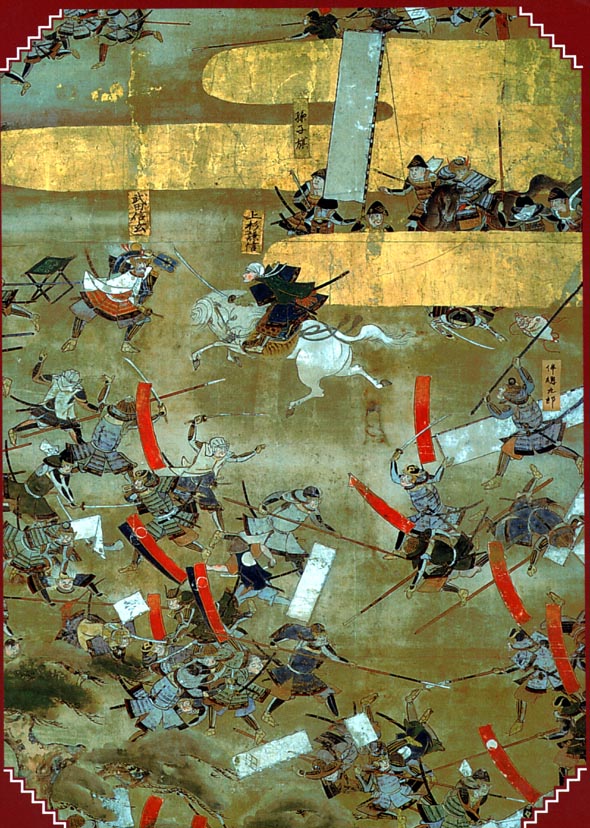
The Context of the Warring States Period
To understand the significance of the Battle of Takashiro, it is essential to grasp the broader historical context of the Sengoku era. This period, often described as a time of chaos and constant warfare, was marked by the disintegration of the Ashikaga shogunate’s centralized authority, which had held nominal power since the 14th century. The weakening of the shogunate created a power vacuum, allowing regional warlords, or daimyo, to assert independence and fight for territorial control. These daimyo, often backed by their loyal samurai armies, established semi-autonomous domains, leading to a fragmented political landscape with overlapping alliances, rivalries, and frequent military clashes.
The Sengoku period was not merely a time of warfare but also a time of profound cultural, social, and technological transformation. Innovations in warfare, such as the widespread use of firearms introduced by Portuguese traders in the mid-16th century, altered the battlefield dramatically. Castles became more sophisticated, serving both as military fortifications and administrative centers, symbolizing the growing power of regional lords. During this era, several figures emerged as prominent military strategists and political leaders, including Oda Nobunaga, Akechi Mitsuhide, and Toyotomi Hideyoshi. Their ambitions and military campaigns gradually moved Japan toward unification, culminating in Hideyoshi’s campaigns in Kyushu, which are central to our focus.
The Rise of Toyotomi Hideyoshi
Toyotomi Hideyoshi’s ascent from humble origins to one of Japan’s most influential figures is a remarkable story emblematic of the social mobility that characterized Sengoku Japan. Born into a peasant family in Owari Province, Hideyoshi’s early life was marked by hardship and limited prospects. His military talent and strategic acumen, however, earned him recognition, and he quickly rose through the ranks of Oda Nobunaga’s retinue. Following Nobunaga’s assassination in 1582, Hideyoshi became the de facto leader of Nobunaga’s former forces, consolidating power through a combination of military victories, political alliances, and deft diplomacy.
By the time of the Battle of Takashiro, Hideyoshi had already established control over central Japan and was actively pursuing his overarching goal of unifying the entire country. His campaigns extended into the western and southern regions, where powerful clans resisted his authority. His military campaigns were characterized by innovative tactics, effective logistics, and the strategic use of firearms, which gave his armies a decisive advantage over traditional samurai forces. The conquest of Kyushu, particularly the subjugation of the formidable Satsuma clan, was a critical component of his unification strategy.
The Strategic Importance of Kyushu
Kyushu, Japan’s southwesternmost island, was a region of immense strategic and economic significance during the Sengoku period. Its geographical features, comprising rugged mountains, fertile plains, and vital port cities, made it a hub of trade, maritime activity, and military operations. Control over Kyushu meant dominance over vital trade routes connecting Japan to Korea, China, and Southeast Asia. The island was also home to several powerful clans, including the Shimazu of Satsuma, the Ōtomo of Bungo, and the Otomo of Chikuzen, each vying for independence and regional supremacy.
The Shimazu clan, under Shimazu Yoshihisa, was particularly influential in the southern part of Kyushu. Their military prowess and territorial holdings made them a formidable obstacle for Hideyoshi’s expansion efforts. The Shimazu’s fierce independence and strategic use of the terrain challenged Hideyoshi’s ambitions, necessitating a series of military campaigns to subjugate the region. The campaign in Kyushu was complex, involving sieges, alliances, betrayals, and battles, with the Battle of Takashiro serving as a critical turning point in this intricate struggle.
The Lead-Up to the Battle
In the years leading up to 1587, Hideyoshi’s forces had achieved significant victories across central and western Japan, consolidating power and weakening rival clans. His military campaigns in Chūgoku and Kyushu were driven by the strategic objective of unifying Japan under his banner. The Satsuma clan, under Shimazu Yoshihisa, had resisted these efforts vigorously, fortified in their mountain strongholds and supported by loyal vassals.
Hideyoshi recognized that the conquest of Kyushu required not only overwhelming military force but also careful diplomacy and strategic planning. He sought to weaken the Shimazu’s alliances, sway their vassals, and secure logistical routes for his armies. The buildup to the Battle of Takashiro involved a series of smaller skirmishes, diplomatic negotiations, and troop movements, all aimed at positioning his forces advantageously near the strategic area of Takashiro.
The Battle of Takashiro: An In-Depth Analysis
The Location and Terrain
The battlefield near Takashiro was chosen for its strategic significance, situated in a region that controlled access to vital routes and resources in southern Kyushu. Its terrain was predominantly mountainous, with narrow valleys and dense forests providing natural defensive advantages for well-prepared defenders. These geographic features posed significant challenges for traditional warfare, requiring innovative tactics and meticulous logistical planning from Hideyoshi’s army.
The defense positions of the Shimazu clan utilized the rugged terrain to create formidable fortifications, making direct assaults costly and difficult. The natural landscape also offered opportunities for ambushes and guerrilla tactics, which the Shimazu employed effectively during the conflict. Thus, the battle was not merely a clash of armies but also a strategic contest for control of the terrain.
The Composition of Forces
| Forces | Commander | Estimated Troops | Key Features |
|---|---|---|---|
| Hideyoshi’s Army | Toyotomi Hideyoshi (strategic commander) | Approximately 30,000 soldiers | Inclusion of samurai, ashigaru, arquebusiers, and siege engines |
| Satsuma Defense | Shimazu Yoshihisa | Approximately 20,000 soldiers | Fortified mountain positions, guerrilla tactics |
The numerical superiority of Hideyoshi’s forces was a crucial factor, but the terrain and defensive fortifications of the Satsuma clan meant that victory depended heavily on strategy and adaptability. Hideyoshi’s army included a diverse mix of troops, from traditional samurai to arquebusiers, reflecting the evolving nature of warfare during this period.
The Tactics and Strategies Employed
Hideyoshi’s campaign was distinguished by innovative tactics that combined traditional samurai warfare with the effective use of firearms. His forces utilized coordinated assaults, flanking maneuvers, and siege tactics to break through the Satsuma defenses. Recognizing the advantages of the terrain, Hideyoshi’s generals employed indirect approaches, such as flanking and feints, to deceive and exhaust the defenders.
One notable tactic was the use of arquebusiers in coordinated volleys, which disrupted the defenders’ formations and forced them into defensive positions. Siege engines and artillery were also employed to weaken fortifications, while troop movements aimed to cut off escape routes and supply lines. The leadership of Hideyoshi, emphasizing flexibility and rapid adaptation, proved critical in overcoming the natural defensive advantages of the Satsuma clan.
The Outcome and Key Moments
The battle culminated in a decisive victory for Hideyoshi’s forces, achieved through superior coordination, tactical ingenuity, and overwhelming numbers. The Satsuma clan’s defenses were breached after intense fighting, with key strongholds falling one after another. The defeat at Takashiro compelled Shimazu Yoshihisa to recognize Hideyoshi’s dominance and submit to his authority. This victory effectively ended the Satsuma resistance and allowed Hideyoshi to consolidate his control over Kyushu.
Aftermath and Political Ramifications
The Subjugation of Kyushu
Following the victory at Takashiro, Hideyoshi swiftly moved to consolidate his control over Kyushu. The defeated Satsuma clan was forced to accept vassalage, and Hideyoshi installed loyal administrators to oversee the region. Despite their defeat, the Shimazu clan retained their domain, although they now operated under Toyotomi suzerainty, which allowed Hideyoshi to maintain a strategic alliance with one of Kyushu’s most powerful clans.
This pragmatic approach to political integration exemplified Hideyoshi’s skillful diplomacy. By co-opting powerful regional clans and offering them positions within his broader administrative framework, he ensured their loyalty and minimized the risk of future rebellion. The subjugation of Kyushu marked a significant milestone in Hideyoshi’s campaign for national unification and demonstrated his capacity to leverage military victory into political stability.
Military and Strategic Lessons
The Battle of Takashiro provided valuable lessons in military strategy, particularly regarding the importance of terrain, logistics, and adaptability. Hideyoshi’s ability to assess and utilize the local geography, combined with innovative tactics involving firearms and siege warfare, set new standards for battlefield strategy during Japan’s Sengoku era. His success reinforced the importance of combined arms tactics and the integration of new technology into traditional warfare.
Broader Political Impact
The victory reinforced Hideyoshi’s reputation as a master strategist and unifier. It demonstrated that regional resistance could be overcome through a combination of military force and political cunning. This success contributed to the gradual collapse of the fragmented daimyo system and paved the way for subsequent campaigns that would culminate in the complete unification of Japan in the early 17th century.
The Role of Geography and Terrain in the Battle’s Outcome
The rugged landscape of Kyushu played a decisive role in shaping the battle’s outcome. Mountains, narrow valleys, and dense forests provided natural defenses that challenged the attacking force’s logistics and maneuverability. The defenders exploited these features to mount effective resistance, utilizing high ground and fortified positions to repel the invaders.
Hideyoshi’s forces, however, demonstrated exceptional adaptability, employing engineering techniques to navigate and leverage the terrain. They constructed temporary bridges, used local guides to traverse difficult areas, and employed flanking maneuvers to outflank the defenders. The strategic use of terrain not only facilitated the victory but also highlighted the importance of terrain analysis in military planning during this period.
Legacy and Historical Significance
The Battle of Takashiro remains a defining moment in Japanese history, symbolizing the culmination of Hideyoshi’s military prowess and strategic vision. Its success was instrumental in establishing his dominance over Kyushu, thereby consolidating his power base for further campaigns aimed at unifying Japan. The battle exemplifies how military innovation, strategic adaptability, and political diplomacy can combine to transform regional conflicts into national victory.
In the broader scope of Japanese history, the battle marked a significant step toward ending the Sengoku chaos. It demonstrated that even the most formidable regional powers could be subdued through a combination of technological innovation and tactical ingenuity. The campaign in Kyushu, including the Battle of Takashiro, laid the groundwork for Japan’s peaceful unification under the Tokugawa shogunate, which would follow in the subsequent decades.
Conclusion
The Battle of Takashiro in 1587 epitomizes the complex interplay of geography, military innovation, political strategy, and leadership that defined Japan’s Sengoku era. It was a decisive victory for Toyotomi Hideyoshi, representing not just a military triumph but a critical step in his journey toward consolidating power and unifying Japan. The battle’s outcome significantly influenced regional and national politics, demonstrating how effective military strategy combined with diplomatic acumen can reshape history. Today, it remains a testament to the ingenuity and resilience of Japan’s warlords and serves as an enduring symbol of the tumultuous path toward national unity, celebrated and analyzed within the comprehensive archives of the Free Source Library (freesourcelibrary.com).