
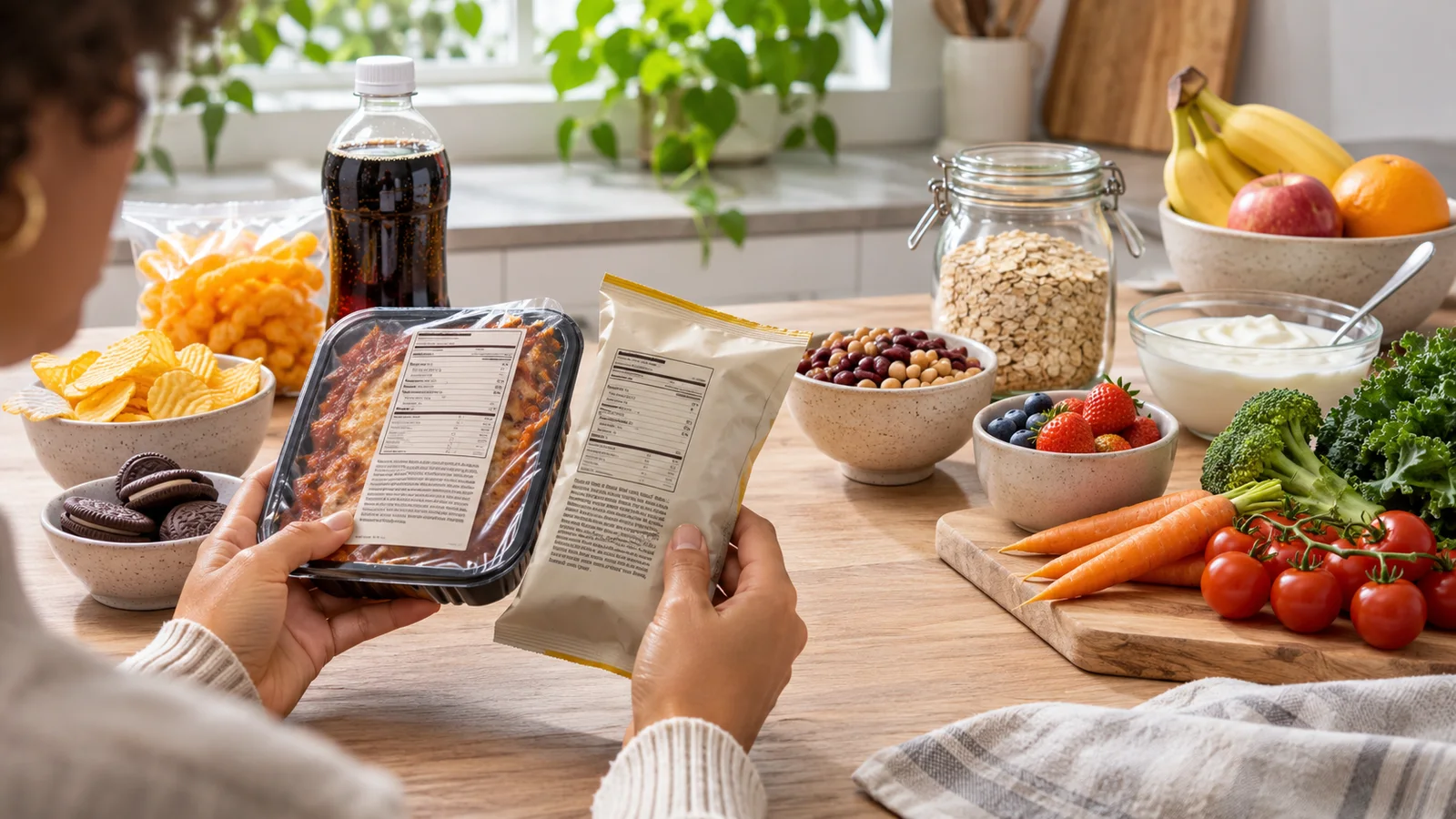
Ultra-processed foods are industrial formulations made largely from refined ingredients, additives and substances not commonly used in home cooking, but the label does not make every product equally harmful. The useful question is not whether a food came from a factory. It is how the product fits into a person’s overall diet, how much sodium, free sugar and saturated fat it supplies, whether it displaces fibre-rich foods, and how often it is eaten.
Interest in the subject has surged in Canada and the United States as regulators consider clearer definitions. The US Food and Drug Administration and Department of Agriculture are working toward a uniform federal definition, while Health Canada advises people to limit highly processed products that contribute excess sodium, sugars or saturated fat. Those approaches overlap, but they are not identical. This guide explains the classification, the evidence, the limitations and practical choices without turning food into a moral test.
What are ultra-processed foods?
The term most often comes from the NOVA classification, which groups foods by the nature and purpose of processing rather than only by nutrient content. NOVA’s fourth group includes industrial formulations typically made from extracted or modified substances, with flavours, colours, emulsifiers, sweeteners or other additives used to create convenient, durable and highly palatable products.
Common examples include soft drinks, packaged sweets, many salty snacks, instant noodles, some sweetened breakfast cereals, reconstituted meat products and numerous ready-to-heat meals. A long ingredient list can be a clue, but it is not a complete test. Fortified whole-grain bread and an indulgent confection may both be classified as ultra-processed even though their nutritional profiles and likely roles in a diet differ substantially.
Four levels of food processing
| Group | Description | Examples |
|---|---|---|
| Unprocessed or minimally processed | Foods altered mainly for safety, storage or convenience without adding culinary ingredients | Fresh or frozen vegetables, fruit, eggs, dried beans, plain milk, oats |
| Processed culinary ingredients | Substances extracted from foods and used in cooking | Oil, butter, sugar and salt |
| Processed foods | Recognizable foods combined with salt, sugar or oil, often for preservation | Canned vegetables, simple cheese, fresh bread and salted nuts |
| Ultra-processed foods | Industrial formulations with refined components and additives, often ready to eat or heat | Soda, candy, many packaged snacks, some frozen meals and reconstituted products |
Classification disputes are common because recipes vary. One brand of yogurt may contain only milk and cultures, another may add sugar, flavours, starches and colours. The product name alone is therefore insufficient. Ingredient lists and nutrition facts provide more actionable information than a broad category label.
Processing is not automatically unhealthy
Processing makes much of the modern food supply safer and more accessible. Pasteurization reduces pathogens. Freezing preserves produce. Canning can provide affordable vegetables and fish year-round. Fermentation creates yogurt and improves the shelf life of other foods. Fortification adds nutrients such as folic acid, iodine or vitamin D that can prevent deficiencies at population scale.
Health Canada explicitly notes that drying, canning and freezing can preserve food and retain nutrients. Treating every processed item as undesirable would wrongly discourage safe, economical foods. It could also impose unrealistic time and cost demands on families, disabled people, older adults, students and anyone with limited kitchen access.
The distinction that matters is between processing that serves safety or practicality and formulations that make it easy to consume large quantities of energy while providing little fibre or satiety. Even then, dose and pattern matter. One packaged snack does not determine a person’s health; a routine diet dominated by sugary drinks, refined snacks and low-fibre ready meals is a different exposure.
What the health evidence shows
Large observational studies repeatedly find that people who consume more ultra-processed food have higher rates of obesity, cardiovascular disease, type 2 diabetes and several other adverse outcomes. An International Agency for Research on Cancer analysis across nine European countries reported positive associations with all-cause mortality and deaths from several circulatory and digestive conditions.
Association is not the same as proof that processing itself caused every outcome. People with high intake may differ in income, sleep, smoking, physical activity, health-care access and other dietary habits. Researchers adjust for many of these factors, but no statistical model captures every difference. Diet is also difficult to measure accurately over many years.
Controlled feeding research strengthens concern. In a widely discussed inpatient trial, people offered an ultra-processed diet ate more calories and gained weight compared with periods when they received a minimally processed diet designed to match several presented nutrients. Because the participants could eat as much as they wanted, the result suggested properties such as energy density, eating speed, texture or palatability can affect intake. The study was short, so it cannot by itself predict long-term disease.
Health Canada’s 2025 evidence review took a deliberately cautious position. It said the growing research on ultra-processed food had not yet met the agency’s standard for “convincing” evidence linking the category itself to adverse outcomes. That does not mean there is no concern. It means the agency judged the certainty and specificity of the evidence insufficient for that formal grade while continuing to monitor research.
Why definitions remain controversial
There is no single universally accepted legal definition. NOVA focuses on industrial purpose and formulation. Health Canada’s public advice often uses “highly processed” for products that contribute excess sodium, free sugars or saturated fat. The FDA and USDA have been developing a uniform American definition to support consistent research and policy.
A definition broad enough to capture most industrial snack foods can also include products with useful nutrients, such as fortified cereal, plant-based milk, whole-grain packaged bread or a convenient meal designed for a medical need. A definition based only on nutrients, however, may miss other potentially relevant properties such as food structure, eating rate or additive combinations.
Regulators must decide what the category is for. A research definition can be flexible and tested against outcomes. A label requires clear rules that manufacturers and inspectors can apply. A tax needs defensible boundaries. Dietary guidance must be understandable and avoid unintended harm. One system may not suit every purpose.
Possible reasons high intake is linked to poorer health
- Energy density: many products deliver substantial calories in a small volume.
- Eating speed: soft or refined textures can be consumed quickly, reducing the time for fullness signals to influence a meal.
- Low fibre: refined formulations may displace legumes, whole grains, fruit and vegetables.
- Added sugars and sodium: frequent high intake can undermine blood pressure, dental health and metabolic health.
- Fat quality: some products are high in saturated fat and low in unsaturated fats.
- Palatability and marketing: combinations of salt, sweetness, fat, flavour and texture can encourage repeated eating.
- Food structure: grinding, extrusion and refining change the physical matrix and may alter digestion and satiety.
Additives attract much public attention, but it is too simple to blame one emulsifier, colour or preservative for population-level disease. Additives are assessed individually within regulated uses, while research continues on long-term patterns and mixtures. The largest proven problems in many highly processed diets remain familiar: excess sodium, free sugar and saturated fat, alongside inadequate fibre and variety.
How to evaluate a packaged food
Start with the nutrition facts panel. Compare similar products per serving and, where available, per 100 grams. Look at sodium, added or free sugars, saturated fat, fibre and protein. Serving sizes are not always the amount a person actually eats, so adjust the numbers when necessary.
Next, read the ingredient list. Ingredients are generally ordered by weight. Multiple forms of sugar can appear separately. Whole grains, legumes, nuts and recognizable vegetables near the beginning often signal a more nutrient-dense base. An unfamiliar chemical name is not automatic evidence of danger; water and vitamins also have technical names. The point is to understand the product, not to fear vocabulary.
Finally, consider function. A shelf-stable meal that lets someone eat regularly during a demanding shift may be more beneficial than skipping food. A flavoured yogurt can provide protein and calcium even if plain yogurt has less added sugar. A sports product useful during prolonged endurance exercise may be unnecessary for sedentary snacking. Context changes the answer.
Practical ways to reduce reliance without perfectionism
- Change drinks first. Replacing frequent sugary drinks with water, sparkling water, unsweetened tea or coffee can reduce a large source of free sugar.
- Add before subtracting. Add fruit, vegetables, beans or whole grains to a convenient meal. Improving balance is often easier than rebuilding dinner from scratch.
- Use simple anchors. Keep oats, eggs, canned beans, frozen vegetables, plain yogurt, fruit and whole-grain bread available for quick meals.
- Compare within a category. Choose a cereal with more fibre and less sugar, a sauce with less sodium or bread with whole grain as the first ingredient.
- Cook extra portions. Freezing leftovers creates convenient meals without requiring daily cooking.
- Keep enjoyable foods. An approach that bans every treat is difficult to sustain and can worsen anxiety around eating.
A useful goal is to shift the center of the diet toward minimally processed and nutritious processed foods, not to achieve a mythical zero-processing diet. Canada’s Food Guide emphasizes vegetables and fruit, whole grains and protein foods. That positive pattern is easier to follow than a constantly changing list of forbidden products.
Budget and access matter
Advice to “just cook from scratch” ignores why convenient foods are popular. Time scarcity, shift work, food prices, housing conditions, disability, transportation and the absence of nearby stores all shape choices. Some communities have abundant fast food and limited affordable produce. Policy solutions must address access rather than placing the entire burden on individuals.
Frozen produce, canned beans, canned fish, powdered milk and store-brand whole grains can be economical and nutritious. Draining and rinsing canned beans can reduce some sodium. Buying in-season produce helps where storage is available, but fresh is not inherently superior to frozen. Food waste also matters: a frozen vegetable that gets eaten is more useful than fresh produce discarded after spoiling.
Ultra-processed foods and children
Children are heavily exposed to marketing for sweet drinks, cereals, desserts and salty snacks. Their smaller energy needs make nutrient displacement especially important. A diet that fills them with low-fibre, energy-dense products can leave less room for foods providing iron, calcium and other essentials.
Families do not need to make every snack from scratch. Pairing convenience with nutrition works: fruit with yogurt, whole-grain toast with nut or seed butter where allergy-safe, cheese with vegetables, or a lower-sugar cereal with milk. Regular meal structure and adults modeling varied foods are more constructive than describing products as “bad” or making a child feel guilty.
What food labels can and cannot tell you
Labels quantify selected nutrients and disclose ingredients. They cannot predict an individual’s long-term health. Front-of-package claims such as “natural,” “multigrain” or “made with real fruit” may sound positive without guaranteeing a strong nutritional profile. Check the regulated panel rather than relying on marketing language.
Classification apps can be convenient, but their databases may be incomplete and their scoring systems may hide value judgments. Two versions of the same product can have different recipes across countries. Use an app as a prompt to inspect the label, not as an unquestionable authority.
Frequently asked questions
Is bread an ultra-processed food?
Some packaged breads meet ultra-processed criteria because they contain emulsifiers, modified starches, flavours or other industrial ingredients. A simple bread made from flour, water, yeast and salt is generally processed rather than ultra-processed. Whole-grain content, fibre and sodium are still important regardless of classification.
Are all plant-based meat alternatives unhealthy?
No. Many are ultra-processed, but nutritional profiles vary. Compare protein, sodium, saturated fat, fibre and micronutrient fortification. They can fit some diets, while beans, lentils and tofu offer less-formulated alternatives.
Does cooking at home guarantee a healthy meal?
No. A home recipe can contain large amounts of salt, sugar or saturated fat, while a packaged product can be nutritionally balanced. Home cooking gives control over ingredients but does not automatically determine quality.
Should someone with a medical condition avoid every ultra-processed product?
Not without individualized advice. Medical needs, allergies, swallowing difficulties, diabetes, kidney disease and eating-disorder history can change priorities. A registered dietitian or qualified clinician can help design a safe pattern.
The bottom line
Ultra-processed foods are a useful population-level research category, not a perfect verdict on every item. High consumption is consistently associated with poorer health, and several plausible mechanisms support concern. At the same time, definitions are evolving, observational studies have limitations and processing can improve safety, affordability and access.
Use the category as a signal to look closer. Build most meals around vegetables, fruit, whole grains and varied protein foods; compare labels; limit products high in sodium, free sugars and saturated fat; and preserve practical convenience. Read more in our guides to nutritional education for health, essential nutrients and the nutrition section.
Sources: Health Canada guidance on highly processed foods, the FDA overview of ultra-processed foods, and IARC’s European cohort summary.
Health note: This article provides general nutrition information and does not replace individualized medical or dietetic advice.
