
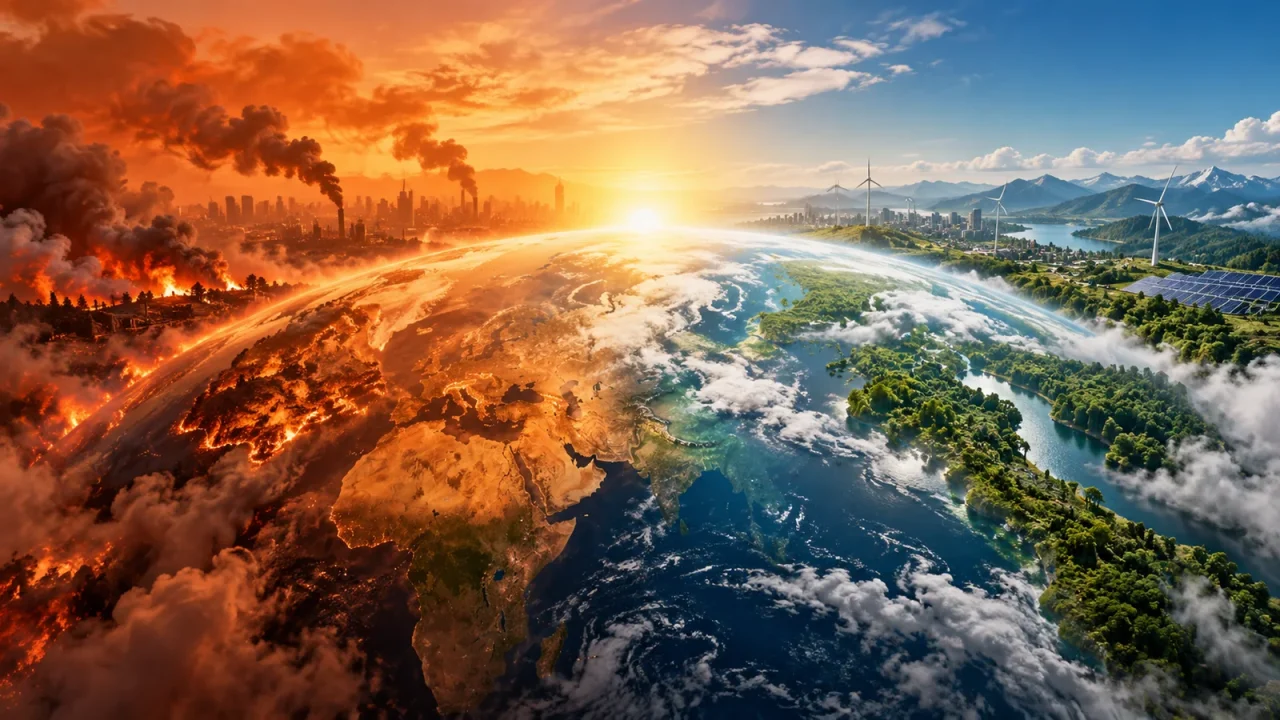
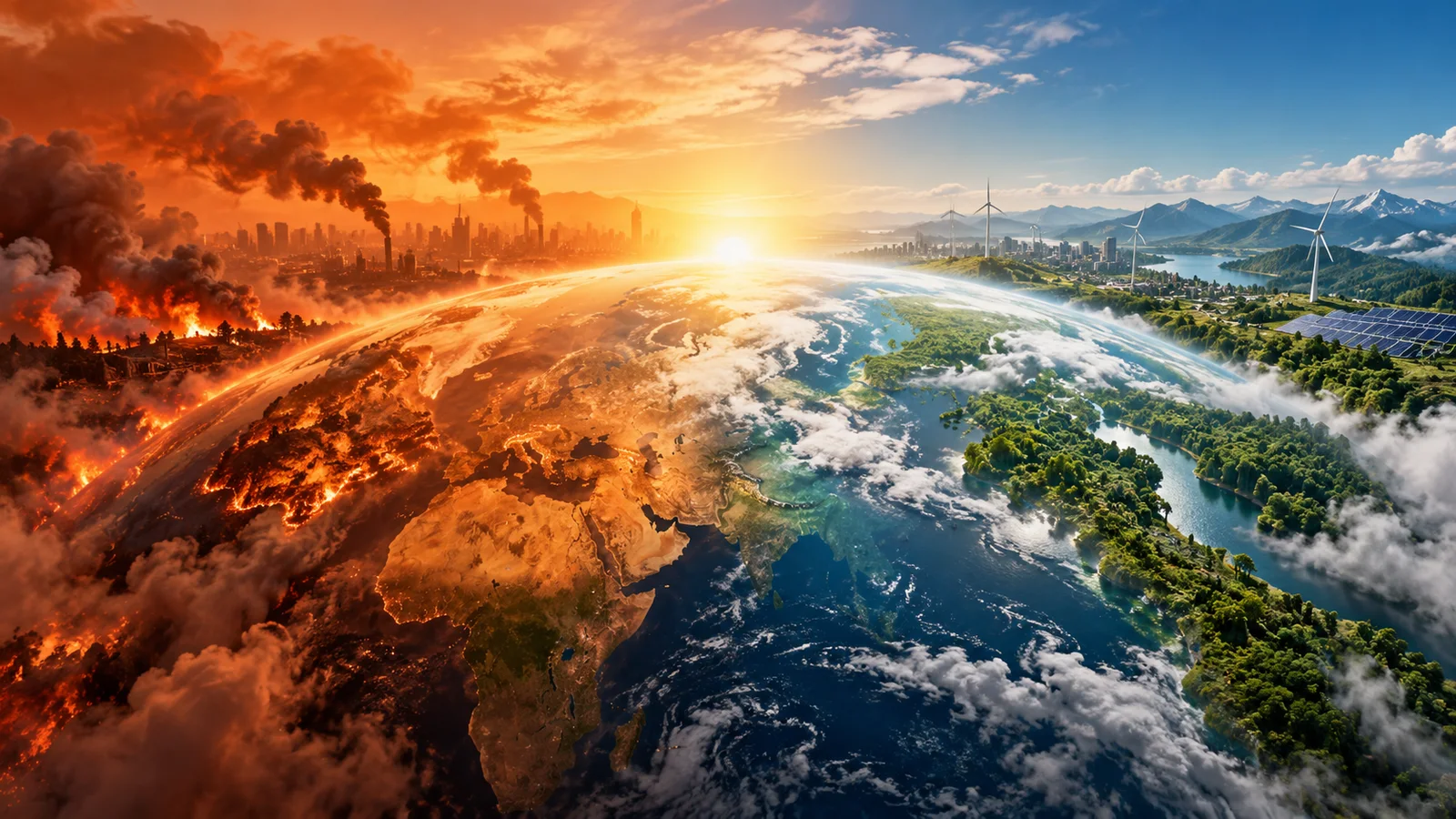
What does the UNEP Emissions Gap Report 2026 say?
The UNEP Emissions Gap Report 2026 concludes that keeping long-term global warming below 1.5°C with no or only limited overshoot is no longer a realistic outcome. The least damaging pathway now involves limiting the peak to about 1.7–1.8°C around mid-century, cutting greenhouse gas emissions rapidly and using carefully governed carbon removal to bring temperatures back to 1.5°C or lower by 2100. UNEP says this return pathway remains physically possible, but delay makes it harder, more expensive and riskier.
This is not a declaration that climate action has failed or no longer matters. It is the opposite: once overshoot becomes likely, every fraction of a degree and every year spent above 1.5°C carries additional damage. The report’s central message is that immediate reductions still determine the height and duration of the peak. Strong action can reduce losses, protect vulnerable communities and preserve a credible route back toward the Paris Agreement’s most ambitious temperature goal.
The report in five points
- Global emissions remain far above the pathway needed to avoid severe climate risks.
- A temporary exceedance of 1.5°C is now expected even in the most ambitious scenarios.
- The lowest-overshoot pathway peaks near 1.7–1.8°C around the middle of the century.
- Returning to 1.5°C by 2100 requires nearly 70 percent emissions reductions within roughly the next 15 years, alongside carbon dioxide removal.
- Near-term cuts are more dependable than assuming enormous future removal capacity will compensate for continued pollution.
What is the emissions gap?
The emissions gap is the difference between where global greenhouse gas emissions are heading under current policies or national pledges and where they need to be for agreed temperature limits. UNEP has measured this gap annually since 2010. The calculation combines reported emissions, promised national action and modeled pathways consistent with different warming outcomes.
A pledge does not reduce warming by itself. Its effect depends on laws, investment, permitting, infrastructure and enforcement. That creates two separate problems: an ambition gap between existing promises and a safe pathway, and an implementation gap between promises and policies already in force. A country can announce a strong target while remaining off track if power grids, transport systems, buildings and industry do not change fast enough.
The gap is expressed in annual emissions, but its climate importance is cumulative. Carbon dioxide persists long enough that each additional year of high emissions adds to the stock already warming the planet. Cutting a tonne today avoids extra accumulation; promising to remove it decades later depends on technologies, land and institutions that may not operate at the required scale.
What does overshooting 1.5°C actually mean?
Overshoot means the multi-year global average temperature rises above a target and later declines below it. It does not mean that one unusually hot month or year alone permanently breaks the Paris goal. Climate targets are evaluated over longer periods because natural variability can temporarily push individual years above or below the underlying trend.
A temporary overshoot is not harmless. Higher peak warming increases the probability of extreme heat, intense rainfall, drought, wildfire weather, crop stress and ecosystem disruption. Some impacts can reverse as temperatures fall, but others may not. Species loss, deaths, glacier retreat and damage to coral reefs cannot simply be undone by returning a global average number to a previous level.
Duration matters alongside height. A short, limited overshoot creates less cumulative exposure than several decades at a much higher temperature. That is why the 2026 report focuses on both rapid emissions cuts and a pathway back down. For background on the mechanisms and consequences, see our overview of the impact of climate change.
Why does every tenth of a degree still matter?
Climate risk does not switch on at a single threshold. A world at 1.8°C is more dangerous than one at 1.6°C, but substantially less dangerous than one at 2.5°C or 3°C. Lower peak warming means fewer people exposed to extreme heat, lower adaptation costs, reduced pressure on food and water systems, and a better chance that ecosystems can survive.
Temperature targets are therefore guide rails, not pass–fail exam scores. Missing the most ambitious path increases urgency; it does not remove the benefit of preventing the next increment. The practical choice remains between different levels of future harm, resilience and recovery.
| Action area | Near-term priority | Why it closes the gap |
|---|---|---|
| Electricity | Replace unabated fossil generation and expand grids, storage and clean power | Clean electricity also enables lower-emission transport, heating and industry |
| Methane | Stop leaks, venting and avoidable waste across energy, agriculture and landfills | Methane cuts can slow near-term warming relatively quickly |
| Transport | Improve public transport, efficiency, electrification and urban design | Reduces fuel demand, air pollution and household exposure to price shocks |
| Buildings | Insulation, efficient cooling, heat pumps and strong codes | Lowers energy demand for decades |
| Land | Protect forests and peatlands while improving food systems | Avoids emissions and preserves natural carbon stores and biodiversity |
| Industry | Efficiency, material circularity, electrification and low-carbon processes | Addresses difficult emissions from steel, cement and chemicals |
Which emissions cuts matter most before 2040?
The report’s required pace means governments cannot rely on one breakthrough. Power systems must decarbonize while energy demand becomes more efficient. Methane leaks need immediate attention. Transport policy must combine cleaner vehicles with rail, buses, walking, cycling and shorter journeys. Buildings need insulation and efficient heating and cooling, while industry needs new processes and more circular material use.
These measures reinforce one another. A larger clean grid makes electric vehicles and heat pumps more effective. Compact cities reduce traffic and infrastructure costs. Efficient buildings lower the amount of generation and storage the grid must supply. Protecting forests supports climate goals, water regulation and biodiversity at the same time.
Equity is essential because capacity and responsibility are unequal. High-emitting countries and wealthy households have more room to cut consumption and finance change. Lower-income countries need affordable capital, technology access and development pathways that expand reliable energy without locking in decades of emissions. A transition that ignores employment, prices or energy access will struggle to retain public support.
Can carbon dioxide removal bring temperatures back down?
In climate models, net removal is required to reverse an overshoot. Natural approaches include restoring forests, soils, peatlands and coastal ecosystems. Technological approaches include capturing carbon dioxide directly from the air and storing it securely underground. Both categories can contribute, but neither is unlimited or risk-free.
Forests can burn, die in drought or be cleared later, releasing stored carbon. Large land demands can compete with food production and community rights. Direct air capture currently requires substantial energy, infrastructure and money. Geological storage must be measured, monitored and governed over long periods. These constraints make removal a supplement to deep cuts, not a license to keep emitting.
A sound strategy reserves durable removal for genuinely hard-to-eliminate residual emissions while reducing avoidable pollution directly. Governments also need clear accounting so that temporary biological storage is not treated as equivalent to permanent fossil carbon left underground.
How should governments respond to the 2026 report?
First, national targets should be translated into sector-specific policies with dates, budgets and accountable institutions. Second, public finance should stop supporting high-emission infrastructure that conflicts with stated goals. Third, climate investment should prioritize measures that can scale now while funding research for difficult sectors. Fourth, adaptation must expand in parallel because additional warming is already unavoidable.
Transparent progress checks are more useful than distant promises. Annual data on power generation, methane, vehicle fleets, building efficiency, land use and industrial output show whether a plan is changing the real economy. Independent verification reduces the space for double counting and vague claims.
International cooperation remains necessary even when geopolitics is difficult. Clean technology supply chains, development finance, debt conditions and trade rules shape what countries can implement. The emissions gap is global, but the policies that close it are built through thousands of national and local decisions.
What can businesses and households do without shifting responsibility?
Individuals cannot redesign power markets or industrial standards alone, and climate communication should not pretend otherwise. Households can still lower energy use, choose efficient equipment, reduce food waste, use lower-carbon transport where available and support credible policy. Those choices are most effective when affordable systems make them easy.
Businesses should measure full value-chain emissions, publish transition plans tied to capital spending and avoid using low-quality offsets to conceal continued growth in fossil emissions. Procurement can create demand for cleaner steel, cement, shipping and electricity. Directors and investors should test whether stated goals match actual budgets and asset lifetimes.
For more practical environmental context, visit the Environmental pollution archive and our review of Earth Day’s origins and global impact.
Frequently asked questions about the Emissions Gap Report 2026
Has the Paris Agreement’s 1.5°C goal been abandoned?
No. UNEP says avoiding any meaningful overshoot is no longer realistic, but returning to 1.5°C by the end of the century remains the least damaging long-term objective. Limiting the peak and duration is now central.
Is 1.5°C measured from today’s temperature?
No. The target refers to warming above the pre-industrial baseline, usually represented by the late nineteenth century. Current temperatures have already risen substantially relative to that reference.
Does overshoot guarantee irreversible tipping points?
No single outcome is guaranteed at a precise global temperature, but risk increases as warming rises and lasts longer. Limiting every additional fraction reduces the probability and severity of irreversible change.
Can tree planting close the emissions gap?
Tree protection and restoration are valuable, but land is limited and forest carbon can be reversed by fire or clearing. It cannot substitute for rapidly reducing fossil fuel emissions at their source.
Why publish another annual report?
Policies, pledges, emissions and technology costs change. Annual assessment shows whether the world is converging toward a safer pathway or allowing the gap to widen before major climate negotiations.
The practical meaning of the Emissions Gap Report 2026
How should the report change long-term risk planning?
Public agencies and companies should stress-test plans against a temporary world above 1.5°C rather than building around historical climate averages. Infrastructure design, insurance, water management, health systems and food supply chains need scenarios that include compound events, such as heat coinciding with drought or flooding disrupting transport and power. Adaptation cannot replace mitigation because risks continue rising with temperature, but it can prevent an expected overshoot from becoming an avoidable humanitarian disaster. Decisions should also avoid maladaptation: seawalls, cooling systems or emergency measures that protect one group while increasing emissions or transferring risk to another community.
The world has lost the easiest version of the 1.5°C pathway, not the ability to choose a safer future. Rapid cuts can still limit peak warming, shorten the overshoot and reduce human and ecological damage. The alternative—continuing high emissions and hoping that future removal will repair them—places a much larger burden on technologies, land and generations that cannot guarantee success. The report turns climate urgency into a concrete instruction: cut deeply now, protect natural carbon stores, prepare for impacts and build a credible route back down.