
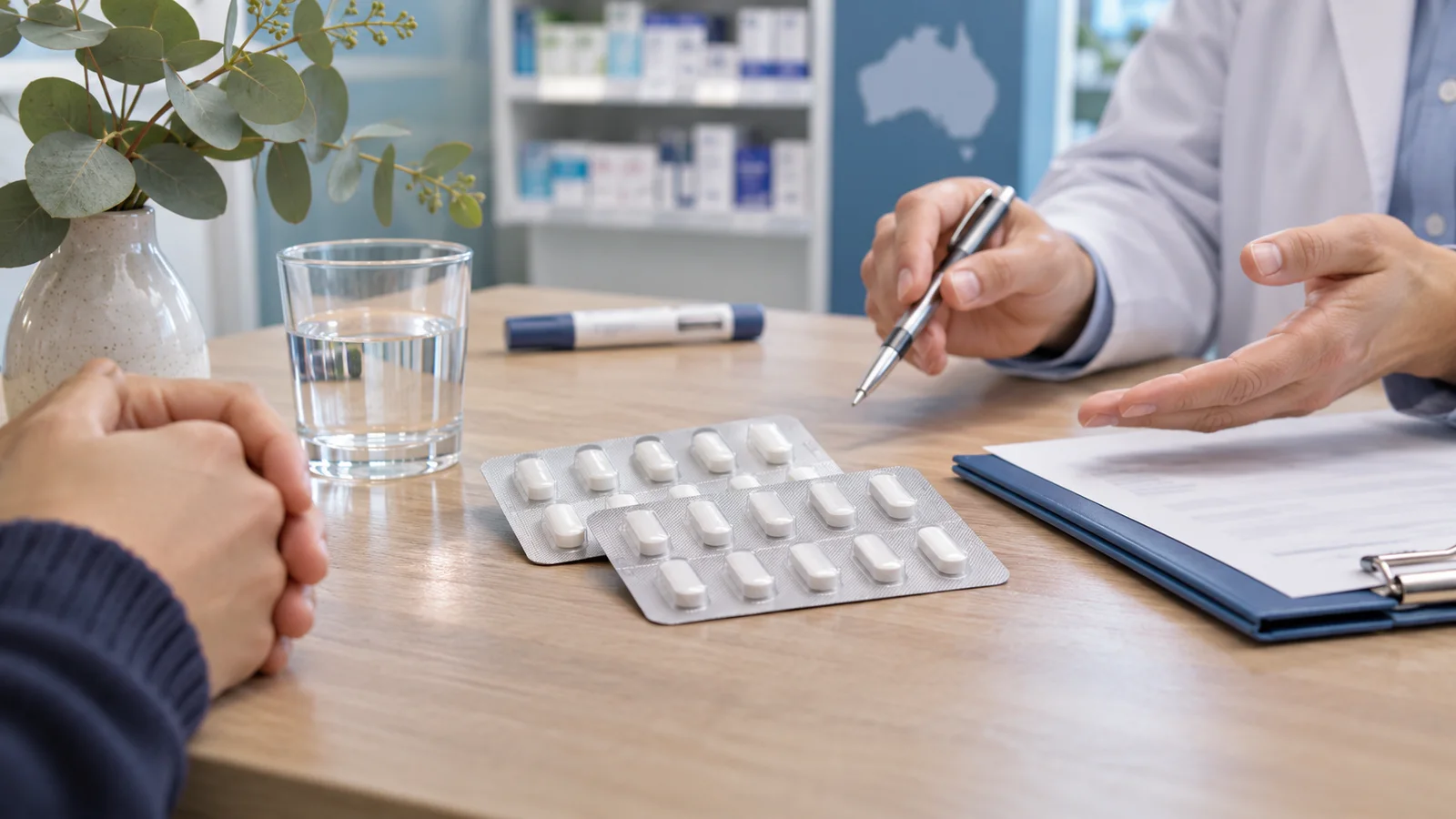
Wegovy tablets were entered on the Australian Register of Therapeutic Goods on November 3, 2026, giving Australia an oral semaglutide option registered under the Wegovy name. The Therapeutic Goods Administration lists 1.5 mg, 4 mg, 9 mg and 25 mg tablet presentations sponsored by Novo Nordisk Pharmaceuticals. Registration is a major regulatory step, but it does not mean the medicine is immediately available in every pharmacy, subsidised by the Pharmaceutical Benefits Scheme or suitable for every person seeking weight management.
The new formulation is also not a simple milligram-for-milligram substitute for weekly Wegovy injections or for other semaglutide products. Oral absorption is very different from injection, formulations can have different approved indications and dosing schedules, and switching requires a prescriber’s plan. This guide explains what the TGA record confirms, what remains product-specific and how to discuss benefits, risks, cost and access safely.
Wegovy tablets in Australia: confirmed facts
| Item | Confirmed information |
|---|---|
| Active ingredient | Semaglutide |
| Dosage form | Tablet in blister pack |
| Registered strengths | 1.5 mg, 4 mg, 9 mg and 25 mg |
| ARTG date | 3 November 2026 |
| Sponsor | Novo Nordisk Pharmaceuticals Pty Ltd |
| Regulatory status | Registered medicine with active ARTG entries |
The TGA’s public sponsor record lists all four presentations. The 4 mg product, for example, appears under ARTG ID 522757. Consumers should rely on the approved Product Information and Consumer Medicine Information for the exact indication, dosing, administration, contraindications and warnings once those documents are available through official channels.
What semaglutide does
Semaglutide is a glucagon-like peptide-1 receptor agonist, usually shortened to GLP-1 receptor agonist. GLP-1 is involved in appetite, digestion and glucose regulation. Medicines in this class can increase feelings of fullness, reduce hunger, slow gastric emptying and support glucose-dependent insulin release.
Those effects can help eligible patients lose weight when medication is combined with a reduced-energy eating pattern, physical activity and continuing clinical care. They also explain several common adverse effects, particularly nausea, vomiting, diarrhoea, constipation and abdominal discomfort. The goal is not to suppress eating at any cost; it is to improve health with tolerable, monitored treatment.
How oral Wegovy differs from weekly injections
The best-known Wegovy presentation has been a once-weekly injection. A tablet changes the route of administration, not merely the packaging. Peptide medicines are normally broken down in the digestive system and absorbed poorly, so oral semaglutide uses formulation technology to help enough medicine cross the stomach lining.
Because only a small portion of an oral dose reaches circulation, tablet strengths cannot be compared directly with injected milligrams. A 25 mg tablet does not mean a person receives more systemic semaglutide than from a much smaller injected number. Bioavailability, timing and dose escalation determine exposure.
Patients should not cut, combine or interchange tablets to imitate an injection schedule. They should not continue an injection and add tablets unless a qualified prescriber explicitly directs it. Duplicate therapy can increase adverse effects and may create serious risk.
Is oral Wegovy the same as Rybelsus?
Both can contain semaglutide, but brand, formulation, strength, indication and approved instructions matter. Rybelsus has been used as an oral semaglutide medicine for type 2 diabetes. Wegovy is associated with chronic weight management. A shared active ingredient does not make branded products automatically interchangeable.
Regulators assess a specific product for specific uses. Prescribers consider the approved Product Information, evidence, patient characteristics and local supply. Using one brand as a substitute for another without medical and dispensing review can produce the wrong dose or conflict with the intended treatment plan.
Who may be considered for treatment
Weight-management medicines are generally considered within defined body-mass-index and health-risk criteria, but the exact Australian indication for the tablet must be checked in the current Product Information. BMI is a screening measure, not a complete diagnosis. Waist distribution, blood pressure, glucose, sleep apnoea, mobility, medicines and personal history can all influence clinical decisions.
A clinician should also ask what a patient expects. Semaglutide is not a rapid cosmetic fix. Benefits usually require ongoing treatment and behaviour support. Weight regain can occur after stopping because biological appetite regulation reasserts itself. That does not mean a patient failed; it reflects the chronic nature of obesity for many people.
Common adverse effects
Gastrointestinal symptoms are most common, especially while the dose is being increased. They can include nausea, vomiting, diarrhoea, constipation, abdominal pain, reflux and reduced appetite. Slow escalation is often used to improve tolerability, but patients must follow the schedule prescribed for the specific product.
Persistent vomiting or diarrhoea can cause dehydration and may worsen kidney function, particularly in people already vulnerable. A patient who cannot keep fluids down, has very little urine, becomes dizzy or feels severely unwell needs prompt medical advice rather than simply “pushing through.”
Eating smaller portions, stopping when comfortably full and avoiding meals that predictably worsen symptoms may help, but self-management should not replace assessment of severe or prolonged effects. Adverse events can be reported to the TGA, and urgent symptoms require immediate clinical care.
Important risks and warning signs
- Severe persistent abdominal pain: this can require urgent evaluation for pancreatitis or other abdominal disease, especially if pain radiates to the back or accompanies vomiting.
- Gallbladder symptoms: rapid weight loss and GLP-1 treatment can be associated with gallstones or gallbladder inflammation. Right-upper abdominal pain, fever or jaundice needs assessment.
- Dehydration: repeated vomiting or diarrhoea can reduce kidney perfusion.
- Low blood glucose: risk is greater when semaglutide is used with insulin or medicines that directly increase insulin release.
- Allergic reaction: swelling, breathing difficulty or widespread hives requires emergency help.
- Vision change: people with diabetes should report sudden or significant visual symptoms promptly.
Warnings differ by country and product, and evidence evolves. The current Australian Product Information should be treated as the authoritative list rather than an overseas advertisement or influencer summary.
Pregnancy, breastfeeding and contraception
Weight-loss treatment is not appropriate during pregnancy. People who are pregnant, planning pregnancy or breastfeeding need specific medical advice. Semaglutide remains in the body for an extended period, so advance planning before conception is important. The approved Australian information should guide how long treatment must be stopped before a planned pregnancy.
Anyone who becomes pregnant while taking the medicine should contact the prescriber rather than making assumptions from social media. Care should focus on safe discontinuation, appropriate pregnancy support and reporting where relevant.
Other medicines and medical procedures
Because semaglutide can slow stomach emptying, it may affect how quickly some oral medicines are absorbed. The effect is not identical for every drug. Patients should give the prescriber and pharmacist a complete list of prescriptions, over-the-counter products and supplements.
Delayed gastric emptying is also relevant to anaesthesia and deep sedation because retained stomach contents can increase aspiration risk. The TGA has published safety information about GLP-1 and dual GIP/GLP-1 medicines in the context of medical procedures. Patients should tell the surgical and anaesthetic team that they use semaglutide. They should not invent their own withholding interval; advice depends on the procedure, symptoms and current professional guidance.
Why tablet instructions matter
Oral semaglutide absorption can be sensitive to food, water volume, timing and other medicines. Product-specific instructions may require taking the tablet in a particular fasting state and waiting before eating, drinking or taking other oral medication. The exact Australian directions must come from the CMI, pharmacist or prescriber.
Ignoring administration instructions can reduce or make exposure more variable. Taking extra tablets to compensate is unsafe. If a dose is missed or vomiting occurs, use the official missed-dose guidance rather than improvising.
Approval does not guarantee immediate supply
An ARTG entry means a therapeutic good is registered for legal supply under its approved conditions. Commercial launch still depends on manufacturing, distribution, stock allocation, packaging and company decisions. Pharmacies may not receive all strengths at the same time.
Patients should also separate registration from subsidy. PBS listing is a distinct process involving clinical and cost-effectiveness assessment, negotiation and eligibility rules. A registered product can initially be private and expensive. Insurance coverage outside Australia follows separate systems.
Shortages and equitable access
Demand for GLP-1 medicines has previously exceeded supply. A new formulation may expand options, but it can also generate a surge in requests. Prescribers and pharmacists have to protect continuity for current patients while following shortage notices and approved indications.
Buying from unverified online sellers is dangerous. Counterfeit products may contain the wrong amount, another substance or no active ingredient. A legitimate prescription medicine should come through an authorised pharmacy with appropriate dispensing information. Social-media sellers who offer shipment without a prescription or request cryptocurrency are strong warning signs.
What success should be measured by
Weight is one outcome, not the only one. Clinicians may track waist measurement, blood pressure, glucose, sleep, mobility, liver markers, cardiovascular risk and quality of life. Preserving muscle is important during weight loss, so adequate protein, resistance activity where safe and attention to function matter.
Response varies. Some people lose substantial weight; others lose less or cannot tolerate treatment. A prescriber may review progress after an appropriate period and decide whether benefits justify cost and adverse effects. Increasing a dose beyond approved instructions is not a solution to limited response.
Questions to ask before starting
- What exact indication is this tablet approved for in my situation?
- What benefits are realistic, and when will we review response?
- How should I take it around food, water and other medicines?
- Which symptoms require an urgent call or emergency care?
- How will we protect nutrition and muscle during weight loss?
- What happens if supply is interrupted?
- What is the full monthly cost, including appointments and monitoring?
- What is the long-term plan if the medicine works?
What not to assume from the approval
Do not assume that tablets are automatically safer than injections. The route avoids needles, but the active medicine still has systemic effects and the oral formulation introduces administration considerations. Do not assume that the highest tablet strength is the starting dose. Dose escalation exists to manage exposure and tolerability.
Do not assume that everyone with a higher body weight needs medication. Obesity care should be respectful and individualized, and body size alone does not reveal health, behaviour or character. Conversely, people who benefit from medical treatment should not be shamed for using it.
Frequently asked questions
Has Australia approved a Wegovy pill?
The TGA entered Wegovy semaglutide tablet presentations on the ARTG on November 3, 2026. The listed strengths are 1.5 mg, 4 mg, 9 mg and 25 mg.
Can patients swap a weekly injection for a tablet?
Only under a prescriber’s direction. Oral and injected doses are not milligram-equivalent, and the transition depends on approved instructions, current dose, tolerability and clinical circumstances.
Is the medicine available on the PBS?
ARTG registration does not itself establish PBS subsidy. Patients should check the current PBS listing and pharmacy price rather than assuming coverage.
Can tablets be bought online without a prescription?
Semaglutide is a prescription medicine. Offers that bypass appropriate prescribing and authorised pharmacy dispensing create substantial counterfeit and safety risks.
Is oral Wegovy a cure for obesity?
No. It can be an effective treatment component for eligible patients, but obesity is chronic and influenced by biology, environment, medicines, sleep and other factors. Continuing care remains important.
The bottom line
Wegovy tablets in Australia represent an important expansion of semaglutide delivery. The TGA register confirms four strengths and an active registration date of November 3, 2026. The development may appeal to people who prefer a tablet, but oral dosing is not interchangeable with a weekly injection and still requires medical supervision.
Before starting or switching, verify the approved Product Information, availability, subsidy status, administration rules and monitoring plan. Seek urgent help for severe symptoms and avoid unverified sellers. For general background, read our guides to weight-loss strategies, nutritional education and the weight loss section.
Sources: the TGA ARTG record for Wegovy 4 mg tablets, the Novo Nordisk sponsor register, and the TGA GLP-1 medicine safety update. Product details should be rechecked against current Australian PI and CMI documents.
Medical note: This article is general information, not a diagnosis, prescription or personal treatment recommendation. Speak with a qualified clinician and pharmacist.