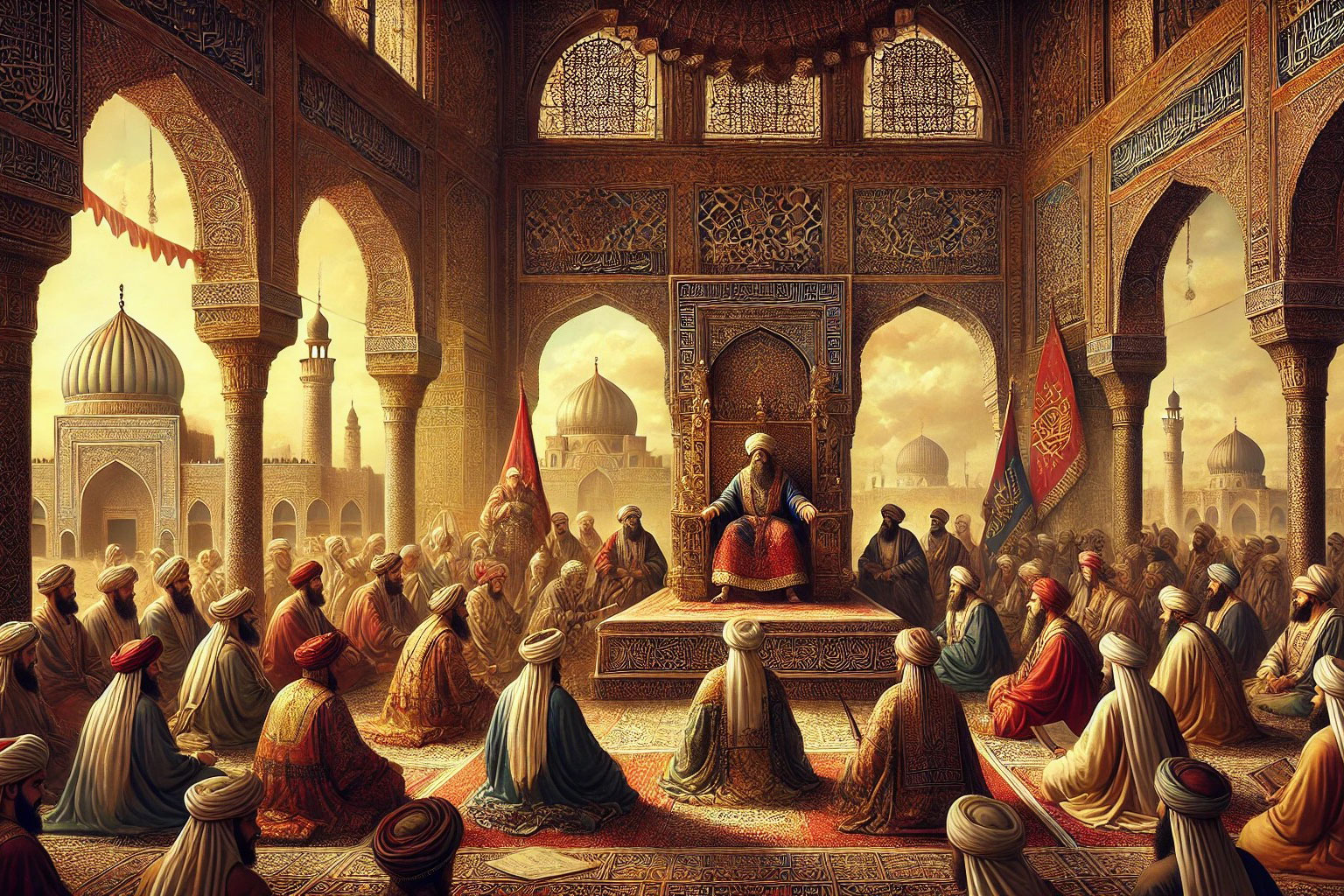
Free Source Library — The Abbasid Caliphate stands as one of the most intellectually vibrant and culturally significant periods in Islamic history, renowned for its flourishing of debates across numerous disciplines that underpinned what is now known as the Islamic Golden Age. This era, stretching from 750 to 1258 CE, witnessed an extraordinary confluence of ideas, disciplines, and cultural influences, fostering a dynamic environment where scholars and thinkers engaged in rich dialogues, raising questions and proposing answers that would influence not only their own civilization but also the entire course of human intellectual development.

The Cultural and Historical Context of Abbasid Intellectual Debates
Political Stability and Patronage as Catalysts
The stability and prosperity brought by the Abbasid dynasty, especially during the reigns of caliphs such as Al-Ma’mun and Al-Mu’tasim, created fertile ground for scholarly pursuits. The political backing of intellectual endeavors, combined with a thriving economy fueled by trade, agriculture, and diverse cultural interaction, allowed scholars to dedicate themselves fully to inquiry without the immediate fears of economic hardship or political instability. Patronage became a central feature, with the caliphs funding libraries, translation projects, and scientific expeditions. This security and support enabled an unprecedented level of intellectual exchange, resulting in debates that traversed disciplinary boundaries.
The Multicultural Melting Pot of Ideas
The Abbasid era was markedly cosmopolitan, with Persian, Greek, Indian, Egyptian, and Christian influences intertwined within Islamic civilization. The integration of diverse traditions enriched debates, especially in philosophy, medicine, astronomy, and jurisprudence. Scholars didn’t operate in isolation; they often engaged with ideas that originated in distant lands, translating, critiquing, and expanding upon them. This cross-pollination helped create original syntheses that became characteristic of Abbasid intellectual culture.
Types of Debates in the Abbasid Era
Theological Debates: Foundations and Factions
Islamic theology, or kalam, was a major subject of debate in the Abbasid period. Scholars sought to interpret the Quran and Hadith in ways that preserved divine authority while allowing the intellectual freedom to address new questions emerging from scientific and philosophical knowledge. These discussions often centered on:
- Predestination vs. free will
- The nature of God’s attributes
- The interpretation of divine texts
- The rationality of faith versus reason
Distinct theological schools emerged, notably the Mu’tazilites, who emphasized rationalism and divine justice, and the Ash’arites, who argued for a more traditionalist approach. Debates between these schools often took place within the court and academic circles, shaping Islamic doctrine for centuries.
Philosophical Discourse and the Translation Movement
The translation movement, catalyzed in Baghdad’s House of Wisdom, was pivotal in bringing Greek, Roman, Persian, and Indian philosophical texts into the Arabic language. It sparked vibrant debates about the nature of existence, knowledge, and morality. Scholars like Al-Kindi initiated the integration of Greek philosophy into Islamic thought, which was further developed by Al-Farabi, Avicenna (Ibn Sina), and others. Key philosophical debates tackled questions such as:
- Is knowledge innate or acquired?
- What is the nature of reality? Is it material or spiritual?
- How should humans attain happiness and virtue?
- What is the relationship between faith and reason?
These discussions helped forge a uniquely Islamic philosophical tradition, blending rational inquiry with religious doctrine.
Scientific Debates: From Astronomy to Medicine
The Abbasid period marked extraordinary advancements in scientific knowledge. The House of Wisdom was a hub of scholarly exchange where debates on natural philosophy, astronomy, medicine, and chemistry thrived.
- **Astronomy**: Scholars like Al-Battani refined Ptolemaic models, improved observational techniques, and created detailed star charts. The debates often centered on planetary motion and celestial mechanics, laying groundwork that would later influence Copernican and Keplerian models.
- **Medicine**: Figures such as Al-Razi and Ibn Sina advanced medical sciences through clinical observations and theoretical treatises. Debates about the nature of disease, the efficacy of treatment methods, and the relationship between diet and health were commonplace.
- **Chemistry and Alchemy**: While rooted heavily in mysticism, early experiments in chemical processes led to discussions on material transformation, which would eventually evolve into modern chemistry.
Linguistic and Literary Debates
Arabic language and literature were central to intellectual life, with scholars debating the proper interpretation of religious texts, grammatical rules, and poetic expression.
- Sibawayh’s grammatical theories provided a foundation for linguistic correctness, prompting debates over linguistic decay versus development.
- Poetry, as both an art and a form of expression, saw critics and poets debate themes of love, morality, and philosophical inquiry, often through competitions called “munazara”.
- Lexical debates also arose, tackling issues of proper usage, word origins, and translation accuracy, which impacted the development of a precise and expressive literary language.
Institutional Frameworks for Debate and Knowledge Preservation
The House of Wisdom: A Model of Multidisciplinary Inquiry
Founded by Caliph Al-Ma’mun, the House of Wisdom in Baghdad epitomized the era’s commitment to open scholarly exchange. It served not only as a library and translation center but also as an academic institution where scholars from diverse backgrounds gathered to debate, teach, and innovate across disciplines. This institution exemplified:
- Open access to texts from multiple civilizations
- Support for original research and debate
- Translation and commentary processes that fostered reinterpretation
The debates here often involved translating complex Greek philosophical treatises and debating their implications using Islamic epistemological frameworks.
Evolution of Islamic Jurisprudence and Interfaith Dialogues
Debates extended into the realm of law (fiqh), where scholars devised and refined legal schools that would influence Islamic practice. They discussed methodologies for interpreting the Sharia, leading to the emergence of four major Sunni schools:
- Hanafi
- Maliki
- Shafi’i
- Hanbali
Similarly, interfaith dialogues emerged, particularly between Muslims, Christians, Jews, and Zoroastrians, aimed at mutual understanding and resolving theological conflicts.
Case Study: Debates Over the Nature of God in Islamic Theology
A particularly influential debate centered on God’s attributes—whether they should be understood literally or metaphorically. The Mu’tazilites argued for a rational, allegorical interpretation, emphasizing divine justice and unity, whereas the Ash’arites maintained that God’s attributes are real and eternal but beyond human comprehension. These debates had profound implications for Islamic doctrine and influenced subsequent theological thought.
Impacts of Abbasid Debates on Modern Knowledge
Philosophy and Science
Many ideas from the Abbasid period filtered into European thought via translations and cultural exchanges, setting the stage for the Renaissance. The integration of Greek philosophy with Islamic scholarship preserved and expanded ancient knowledge, which later inspired thinkers such as Copernicus, Galileo, and Kepler.
Legal and Religious Thought
Legal methodologies established during the Abbasid era continue to influence Islamic jurisprudence, shaping contemporary debates over Islamic law and its modern adaptations.
Literary and Linguistic Development
The codification of grammatical rules and poetic forms provided a standard for Arabic language that persists to this day, fostering a rich literary tradition.
Practical Frameworks for Conducting Debates and Advancing Knowledge Today
Modern scholars and students can learn from Abbasid debates by adopting frameworks such as:
- Engaging multiple perspectives to enrich understanding
- Combining translation with critical analysis
- Fostering interdisciplinary dialogue
- Supporting open access to resources and collaborative research
This approach promotes dynamic and inclusive scholarship, echoing the spirit of the Abbasid intellectual renaissance.
Common Challenges and How to Overcome Them
Despite their achievements, Abbasid scholars faced hurdles such as ideological conflicts, political interference, and linguistic complexities. Addressing these issues today involves:
- Encouraging open-mindedness and critical thinking
- Building institutions that support diverse viewpoints
- Ensuring access to high-quality translation and interpretation services
- Fostering intercultural communication and understanding
Conclusion: The Enduring Legacy of Abbasid Debates
The debates within the Abbasid Caliphate epitomized a collaborative quest for knowledge, driven by curiosity, critical inquiry, and mutual respect among diverse thinkers. Their pioneering spirit laid the groundwork for modern scientific methods, legal principles, philosophical inquiries, and literary standards. Today, their legacy endures through the continuous pursuit of understanding across disciplines, reminding us that debate and dialogue remain essential tools for human progress.
References
- Hodgson, M. G. (1974). *The Venture of Islam*. University of Chicago Press.
- Gutas, D. (2001). *Avicenna and the Aristotelian Tradition*. Brill Academic Publishers.