
Free Source Library — Exploring the colossal world of dinosaurs reveals astonishing giants like the Argentinosaurus, a creature that continues to inspire awe due to its unmatched size and biological mysteries.
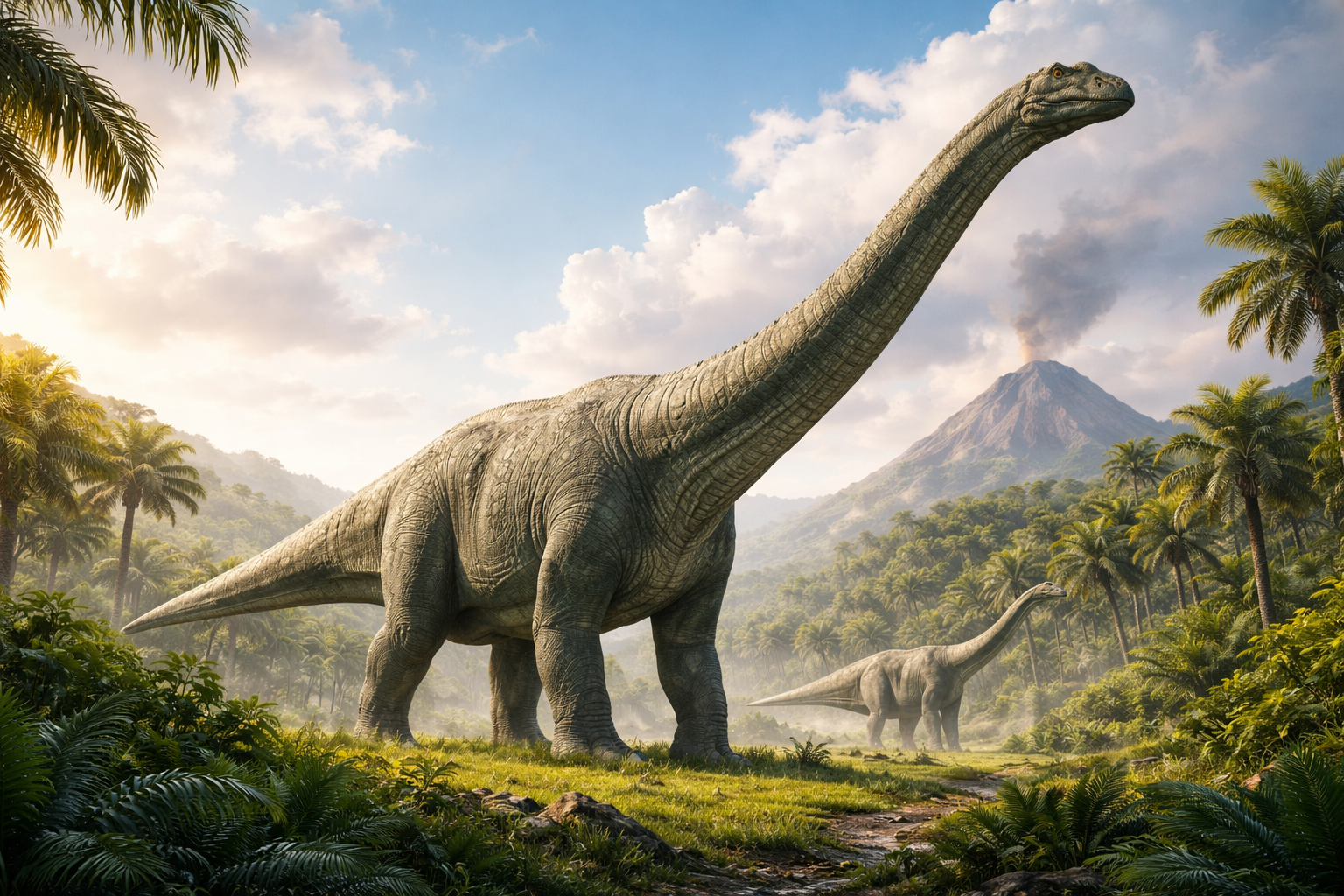
The Enormous Legacy of Argentinosaurus: The Largest Dinosaur Ever Discovered
Imagine a creature so vast that it rivals the size of some of the largest animals to have trod the Earth, a living colossus whose bones whisper tales of prehistoric dominance. The Argentinosaurus stands as a testament to Earth’s most ambitious evolutionary experiments, an apex among sauropods that reigned during the Late Cretaceous period. Its discovery not only revolutionized our understanding of dinosaur gigantism but also sparked new questions about the limits of terrestrial vertebrate size, its ecological roles, and the biological adaptations that permitted such enormity.
Historical Origins and Discovery
The story of the Argentinosaurus begins in the rugged terrains of Neuquén Province, Argentina, where local farmer Guillermo Heredia first unearthed fossil fragments in 1987. Initial finds included vertebrae and limb bones now recognized as belonging to the most gigantic known land dinosaur—yet these pieces alone could not tell the full story. Over subsequent years, research led by paleontologist José Bonaparte and international teams expanded the fossil record, revealing a creature of staggering proportions.
The fossils were found in the sediments of the Late Cretaceous Allen Formation, sedimentary layers rich in dinosaur bones, which serve as a window into an ancient ecosystem teeming with life. The sedimentology indicates that the environment was likely a floodplain or a deltaic setting, with rivers and lush vegetation supporting a diverse array of prehistoric flora and fauna.
Defining the Magnitude: Size and Weight Estimates
Quantifying the size of such a colossal animal remains inherently challenging due to fragmentary fossils. Nevertheless, using comparative anatomy, biomechanical models, and the available skeletal remains, paleontologists have arrived at estimated metrics that continue to fascinate both scientists and the public.
| Estimated Dimensions | Range and Approximate Values |
|---|---|
| Length | 30–40 meters (98–131 feet) |
| Weight | 50–100 metric tons (55–110 short tons) |
| Neck Length | Over 9 meters (30 feet) |
| Tail Length | 15–20 meters (49–66 feet) |
To put that into perspective, the Argentinosaurus was roughly the length of a four-lane highway and weighed as much as approximately ten African elephants combined. Its vertebral bones alone could reach two meters (over six feet) in height, and limb bones suggest a weight-bearing capacity unlike anything seen in today’s terrestrial fauna.
The Challenges of Size Estimation
Because only partial skeletons are available, these estimates rely heavily on analogy with more complete sauropod specimens and biomechanical modeling. For example, the circumference of limb bones can be used to estimate total body mass through regressions based on modern analogs, but uncertainties remain. Here are some critical factors influencing size estimations:
- Bone robustness: Thick, sturdy bones support greater weight, but fossilization can distort measurements.
- Fossil completeness: The more skeletal parts recovered, the more accurate the estimates.
- Comparative anatomy: Relating fragmentary fossils to better-known relatives with complete skeletons allows for informed inferences.
Anatomical Features and Adaptations
Body Structure and Skeletal Anatomy
The Argentinosaurus belonged to the Titanosauria, a subgroup distinguished by their massive, robust bones and distinctive skeletal features. Its vertebrae were among the largest ever discovered, with some individual bones exceeding a meter in diameter. The animal’s skeletal framework was designed to bear tremendous weight, featuring a columnar limb structure, reinforced limb joints, and an extensive, flexible neck.
Its small head, relative to body size, was equipped with small, leaf-shaped teeth. These teeth suggest a diet specialized in cropping foliage close to the ground or at low to mid-levels in the canopy, depending on plant height and environmental context.
Listening to the Skeleton: Insights into Function and Movement
Biomechanical modeling suggests that the Argentinosaurus moved with a slow, deliberate gait similar to that of modern elephants. Its massive limb bones, combined with a specialized columnar limb architecture, provided stability rather than speed. The animal’s center of mass was located centrally, with a long tail acting as a counterbalance, crucial for balancing movement and supporting its gigantic neck during foraging.
Fossilized footprints, though rare for such large animals, show that some sauropods like Argentinosaurus could traverse considerable distances daily, possibly supporting extensive herbivorous ranges. Studying these footprints, along with the limb bone analysis, helps paleontologists estimate stride length, walking speed, and energy expenditure.
Dietary Habits and Ecological Role
Feeding Strategies of the Titanosaur
The Argentinosaurus’s tiny head and long neck suggest a feeding mechanism optimized for large-scale browsing. From its high vantage point, it could access a broad range of vegetation—something critical in the competitive ecosystems of the Late Cretaceous. Its dentition indicates a diet that required limited dental processing, relying instead on sheer volume intake to sustain its enormous size.
Estimations of daily foliage consumption vary, but some hypotheses suggest an intake of several tons of plants daily—a dietary need that may have influenced the structure of its habitat, promoting the growth of dense forests and low-lying shrubbery to support such giants.
Ecological Impact and Interactions
As a dominant herbivore, the Argentinosaurus likely played a considerable role in shaping its environment. Its feeding habits could have influenced plant community structure, seed dispersal, and even the landscape, with massive feeding and movement patterns impacting soil and plant growth. Predators such as Giganotosaurus and Mapusaurus might have targeted juvenile or weak individuals, but the massive size of mature Argentinosaurus would have served as a formidable defense, reducing predation pressure.
Evolutionary Significance and Relationship with Other Sauropods
Position in the Sauropod Lineage
The Argentinosaurus is situated within Titanosauria, a diverse and widespread group that includes some of the largest known land animals. Recent discoveries of similar giants like Patagotitan and Dreadnoughtus suggest an evolutionary trend of gigantism among South American sauropods during the Late Cretaceous.
Comparative analysis indicates several evolutionary strategies shared among titanosaurs:
- Reduction in skull size relative to body
- Elongation of neck vertebrae for browsing efficiency
- Development of very thick limb bones for support
- Widened and robust pelvis and limb girdles
Why Did These Giants Evolve?
Gigantism among titanosaurs might have been driven by a combination of ecological and evolutionary pressures:
- Resource availability: Abundant vegetation allowed for bigger body sizes.
- Predation pressures: Larger size reduces vulnerability to predators.
- Thermoregulation: Larger bodies facilitate heat dissipation and regulation in warm climates.
The End of the Giants: Extinction and Legacy
The rise and fall of giants like the Argentinosaurus are tightly linked to the dramatic environmental changes during the late Cretaceous. Despite their dominance, they eventually succumbed to a complex web of extinction factors including climatic shifts, habitat loss, and the decline of their ecosystems.
Their legacy endures through the fossil record, museum specimens, and the ongoing scientific quest to understand Earth’s prehistoric biodiversity. Discoveries of similar monumental titanosaur species continue to expand our knowledge, offering a richer picture of how these amazing animals lived, thrived, and ultimately vanished.
Implications for Paleontology and Conservation
The study of these ancient giants informs modern conservation efforts by illustrating the importance of habitat stability and diversity. Understanding their ecological roles helps us appreciate the delicate balance of ecosystems—not only in the prehistoric past but also in our present world.
Further Explorations and Future Discoveries
Unanswered questions remain: How exactly did Argentinosaurus support its colossal weight? What were its growth rates? Did it migrate seasonally? As new fossils are uncovered with advances in imaging technology, 3D modeling, and molecular analysis, convergence of data promises to refine our understanding of these enigmatic giants.
If you’re curious about dinosaur biology and evolution, or want to explore how paleontologists reconstruct such giant creatures, numerous resources are available to deepen your understanding and fascination.
References
- https://www.nhm.ac.uk/discover/dino-directory.html
- https://biology.truman.edu/vertebrate_paleontology/