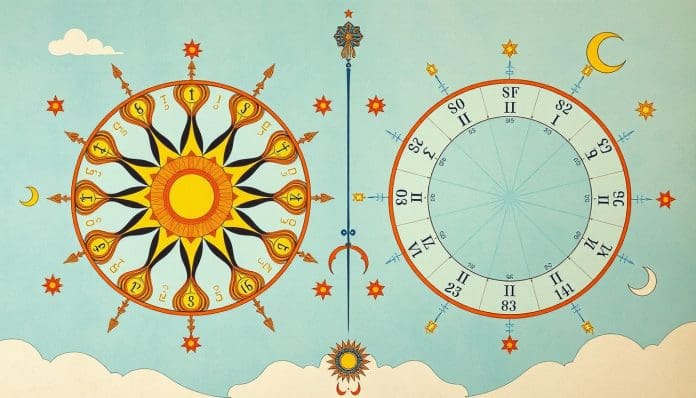
 Free Source Library — An in-depth exploration of how humans have historically and culturally organized time through solar and lunar calendar systems.

Understanding Solar and Lunar Calendars: Foundations, Features, and Significance
Throughout human history, societies around the world have developed various systems to measure and organize time, reflecting their environmental conditions, religious beliefs, and societal needs. Among these systems, solar and lunar calendars stand out as the most prevalent and influential. These two calendar types differ fundamentally in their basis—one relies on the Earth’s orbit around the Sun, while the other depends on the phases of the Moon. Grasping the nuanced distinctions, historical developments, and cultural significance of these calendars offers a window into the diversity of human civilization and its relationship with astronomical phenomena.
The Solar Calendar: Anchoring Time to Earth’s Orbit
What Is the Solar Calendar?
The solar calendar tracks time based on Earth’s orbit around the Sun, with the year defined as the time it takes for the Earth to complete one orbit—approximately 365.24 days. This system anchors its measurement to the celestial mechanics of the Earth-Sun relationship, capturing seasonal changes and aiding in agricultural, civil, and navigational planning. Because the solar calendar aligns closely with the Earth’s position in its orbit, it’s inherently synchronized with seasonal cycles—spring, summer, fall, and winter—making it especially suitable for civil society and agricultural societies.
The Gregorian Calendar: The Global Civil Standard
The Gregorian calendar, introduced in 1582 by Pope Gregory XIII as a reform of the Julian calendar, is the dominant civil calendar worldwide today. Its primary goal was to correct inaccuracies that had accumulated over centuries, which caused the calendar to drift away from the actual solar year. By refining the leap year rule, the Gregorian calendar ensures that the average calendar year length (365.2425 days) matches the solar year with remarkable precision.
Mechanics of the Gregorian Calendar
| Component | Description |
|---|---|
| Year Length | 365 days, with a leap day added every 4 years, except centurial years not divisible by 400 |
| Months | 12 months with varying lengths: January (31), February (28/29), March (31), April (30), May (31), June (30), July (31), August (31), September (30), October (31), November (30), December (31) |
| Leap Year Rule | Year divisible by 4 is a leap year, except century years unless divisible by 400 |
Beginning of the Year: Variations and Cultural Contexts
Although January 1st is the internationally recognized start of the calendar year, this choice is historically and culturally contingent. Many ancient societies aligned the beginning of the year with celestial events such as the vernal equinox (as in the Babylonian calendar), the winter solstice, or other astronomical markers. For example, the ancient Romans initially celebrated the new year in March, which coincided with the start of the agricultural season.
Why the Solar Calendar Works Well for Civil Use
Because of its stability and alignment with seasons, the solar calendar has become the backbone of civic life, agriculture, commerce, and global communication. Its predictability helps plan crops, market cycles, holiday schedules, and international events.
The Lunar Calendar: Synchronizing Society with the Moon
What Is a Lunar Calendar?
The lunar calendar bases its reckoning on the Moon’s orbital phases, mainly the transition from new moon to full moon and back. Since the Moon completes an orbit around Earth roughly every 29.5 days, lunar months are approximately that length. This results in a lunar year of about 354 days, shorter than the solar year—prompting unique challenges and adaptations in various cultures.
Islamic (Hijri) Calendar: A Purely Lunar System
Structure and Calculation
The Islamic calendar consists of 12 lunar months, each starting with the visual sighting of the new crescent moon. Its months alternate between 29 and 30 days, totaling 354 or 355 days annually. Because of its purely lunar nature, Islamic months shift through seasons by roughly 10 days annually relative to the Gregorian calendar. This rotational movement means that Islamic festivals and events, such as Ramadan, move through different seasons over a 33-year cycle.
Significance and Observational Basis
The reliance on actual moon sightings makes the Islamic calendar inherently local and observational. Urban, rural, and regional variations in moon observations can lead to differences in the start dates of months and celebrations between communities.
Lunar New Year and Other Cultural Calendars
The Chinese lunar calendar is perhaps the most famous example of a lunisolar system, combining lunar months with adjustments to align with the solar year. The Chinese New Year, for example, begins with the second new moon after the winter solstice, generally falling between late January and mid-February. Similarly, the Jewish calendar is a lunisolar system that uses intercalation (adding an extra month) to ensure that religious festivals remain aligned with specific seasons.
Distinguishing Features: Comparing Solar and Lunar Calendars
Key Differences in Calculation
- Basis: Earth’s orbit (solar) vs. Moon phases (lunar)
- Month Length: Fixed solar months (varied) vs. lunar months (~29.5 days)
- Year Length: ~365 days (solar) vs. ~354 days (lunar)
- Seasonal Alignment: Stable (solar) vs. shifting (lunar)
- Observation: Usually fixed and calculated (solar) vs. observational (lunar)
Advantages and Disadvantages
| Aspect | Solar Calendar | Lunar Calendar |
|---|---|---|
| Predictability | High, fixed dates, easy to plan | Less predictable, depends on moon sighting |
| Cultural Significance | Typically secular, used globally for civil purposes | Often religious, tied to festivals and rituals |
| Alignment with Seasons | Stable, aligns with seasons | Shifts through seasons annually |
| Ease of Use | More straightforward for civil administration | Requires lunar observation, less uniform |
Adaptations and Hybrid Systems: Lunisolar Calendars
The Need for Synchronization
Some cultures devised calendars blending aspects of both solar and lunar systems to reconcile lunar months with the solar year. This approach ensures religious festivals remain in specific seasons while maintaining lunar month rituals.
Case Study: The Hebrew Calendar
The Hebrew calendar employs a 19-year Metonic cycle, adding a leap month (Adar II) in 7 out of every 19 years to keep lunar months aligned with the solar seasons. This system allows religious observances like Passover to remain in spring, while lunar months maintain their cultural significance.
Practical Framework for Lunisolar Calendar Construction
- Calculate the lunar months based on moon sightings or astronomical calculations.
- Identify the need for intercalation based on the deviation from the solar year.
- Insert an extra month at designated intervals to maintain seasonal alignment.
- Adjust calendar rules based on regional astronomical observations or traditional practices.
Implementation Challenges and Common Mistakes
Calendar Drift and Discrepancies
Without careful correction, lunar calendars tend to drift through seasons, complicating religious and agricultural planning. For example, the Islamic calendar’s consistent shift through the solar year can make fixed seasonal festivals difficult to predict and organize.
Misinterpretation of Astronomical Events
Local visible phenomena, like moon sightings, are subjective and prone to variance, leading to disagreements on month starts and holiday dates. This emphasizes the importance of standardized astronomical calculations in modern implementations.
Technical and Cultural Pitfalls
Implementing accurate lunisolar calendars requires sophisticated astronomical data and cultural consensus. Political, religious, or regional differences can influence calendar adjustments, leading to discrepancies.
Practical Tools and Technologies in Modern Calendaring
- Use of astronomical calculators and software for moon sighting predictions
- Integration of international time standards (UTC) for synchronization
- Apps and online tools for religious festivals tracking and calendar conversions
Deeper Case Scenarios and Applications
Case Scenario 1: Planning Multinational Agricultural Campaigns
Understanding the implications of calendar types can be crucial for international agriculture. For instance, a crop planting schedule based on a solar calendar aligns with seasonal norms, but cultural festivals based on lunar calendars may influence local labor availability and market timings.
Case Scenario 2: Synchronizing Religious Festivals in Diverse Cultures
In communities where multiple calendar systems coexist, such as Muslim and Chinese populations, coordinating public events and religious practices requires precise calculations and cultural sensitivity.
Step-by-Step Framework for Society’s Calendar Planning
- Identify the primary purpose: civil, religious, or cultural.
- Select the relevant calendar system(s) based on tradition and functionality.
- Integrate astronomical data for accuracy, especially for lunar phases.
- Develop algorithms or tools for calendar conversion and prediction.
- Implement communication and consensus mechanisms for calendar changes or decisions.
Summary and Insights
The distinction between solar and lunar calendars reflects humanity’s diverse ways of understanding and relating to the cosmos. Civil society predominantly relies on the predictable and stable solar calendar, ensuring harmony with Earth’s seasons and supporting complex societal functions. Meanwhile, religious and cultural identities preserve lunar and lunisolar calendars, anchoring festivals and rituals in celestial phenomena observed with cultural nuance. Recognizing these differences enriches our appreciation of global diversity and enhances our ability to manage and synchronize complex societal activities across different calendar traditions.
References
- United Nations Office for Outer Space Affairs. “Calendars and Chronology.”
- NASA Scientific Visualization Studio. “Earth and Moon orbital mechanics.”