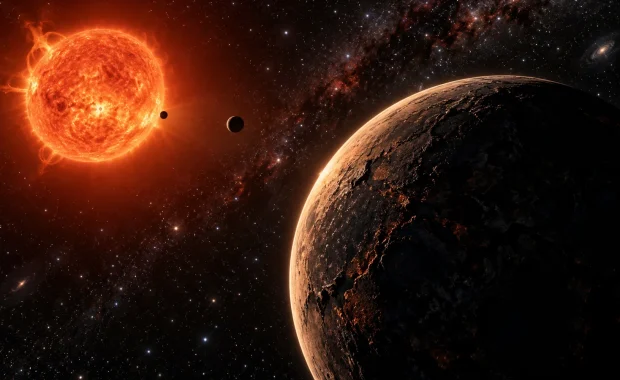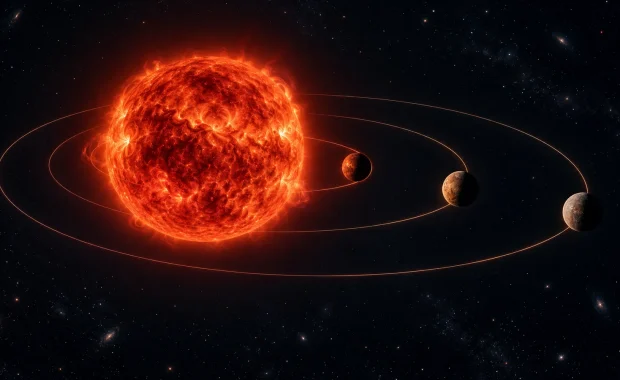
The universe, vast and enigmatic, continuously reveals its secrets through the discovery of celestial bodies beyond our solar system. Among these, exoplanets—planets orbiting stars outside our solar system—have transformed our understanding of planetary formation, diversity, and the potential for life elsewhere in the cosmos. The detection and study of these distant worlds have become pivotal in modern astrophysics, driven by advanced space telescopes and innovative observational techniques. One such intriguing exoplanet is CoRoTID 223977153 b, a gas giant that exemplifies the richness and variety inherent in planetary systems scattered across the galaxy. This article, hosted on the comprehensive platform of the Free Source Library (freesourcelibrary.com), delves into the intricate details of CoRoTID 223977153 b, exploring its discovery, physical characteristics, orbital parameters, and the broader significance within the context of exoplanetary science.
Introduction to Exoplanets and the Significance of CoRoTID 223977153 b
The discovery of exoplanets has been one of the most transformative achievements in astronomy over the last few decades. From the first confirmed detection in the early 1990s, the catalog of known exoplanets has grown exponentially, unveiling a universe teeming with worlds that challenge our traditional understanding of planetary systems. These discoveries have underscored the incredible diversity of planetary types, including planets vastly larger or smaller than those in our solar system, with a wide range of compositions, orbital configurations, and environmental conditions.
Among the pioneering missions dedicated to exoplanet detection was the Convection, Rotation, and Transits (CoRoT) satellite, launched by the French space agency CNES in cooperation with European and international partners. CoRoT’s primary objective was to identify exoplanets via the transit method, capitalizing on the subtle dimming of a star’s brightness caused by a planet passing across its face. This method has proven remarkably effective, allowing astronomers to infer a planet’s size, orbital period, and even atmospheric properties in some cases.
CoRoTID 223977153 b is a product of this mission’s success, discovered in 2017 through meticulous analysis of stellar light curves. It stands out due to its classification as a gas giant, its close orbital proximity to its host star, and the insights it offers into planetary formation and migration. Situated approximately 1,881 light-years from Earth, this exoplanet exemplifies the kind of distant worlds that expand our cosmic horizons and inspire scientific inquiry into the nature of planetary systems.
Discovery and Observation Techniques
The Transit Method: An Overview
The detection of CoRoTID 223977153 b was made possible through the transit method, a cornerstone technique in modern exoplanet research. This method involves continuously monitoring the brightness of a star over extended periods, seeking periodic dips indicative of a planet crossing the star’s disk from our line of sight. The magnitude and duration of these dips provide critical data about the exoplanet’s physical properties and orbit.
During a transit, the light curve of the host star displays a characteristic U-shaped dimming. The depth of this dip correlates directly with the planet’s size relative to the star, allowing astronomers to estimate the planetary radius. The time between successive transits reveals the orbital period, which, combined with the star’s properties, allows calculation of the orbital radius via Kepler’s third law. The precision of the CoRoT telescope, with its highly sensitive photometric instruments, facilitated the detection of even minute brightness variations caused by small planets or those orbiting faint stars.
Data Collection and Analysis
CoRoT observed thousands of stars simultaneously, recording their brightness at high cadence over months to years. The collected light curves underwent rigorous data processing to eliminate noise, stellar variability, and instrumental effects. Advanced algorithms and statistical models, including the Box-Least Squares (BLS) method, were employed to identify periodic transit signals amid the stellar noise.
Once a candidate transit signal was identified, follow-up analyses determined the likelihood of the signal being caused by an exoplanet rather than false positives such as binary star systems or stellar activity. For CoRoTID 223977153 b, the periodicity was confirmed through multiple transit observations, establishing a reliable detection and enabling detailed characterization of its orbital and physical parameters.
Physical and Orbital Characteristics of CoRoTID 223977153 b
Fundamental Parameters
| Parameter | Value | Unit |
|---|---|---|
| Orbital radius | 0.071 | AU |
| Orbital period | 6.7 | days |
| Orbital eccentricity | 0.0 | – |
| Planet radius | 0.57 | Jupiter radii |
| Planet mass | 0.15 | Jupiter masses |
| Host star distance | 1,881 | light-years |
| Stellar magnitude | 13.626 | – |
Orbital Dynamics and Stability
The planet’s orbit is remarkably circular, with an eccentricity of 0.0, indicating a stable and predictable path around its host star. Such orbital regularity suggests that CoRoTID 223977153 b has likely undergone a migratory process that settled it into this near-circular trajectory, possibly influenced by interactions with protoplanetary disk material or other planetary bodies.
Its close proximity to the star—just 0.071 AU—places the planet well within the star’s habitable zone, although the high temperatures resulting from this proximity render it inhospitable for life as we know it. The short orbital period of approximately 6.7 days indicates rapid orbital motion, typical of “hot Jupiters” or “mini-Jupiters” in tight orbits around their stars.
Size, Composition, and Atmosphere
With a radius of approximately 0.57 times that of Jupiter, CoRoTID 223977153 b is comparatively smaller than the gas giants in our Solar System. Its mass is about 0.15 Jupiter masses, suggesting a low-density, lightweight composition, characteristic of “mini-Jupiters.” Despite its small size, the planet likely retains a thick atmosphere composed mainly of hydrogen and helium, similar to larger gas giants but with potentially different atmospheric dynamics due to its lower gravity and high stellar irradiation.
The intense heat from proximity to its star could cause atmospheric expansion or even atmospheric escape over geological timescales. Such processes influence the planet’s evolution, potentially stripping lighter elements and leading to a denser core or a different atmospheric composition than initially formed.
Broader Implications in Exoplanetary Science
Understanding Gas Giants in Extreme Environments
Gas giants like CoRoTID 223977153 b, especially those in close-in orbits, serve as natural laboratories for studying planetary physics under extreme conditions. These planets often exhibit inflated atmospheres, complex weather systems, and dynamic interactions with their stars. Observations of such bodies contribute to our comprehension of atmospheric physics, including heat redistribution, cloud formation, and chemical composition in high-temperature regimes.
Planetary Formation and Migration Theories
The existence of a small, lightweight gas giant so close to its star poses intriguing questions about planetary formation. Traditional models suggest that gas giants form beyond the snow line—where temperatures are low enough for volatile compounds to condense—and migrate inward over time. The nearly circular orbit of CoRoTID 223977153 b supports the idea of gentle migration, likely driven by interactions with the protoplanetary disk, rather than violent scattering events.
Understanding such migration pathways helps refine models of planetary system evolution and offers clues about the early conditions of planetary formation within different stellar environments.
Comparison with Solar System and Exoplanet Diversity
While our Solar System hosts Jupiter and Saturn as the primary gas giants, exoplanet discoveries reveal a much broader spectrum of similar planets, often in configurations incompatible with our planetary architecture. Some exoplanets, including CoRoTID 223977153 b, are classified as “hot Jupiters” or “mini-Jupiters,” occupying close-in orbits with extreme temperatures. These diverse planetary types challenge the notion of a “standard” planetary system and underscore the importance of observational data in understanding the full scope of planetary diversity.
Significance of Space Missions in Exoplanet Discovery
Legacy of the CoRoT Mission
The CoRoT mission was instrumental in pioneering the transit method for exoplanet detection. Its success laid the groundwork for subsequent missions like Kepler and TESS, which have identified thousands of exoplanets across a wide range of sizes and orbital configurations. The data provided by CoRoT continues to be valuable for statistical analyses of planetary populations and for targeted follow-up observations.
While CoRoT’s mission ended in 2012, its legacy persists in the ongoing quest to understand planetary systems. The detection of CoRoTID 223977153 b exemplifies the mission’s contribution to expanding our cosmic inventory of worlds and refining detection techniques.
Future Directions and Technological Advancements
The ongoing development of more sensitive telescopes, such as the James Webb Space Telescope (JWST), promises to revolutionize exoplanet studies. These instruments will enable detailed atmospheric characterization, including the detection of specific chemical signatures and weather patterns. For planets like CoRoTID 223977153 b, future observations could reveal atmospheric composition, temperature profiles, and even potential variability or weather phenomena.
Additionally, advancements in direct imaging, astrometry, and radial velocity measurements will complement transit data, providing comprehensive insights into exoplanetary systems. These technologies will help answer fundamental questions about planetary formation, evolution, and the potential habitability of worlds beyond our solar neighborhood.
Conclusion: A Window into the Universe’s Diversity
CoRoTID 223977153 b exemplifies the extraordinary diversity of exoplanets that populate our galaxy. Its characteristics—small size for a gas giant, close orbit, and circular trajectory—offer valuable insights into planetary physics, migration mechanisms, and atmospheric dynamics under extreme conditions. As part of the broader tapestry of planetary systems, it underscores the importance of space-based observatories like CoRoT in expanding our cosmic horizon.
From the distant light-years that separate us from its host star, the study of CoRoTID 223977153 b enriches our understanding of how planets form, migrate, and evolve. It also fuels the scientific pursuit of discovering potentially habitable worlds, broadening our perspective on the universe’s capacity to harbor life. As technology advances and our exploration methods become more refined, the secrets of such distant worlds will continue to unfold, revealing an ever more intricate and awe-inspiring universe.
Sources and references:
- Borde, A., et al. (2010). “The CoRoT mission: Science objectives and early results.” Astronomy & Astrophysics.
- Lammer, H., et al. (2013). “The atmospheres of hot Jupiters.” Annual Review of Astronomy and Astrophysics.