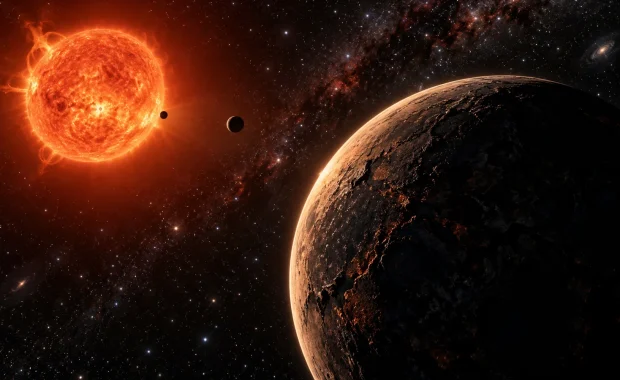
YZ Ceti b is one of the nearest known Earth-mass exoplanets, but “Earth-mass” should not be confused with “Earth-like.” The planet circles a small red dwarf in about 2.02 days, receives several times Earth’s stellar energy, and has not been seen crossing its star. Its radius, bulk composition, surface conditions, and atmosphere remain unknown.
The planet has drawn special attention because radio bursts from the YZ Ceti system may be consistent with magnetic interaction between the star and planet. That possibility is scientifically important: a planet-size magnetic field outside the Solar System is extremely difficult to detect. It is also unsettled. Stellar activity can produce radio emission without a planet, and current observations do not amount to a confirmed detection of YZ Ceti b’s magnetic field.
YZ Ceti b at a glance
- Host star: YZ Ceti, also known as GJ 54.1, about 3.71 parsecs or 12.1 light-years away.
- Detection: radial velocity, announced with the three-planet system in 2017.
- Orbital period: about 2.02 days in the 2020 CARMENES reanalysis.
- Minimum mass: about 0.70 Earth masses in that same analysis.
- Orbit size: about 0.0163 astronomical units.
- No confirmed transit, radius, atmosphere, or direct image.
- Radio observations offer intriguing but unconfirmed evidence of star–planet magnetic interaction.
The star: a nearby red dwarf
YZ Ceti is an M4.5 V red dwarf in the constellation Cetus. Gaia-based measurements put it roughly 3.712 parsecs away. A 2020 analysis adopted a mass near 0.142 times the Sun’s, a radius near 0.157 solar radii, an effective temperature around 3,151 kelvin, and a luminosity only about 0.22 percent of the Sun’s.
Those small numbers help explain why Earth-mass planets are measurable. An orbiting planet pulls both itself and its star around their common center of mass. A low-mass star responds more noticeably to a small planet than a Sun-like star does, increasing the radial-velocity signal.
Red dwarfs are also active. Starspots, magnetic regions, and flares alter spectra and brightness, potentially imitating or obscuring planetary signals. YZ Ceti rotates in roughly 68 days, far longer than planet b’s two-day orbit, but activity still has to be modeled across the data.
How YZ Ceti b was found
The radial-velocity method measures repeated shifts in a star’s spectrum. As the star moves toward Earth, its spectral lines shift slightly toward shorter wavelengths; as it moves away, they shift toward longer wavelengths. A periodic pattern can reveal an unseen companion.
The 2017 discovery study reported at least three low-mass planets around YZ Ceti using HARPS measurements. The signals were tiny—on the order of one or two meters per second—and the observing schedule created alternative mathematical periods called aliases. For the innermost planet, the original favored period was about 1.97 days.
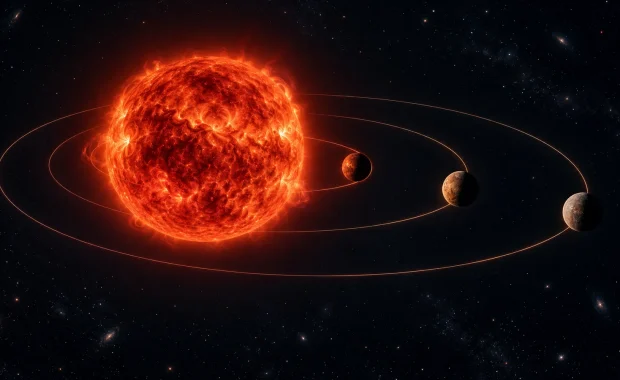
A larger 2020 analysis added 229 radial-velocity measurements, combined HARPS and CARMENES observations, simulated the sampling aliases, and modeled stellar activity. It favored 2.02 days for planet b, with planets c and d at about 3.06 and 4.66 days. That is why current summaries can differ from the first announcement without implying that either number was a typographical error.
What “minimum mass” means
Radial velocity measures motion along our line of sight. The signal gives the planet’s mass multiplied by the sine of the orbital inclination, written M sin i. If the orbit is close to edge-on, sin i is near one and the true mass is close to the minimum. If the orbit is more face-on, the true mass is larger.
For YZ Ceti b, the 2020 circular-orbit model estimated M sin i at 0.70 Earth masses, with a reported uncertainty of roughly plus 0.09 and minus 0.08 Earth masses. This is not a direct weighing and should not be presented as an exact true mass.
Dynamical stability constrains extremely face-on, high-mass arrangements, but it does not select one precise inclination. Without a transit, astrometric orbit, or another independent inclination measurement, the minimum-mass language remains essential.
A two-day year
YZ Ceti b completes an orbit in approximately 2.0209 Earth days and travels at about 0.0163 astronomical units from its star in the 2020 solution. One astronomical unit is the average Earth–Sun distance. The planet is therefore about sixty times closer to its star than Earth is to the Sun.
Because YZ Ceti is far dimmer than the Sun, distance alone does not determine heating. The analysis estimated that planet b receives about 8.2 times the stellar flux Earth receives and has an equilibrium temperature near 471 kelvin under standard assumptions. Actual surface or atmospheric temperatures could differ substantially depending on reflectivity, heat circulation, greenhouse gases, and whether an atmosphere exists.
At such close range, tidal forces probably matter. The planet may rotate synchronously, showing nearly the same hemisphere to the star, though orbital eccentricity, interior response, and companion interactions affect the details. Synchronous rotation is not proven by the radial-velocity data.
Why it is not an Earth twin
Mass alone does not reveal whether a planet is rocky, iron-rich, water-rich, or wrapped in gas. YZ Ceti b’s radius is unknown because no transit has been detected. Density requires both mass and radius, so the planet’s internal composition cannot yet be measured.
The planet also lies well inside conventional estimates of the star’s habitable zone and receives intense irradiation. Red-dwarf ultraviolet and X-ray activity can erode atmospheres, especially for a close-in world. A magnetic field might reduce some types of charged-particle exposure, but it would not automatically create habitable temperatures or preserve an atmosphere.
Words such as “Earth-size,” “Earth-mass,” “rocky,” and “habitable” answer different questions. For YZ Ceti b, Earth-mass is justified as an approximate mass class; the other labels require evidence not currently available.
The radio-burst clue
In 2023, researchers reported coherent radio bursts from YZ Ceti observed with the Karl G. Jansky Very Large Array. Some burst timings were consistent with an interaction involving planet b. In this scenario, the planet moves through the star’s magnetic environment, disturbing it and launching energy along magnetic field lines. The resulting emission would originate mainly near the star, even though the planet helps drive it.
This resembles, in broad physical terms, interactions between Jupiter and its moon Io. It is not an exact copy: the bodies, plasma environment, field strengths, and emission processes differ. Models ask whether the available power, polarization, orbital timing, and geometry can reproduce the signal.
The observations were suggestive rather than conclusive. Bursts did not establish a repeating, uniquely planetary pattern, and active red dwarfs can flare or emit coherent radio waves on their own. Later work has continued to examine the star’s magnetic topology and whether planet-induced flaring is plausible. The careful conclusion is that YZ Ceti b is a leading test case, not the first securely measured magnetic field of an Earth-mass exoplanet.
Two signals that answer different questions
The radial-velocity and radio observations should not be blended into one claim. The repeating Doppler signal establishes that a low-mass planet orbits the star and measures its period and minimum mass. The radio bursts come from magnetized plasma in the system and are being tested for an orbital connection. A disputed radio interpretation does not erase the radial-velocity planet; conversely, a secure planet does not prove that every burst is planet-driven.
Timing is central to the magnetic hypothesis. If planet b repeatedly crosses regions where its motion can launch Alfvén waves toward the star, bursts may favor particular orbital phases. But the star rotates, its large-scale field changes, and emission can be visible only when beamed toward Earth. A small number of events can therefore look suggestive without providing a stable periodic sequence.
Researchers also examine polarization. Coherent processes can produce strongly polarized radiation, while the sign and frequency behavior contain information about magnetic geometry and plasma density. These observations constrain models rather than photographing a magnetosphere. A robust result will need repeatability, simultaneous monitoring at other wavelengths, and predictions that distinguish a planet-driven event from an ordinary stellar flare.
What a planetary magnetic field would tell us
A magnetic field depends on motion of electrically conducting material inside a planet—a dynamo. Its existence could constrain internal structure, cooling, rotation, and core behavior. Magnetic fields also shape how stellar wind interacts with an atmosphere.
Detection would not directly provide a surface field map. Researchers would infer field strength and geometry through a model connecting the planet, stellar wind, stellar magnetosphere, and observed radio power. Each component contributes uncertainty. Repeated observations at predicted orbital phases and multiple radio frequencies are needed to separate the model from ordinary stellar variability.
Why no transit matters
A transit occurs when a planet crosses the stellar disk from Earth’s viewpoint, causing a small dip in brightness. Transit searches with TESS did not identify the expected event for the known planets. The 2020 analysis used the non-detection to place an upper bound on orbital inclination under its convention, excluding the most nearly edge-on geometry.
No transit means no direct radius, no transit spectrum of an atmosphere, and no easy density. It also makes confirmation of the radio interaction harder because the orbital geometry is less constrained. However, most orbital orientations do not transit, so a non-transiting planet is entirely normal.
How future observations could help
- Long radio campaigns can test whether bursts repeat with the orbital period and polarization expected from a magnetic interaction.
- Simultaneous optical monitoring can identify ordinary stellar flares that coincide with radio events.
- Spectropolarimetry can map the star’s large-scale magnetic field and improve interaction models.
- Continued radial velocity can refine mass, eccentricity, and interactions among the three planets.
- Astrometry may eventually constrain inclination, although the signal from such a low-mass planet is extraordinarily small.
Frequently asked questions
Is YZ Ceti b habitable?
It is unlikely under conventional criteria. It receives about eight times Earth’s stellar flux and orbits an active red dwarf extremely closely. Its atmosphere and surface are unknown.
Is it smaller than Earth?
Its measured minimum mass is below Earth’s, but its radius has not been measured. “Smaller” can refer to mass or physical diameter, so the distinction matters.
Has its magnetic field been detected?
No definitive planetary field has been detected. Radio bursts make star–planet magnetic interaction plausible, but purely stellar explanations remain viable.
Can we see the planet?
No direct image separates it from the star. Its existence is inferred from the star’s radial-velocity motion.
How long is a year there?
About 2.02 Earth days, based on the resolved orbital signal.
Bottom line
YZ Ceti b is a nearby, low-minimum-mass planet on a scorching two-day orbit around a small red dwarf. Precision spectroscopy establishes the orbit, but the planet does not transit, leaving its radius and composition unknown. Radio bursts have turned it into an exceptional laboratory for star–planet magnetic interaction, yet the strongest scientifically accurate wording remains “candidate magnetic signature,” not confirmation.
Sources
- Astronomy & Astrophysics (2020): CARMENES characterization of YZ Ceti
- Astronomy & Astrophysics (2017): Discovery of the three-planet system
- Nature Astronomy (2023): Coherent radio bursts from YZ Ceti
- NASA Exoplanet Archive: YZ Ceti system
Evidence reviewed: October 16, 2026.