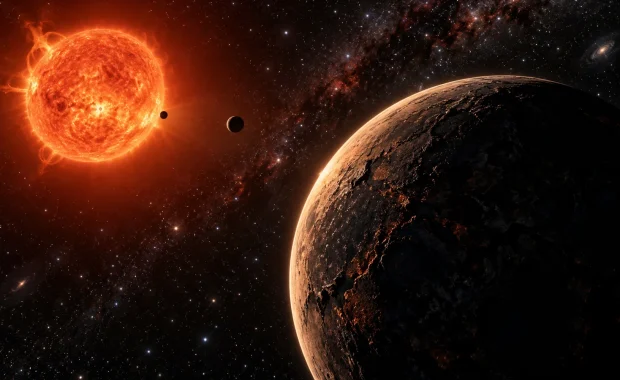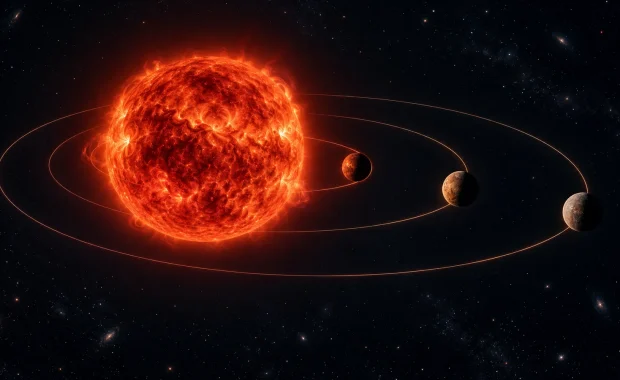
YSES 2 b once appeared to be an unusually wide-orbit planet captured directly beside a young Sun-like star. It is now a valuable example of something different: a convincing candidate that failed a more precise test. Follow-up observations reported in 2025 showed that the point of light is a distant background star, not a planet gravitationally bound to YSES 2.
That correction does not make the original investigation pointless. Direct imaging works near the limits of contrast, angular resolution, and time. A background object can line up with a nearby star closely enough to imitate a companion. Science becomes more reliable when an attractive interpretation is tested over several epochs and revised when the sky does not move as predicted.
YSES 2 b at a glance
- It was reported in 2021 as a directly imaged giant-planet companion to the young star YSES 2.
- The candidate appeared roughly 115 astronomical units from the star in projected separation.
- Later SPHERE and GRAVITY observations measured its position far more precisely over time.
- The motion matches a late-type M dwarf more than 2 kiloparsecs behind YSES 2, not a bound planet.
- The NASA Exoplanet Archive now treats the object as refuted rather than confirmed.
What was originally reported?
In 2021, researchers using the SPHERE instrument on the European Southern Observatory’s Very Large Telescope reported a faint companion candidate near YSES 2. The star is young, broadly similar to the Sun in mass, and part of the Young Suns Exoplanet Survey. Young planets retain heat from formation and can glow strongly in infrared wavelengths, so youth makes such systems productive targets for direct imaging.
The source appeared at a wide projected separation. If physically associated with the star, its brightness and model-dependent temperature would have been consistent with a several-Jupiter-mass planet. That combination was scientifically interesting: a relatively low mass ratio paired with a very wide orbit can be difficult to explain with standard planet-formation pathways.
The team did not photograph a detailed planetary disk. “Directly imaged” usually means that instruments separate a faint point source from the much brighter light of its star. Researchers then infer physical properties from brightness, colors, spectra, age estimates, distance, and evolutionary models. Each link in that chain carries uncertainty.
Why did it look like a companion?
Nearby stars move across the sky because of their true motion through the Galaxy, while Earth’s annual orbit adds a small apparent loop called parallax. A real companion should share the star’s overall motion, with an additional, usually slower shift caused by its orbit. A remote background source should trace a different relative path as the foreground star moves.
The first measurements did not provide an indefinitely long time baseline, and the source itself was not stationary. Treating every background star as fixed is an approximation. A remote star has its own proper motion and parallax; those can partially resemble the motion expected from a companion during a limited set of observations.
This is the core difficulty. The relevant question is not simply whether the point moved. Astronomers must compare at least two quantitative hypotheses: a source bound to YSES 2 and an unrelated object with its own distance and velocity. The answer improves when the time baseline grows and positional precision becomes much finer.
The decisive follow-up
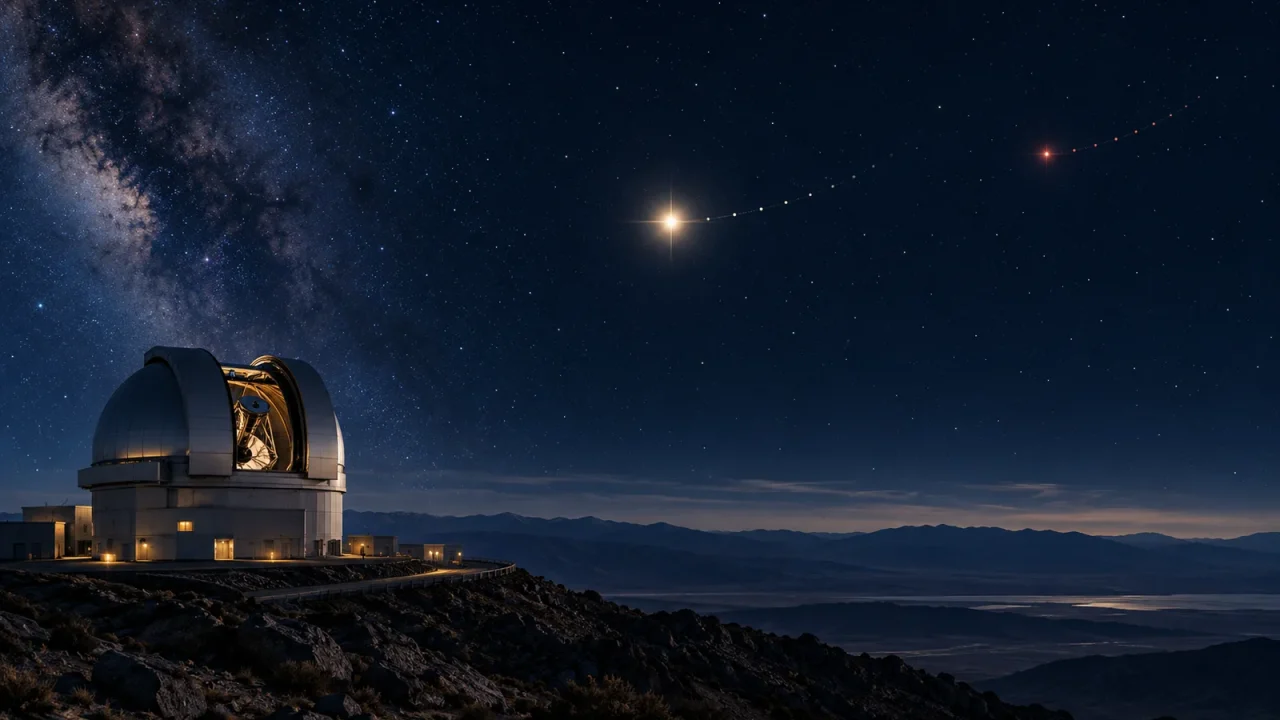
A 2025 study combined measurements from SPHERE with very precise astrometry from GRAVITY, an interferometric instrument at the Very Large Telescope Interferometer. GRAVITY combines light from multiple telescopes and can measure tiny relative position changes. Multiple epochs exposed motion that the bound-companion interpretation could not reproduce satisfactorily.
The researchers found that the object is best explained as a late-type M dwarf located more than 2 kiloparsecs behind YSES 2. A kiloparsec is about 3,262 light-years, so the inferred distance is thousands of light-years rather than the nearby distance of the foreground system. The study estimated a transverse speed around 300 kilometers per second and placed the star in a Galactic spiral arm.
The key signal was sub-milliarcsecond parallactic motion. A milliarcsecond is one-thousandth of an arcsecond—an angle so small that ordinary imaging cannot resolve it. With that precision, the background-star model explained the observations. The candidate therefore lost its status as a planet.
How common-proper-motion tests work
- Measure a candidate’s position. Researchers record its angular separation and position angle relative to the target star.
- Predict a background track. The foreground star’s known proper motion and parallax predict how a fixed background point would appear to move.
- Predict a bound track. A co-moving companion should remain close to the star’s motion, with plausible orbital curvature.
- Observe again. New epochs lengthen the baseline and shrink the range of paths that fit.
- Allow the background source to move. High-quality analysis fits its own proper motion and parallax instead of assuming zero.
- Compare models. Astrometry, photometry, and spectra jointly indicate which physical interpretation is supported.
A simple “co-moving or background” diagram can be useful, but nature is not limited to a motionless distant sky. YSES 2 b demonstrates why the background model may need extra parameters. Its large inferred transverse velocity made it an unusual contaminant, but unusual is not impossible in a field containing enormous numbers of stars.
What SPHERE contributed
SPHERE is designed for high-contrast imaging and spectroscopy. A coronagraph suppresses much of a bright star’s light, while adaptive optics corrects atmospheric distortion. Image-processing techniques subtract the star’s remaining glare and reveal faint nearby sources.
These methods are powerful but create complicated noise. Speckles produced by imperfect optics can resemble point sources. Rotation-based processing can alter the measured brightness or shape of real objects. Teams therefore inject artificial sources, calibrate instrument behavior, and test whether detections recur in independent data.
SPHERE detected and characterized the source well enough to motivate follow-up. Its result was a candidate interpretation based on the evidence then available. GRAVITY later supplied the differential astrometric accuracy needed to distinguish the two trajectories.
What GRAVITY changed
Interferometry treats separated telescopes as parts of a larger observing system. GRAVITY operates in near-infrared light and can perform precision astrometry in challenging environments. For this target, repeated relative measurements revealed a tiny parallactic signature inconsistent with a shared distance.
The instrument did not merely take a sharper beauty image. Its scientific value was metrology: determining where the source was at different times with exceptional precision. That illustrates a broader principle in astronomy—an object’s motion can identify its nature more decisively than its appearance.
Why brightness and color were not enough
A young giant planet and a cool red star can overlap in limited infrared measurements, especially when distance is initially assigned incorrectly. If researchers assume the faint source lies at YSES 2’s distance, its luminosity appears low enough for a planet. Put the same apparent light thousands of light-years away, and its true luminosity must be much greater, consistent with a star.
Dust extinction, metallicity, surface gravity, model assumptions, and filter coverage can complicate color comparisons. Spectroscopy can expose molecular or atomic features, but faint-source spectra may have low signal-to-noise. Astrometry supplies a largely independent constraint: do the two sources share distance and motion?
Was the original discovery “bad science”?
No. A candidate is a testable classification, not a promise that later data cannot change it. The original team compared available astrometry with a background hypothesis and published methods and uncertainties. Later researchers acquired better data, modeled a moving background source, and produced a stronger explanation.
Bad practice would be hiding contrary measurements, presenting uncertainty as certainty, or continuing to call the object confirmed after refutation. Updating catalogues and explanatory articles is part of the self-correcting process. The record now preserves both stages: why the planetary interpretation was plausible and why it was rejected.
What happened to the proposed formation puzzle?
When YSES 2 b was treated as a planet, its wide separation and low planet-to-star mass ratio invited explanations involving disk instability, core accretion plus outward scattering, or other dynamical histories. Those models no longer need to explain this particular object because the premise was wrong.
The broader formation questions remain relevant to genuine wide-orbit planets. Direct-imaging surveys have found real companions, and each system tests how disks fragment, how cores grow, and how planets migrate or scatter. Removing a false positive sharpens those population studies by preventing one background star from biasing statistics.
Why catalog status matters
Exoplanet catalogues are working scientific databases. They record discovery methods, parameters, references, and dispositions such as confirmed, candidate, controversial, or false positive. Researchers use those records to select targets and analyze populations, while journalists and educators use them to explain discoveries.
A stale page can propagate an obsolete claim through search results, classroom assignments, and automated summaries. For YSES 2 b, the responsible wording is direct: it was once reported as an exoplanet candidate, but current evidence identifies it as a background star. It should not be included in counts of confirmed planets.
How one false positive affects population studies
Directly imaged planets are rare compared with transit and radial-velocity discoveries, so each object can carry unusual statistical weight. Researchers use samples to estimate how often giant planets occupy wide orbits, how occurrence changes with stellar mass, and whether observed mass ratios favor one formation route. A contaminant left in a small sample can shift those estimates more than one error in a catalogue containing thousands of objects.
Survey teams therefore publish detection limits as well as detections. They estimate the probability that a background object lands inside the search region, test how efficiently their pipeline recovers artificial planets, and obtain follow-up when possible. Reclassifying YSES 2 b improves the denominator and numerator of later analyses: the survey still observed the star and reached a known sensitivity, but this source no longer counts as a planet.
The correction can also improve future target selection. The background M dwarf is now an astrometric object with an unusual inferred velocity rather than a useless blot. Its measurements can help researchers understand contaminants that other imaging programs may encounter.
Lessons for reading exoplanet announcements
- Check whether an object is called a candidate or a confirmed planet.
- Look for multiple observing epochs, not just a single detection.
- Ask whether the analysis allowed a moving background source.
- Distinguish projected separation from a fully determined orbit.
- Remember that mass and temperature inferred from brightness depend on age and distance.
- Check a current archive and the newest refereed follow-up, especially for unusual systems.
Frequently asked questions
Is YSES 2 b a confirmed exoplanet?
No. Precise follow-up astrometry showed that it is a distant background M dwarf. Current catalog treatment reflects the refutation.
Did YSES 2 b orbit YSES 2?
No evidence now supports a bound orbit. The alignment occurred along our line of sight, while the sources lie at very different distances.
Why did the answer take years?
Motion tests improve with elapsed time and repeated high-precision observations. Telescope access, instrument sensitivity, calibration, and analysis also set practical limits.
Can direct imaging still be trusted?
Yes, when detections are validated with astrometry, spectra, and repeated observations. The correction shows those safeguards working.
Does the star YSES 2 still exist?
Yes. The refutation concerns the supposed companion, not the foreground star itself.
Bottom line
YSES 2 b is not a planet. It is a distant M dwarf whose own motion initially helped it imitate a wide companion to a young nearby star. SPHERE revealed the source; multiple epochs and GRAVITY’s sub-milliarcsecond astrometry established its true nature. The episode is not an embarrassment to hide but a clear demonstration of how astronomy converts an appealing candidate into a tested conclusion.
Sources
- Astronomy & Astrophysics (2025): YSES 2b is a background star
- Astronomy & Astrophysics (2021): Original YSES 2 b report
- NASA Exoplanet Archive: YSES 2 overview
Evidence reviewed: October 16, 2026.