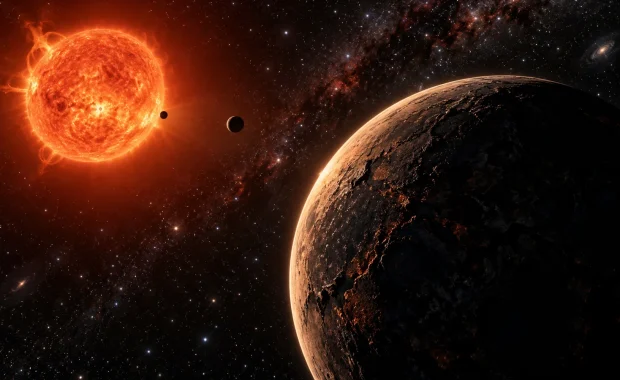
The YZ Ceti planetary system packs at least three low-mass worlds inside a region much smaller than Mercury’s orbit around the Sun. The planets complete years in roughly 2.02, 3.06, and 4.66 Earth days. Their host is a faint red dwarf only about 12.1 light-years away, making this one of the nearest laboratories for studying compact planetary architecture.
Nearby does not mean easy to see. None of the three planets has a confirmed transit or direct image. Astronomers discovered them by measuring motions of the star smaller than ordinary walking speed. Years of additional data were needed to distinguish their true orbital periods from aliases created by the timing of observations and to separate planetary signals from stellar activity.
The system at a glance
- YZ Ceti is an M4.5 V red dwarf about 3.712 parsecs from the Sun.
- At least three planets—b, c, and d—are supported by precision radial-velocity measurements.
- The 2020 favored periods are approximately 2.02, 3.06, and 4.66 days.
- Their measured minimum masses are about 0.70, 1.14, and 1.09 Earth masses.
- All three orbit too close to the star to be simple Earth analogues.
- No robust fourth planet was found in the expanded 2020 analysis.
Meet YZ Ceti
YZ Ceti, also catalogued as GJ 54.1, lies in the constellation Cetus. It has only about 14 percent of the Sun’s mass, 16 percent of its radius, and roughly 0.22 percent of its luminosity according to stellar parameters adopted in a detailed CARMENES study. Its effective temperature is about 3,151 kelvin, which places most of its output at redder and infrared wavelengths than the Sun’s.
The star is not simply a scaled-down quiet Sun. Like other mid-M dwarfs, it shows magnetic activity and flares. Photometric monitoring suggests a rotation period near 68 days. Spots and active regions moving across the stellar surface can distort spectral lines, making the star appear to wobble even when no planet causes the change.
Its proximity is scientifically useful. The star is bright enough for repeated precision spectroscopy, radio monitoring, and magnetic mapping. Yet the planets’ very small signals and non-transiting geometry make detailed characterization demanding.
Three planets compared
| Planet | Orbital period | Minimum mass | Orbit size | Estimated stellar flux |
|---|---|---|---|---|
| YZ Ceti b | about 2.02 days | 0.70 Earth masses | 0.0163 AU | 8.21 times Earth |
| YZ Ceti c | about 3.06 days | 1.14 Earth masses | 0.0216 AU | 4.72 times Earth |
| YZ Ceti d | about 4.66 days | 1.09 Earth masses | 0.0285 AU | 2.70 times Earth |
These values come from the circular-orbit model in the 2020 CARMENES reanalysis and have uncertainties. “Minimum mass” means M sin i, not necessarily the true mass. The table is a consistent comparison from one analysis, not a claim that every final digit is permanent.
How radial velocity revealed the system
A planet and star orbit their common center of mass. We do not see YZ Ceti’s planets directly; high-resolution spectrographs measure the star moving slightly toward and away from Earth. The resulting Doppler shifts repeat at the orbital periods.
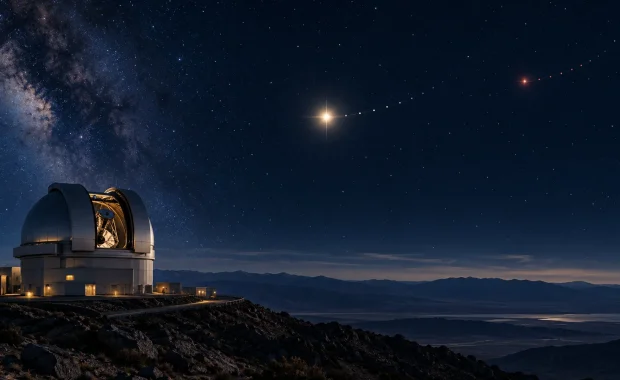
HARPS, mounted on the European Southern Observatory’s 3.6-meter telescope in Chile, supplied the observations behind the 2017 announcement. The CARMENES spectrograph in Spain later added extensive visible and near-infrared coverage. The combined analysis used hundreds of measurements and accounted for instrumental offsets.
The planetary velocity amplitudes are below about two meters per second. At that scale, calibration, Earth’s own motion, instrument changes, and the star’s surface behavior all matter. Reliable detection is a statistical pattern across many nights, not a single dramatic measurement.
The alias problem
Astronomers cannot observe a target continuously. Daylight, seasons, weather, telescope schedules, and visibility create gaps. Regular gaps imprint a “spectral window” on the data. A real periodic signal can then produce competing peaks in a periodogram, rather as a spinning wheel in a video can appear to turn at the wrong speed.
For YZ Ceti, aliases made several configurations seem possible. The original study favored about 1.97 days for planet b, while other analyses questioned whether all signals were unique. Planet c’s 3.06-day signal competed with a roughly 0.75-day alias; planet d’s 4.66-day signal had a shorter alternative.
The 2020 team injected synthetic signals into data sampled at the real observation times. It compared the heights and phases of the resulting alias peaks with the observations. This supported periods of 2.02, 3.06, and 4.66 days. It is a useful reminder that a periodogram’s tallest peak is not automatically the physical answer.
Separating star from planets
Starspots and magnetic regions rotate with the star and evolve. Their signals may appear in radial velocity, brightness, hydrogen emission, calcium lines, line width, and other activity indicators. Researchers examined several photometric datasets and spectroscopic tracers to estimate YZ Ceti’s rotation near 68 days.
The 2020 analysis modeled activity with a Gaussian process, a flexible statistical framework for correlated variation. The model was fitted together with three Keplerian planetary signals. No model removes uncertainty completely, but consistent short periods across instruments and a separate, much longer activity timescale strengthen the planetary explanation.
Continued measurement remains important. Stellar activity cycles can change, and apparently minor assumptions about eccentricity or correlated noise affect inferred masses. Published values should be read with their model and error bars.
Is there a fourth planet?
The discovery paper discussed a tentative additional signal near one day. Later analyses reached different conclusions about how many planets the data required. With the larger dataset, the 2020 team found no evidence supporting a fourth companion and retained the three-planet solution.
That does not prove no other planet exists anywhere around YZ Ceti. It means the tested data did not justify that particular additional signal. A smaller, longer-period, or unfavorably oriented planet could remain below detection limits. “At least three” is therefore more precise than claiming the system can contain only three.
An ultra-compact architecture
Planet d, the outermost of the three, orbits at only about 0.0285 astronomical units. Mercury’s average distance from the Sun is about 0.387 AU—more than thirteen times larger. All three YZ Ceti orbits would fit easily within a small fraction of Mercury’s orbit.
The period ratios place the system near a structured chain. Dynamical simulations in the 2020 study tested whether sampled solutions survived over one million orbits of the innermost planet. Only part of the initial Keplerian sample met that stability criterion, allowing dynamics to rule out some parameter combinations.
A subset of stable solutions showed libration of a three-body Laplace angle, which can indicate resonant behavior among all three planets. That is not the same as saying the system’s exact resonance is fully established. Better masses, eccentricities, and inclinations would clarify its dynamical state and formation history.
How might such a system form?
Young stars are surrounded by gas and dust disks. Small solids collide and grow, while gas and disk interactions can move forming planets inward. Compact systems may develop resonant chains during migration. After the disk disperses, gravitational interactions can preserve, reshape, or disrupt those relationships.
YZ Ceti’s low-mass planets and short periods fit the broad population of compact systems commonly found around red dwarfs. Detailed composition is unknown, so formation models cannot yet determine whether the planets assembled near their present orbits or migrated from colder regions.
Precise orbital eccentricities would help. Nearly circular, resonant orbits might preserve evidence of smooth disk migration, while larger eccentricities could point toward later interactions. Current radial-velocity signals are too delicate for a simple historical verdict.
Are the planets rocky?
The minimum masses are compatible with terrestrial-scale worlds, and population studies suggest planets in this mass range often have substantial rock and metal. But none of the YZ Ceti planets transits, so their radii and densities are unavailable. A true mass can also exceed the minimum if the orbital plane is tilted away from edge-on.
Calling them “rocky planets” is a reasonable model-informed possibility, not a direct measurement. Calling c or d a “super-Earth” describes mass class in some usage; it does not imply continents, oceans, or an Earth-like climate.
Habitability and irradiation
All three planets receive more energy than Earth. The 2020 model estimated about 8.21, 4.72, and 2.70 times Earth’s stellar flux for b, c, and d. Corresponding equilibrium temperatures were about 471, 410, and 357 kelvin under uniform assumptions that do not include a measured atmosphere.
Even planet d is interior to conventional habitable-zone estimates. Atmospheres, reflectivity, clouds, and circulation can change actual temperatures, but high irradiation and stellar activity make casual claims of habitability unjustified. “Nearby and Earth-mass” is not equivalent to “potential second Earth.”
No transits, no measured radii
TESS photometry did not reveal transits at the predicted periods. The system therefore lacks the powerful mass-plus-radius combination used to calculate density. Transit spectroscopy cannot currently probe the atmospheres, and orbital inclinations remain incompletely known.
The non-detection itself is useful: it excludes a narrow range of nearly edge-on configurations under the study’s assumptions. Dynamical stability excludes extremely low inclinations that would make the true masses too large. A wide middle range remains possible.
Why radio astronomers care
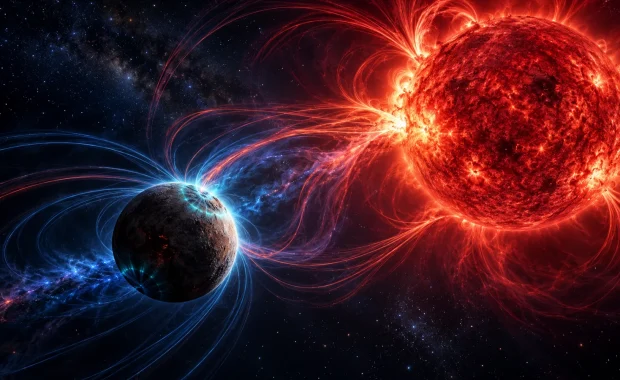
Coherent radio bursts observed from YZ Ceti have been investigated as possible signs of magnetic interaction between planet b and the star. If an orbiting planet repeatedly drives emission in the stellar magnetosphere, it could offer a new route to studying magnetic environments of terrestrial-scale planets.
The evidence is not conclusive, because an active red dwarf can generate radio bursts by itself. Repeated orbital-phase behavior, simultaneous flare monitoring, polarization, and improved stellar magnetic maps will be needed. The possibility adds a new layer to a system already valuable for dynamics.
How the three articles differ
This page focuses on the architecture of the full YZ Ceti planetary system. For the innermost world and radio evidence, read our detailed guide to YZ Ceti b. For the outer known planet, see what we know about YZ Ceti d. The separation prevents one general system article from obscuring planet-specific uncertainties.
Frequently asked questions
How many planets orbit YZ Ceti?
At least three are supported: b, c, and d. The expanded 2020 analysis did not support the proposed fourth signal.
Which planet is closest to the star?
YZ Ceti b, with a period about 2.02 days and orbit size near 0.0163 AU.
Which planet is largest?
Their radii are unknown. In the 2020 model, c has the largest minimum mass, but all three uncertainties overlap partly.
Can the planets be photographed?
Not with current direct-imaging capability. They are inferred from the star’s motion and lie extremely close to it on the sky.
Is this the nearest multiplanet system?
It was described as the nearest known multiplanet system when reported. Such rankings can change as new planets are discovered and confirmed, so current catalogues should be checked.
Bottom line
YZ Ceti hosts a compact trio of terrestrial-mass planets whose years last less than five days. Their discovery required precision radial velocity, careful alias testing, activity modeling, and dynamical checks. The system’s proximity makes it unusually accessible, but the lack of transits leaves radii, densities, atmospheres, and true masses uncertain. Its real scientific strength is not a claim of three Earth twins; it is the chance to study how tiny planets orbit and interact around one of our nearest red-dwarf neighbors.
Sources
- Astronomy & Astrophysics (2020): Detailed YZ Ceti system analysis
- Astronomy & Astrophysics (2017): Original discovery study
- NASA Exoplanet Archive: YZ Ceti system overview
Evidence reviewed: October 16, 2026.