
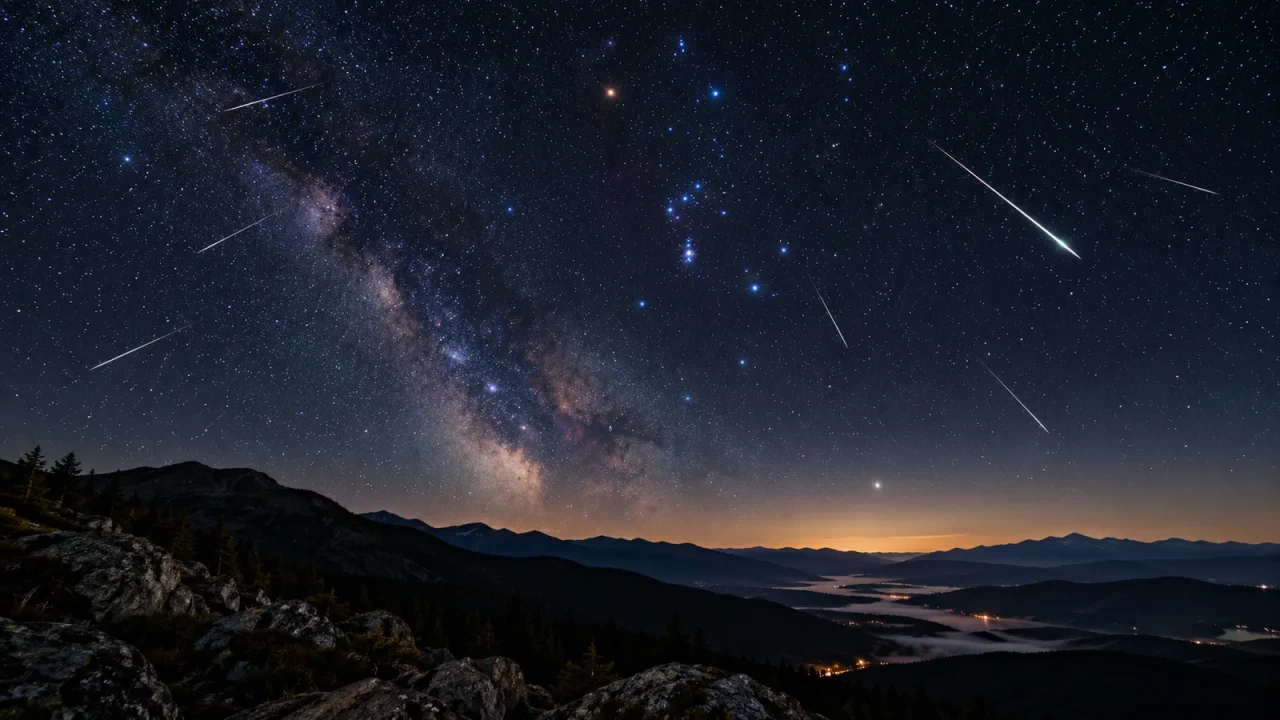
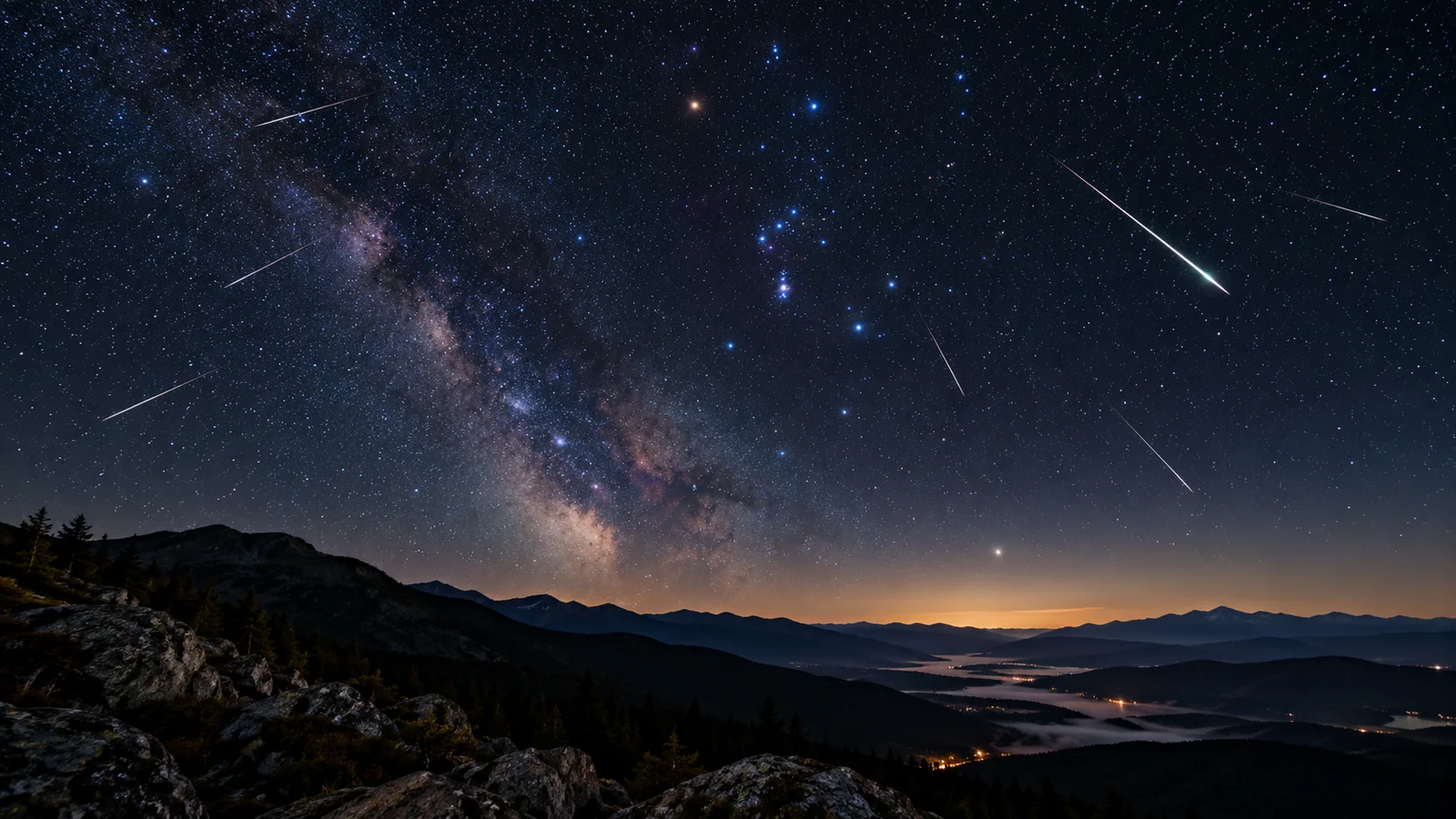
When and how can you see the Orionid meteor shower in 2026?
The Orionid meteor shower reaches its 2026 peak on the night of October 21 into the morning of October 22. The best opportunity comes in the few hours before dawn, after the bright waxing gibbous Moon has set. From a genuinely dark location, observers may see roughly 10 to 20 meteors per hour, although moonlight, clouds, city glow and local horizon conditions can reduce the visible count. No telescope is needed: find a wide view of the sky, let your eyes adapt to darkness and watch patiently.
The Orionids are especially interesting because every streak is produced by material shed by Halley’s Comet. Earth crosses that stream of dust each October, and the particles strike the atmosphere at about 66 kilometers per second. Their speed can create bright trains that linger briefly after the meteor itself disappears. This guide explains the timing, direction, equipment, weather checks and viewing strategy needed to make the most of the 2026 peak.
Quick facts for the 2026 Orionids
- Peak night: October 21–22, 2026.
- Best viewing window: the darkest hours after moonset and before morning twilight.
- Activity period: approximately October 2 through November 7.
- Typical dark-sky rate: about 10–20 meteors per hour near the peak.
- Parent comet: 1P/Halley, commonly called Halley’s Comet.
- Meteor speed: about 66 kilometers per second, or 41 miles per second.
- Equipment: none; binoculars and telescopes narrow the field of view and are not useful for meteor watching.
Why are the Orionids connected to Halley’s Comet?
A meteor shower occurs when Earth moves through a trail of small particles left along a comet’s orbit. Halley’s Comet releases dust and rocky grains as solar heating turns frozen material on its surface into gas. Those particles spread along the comet’s path. When Earth intersects the stream, individual grains enter the upper atmosphere at extreme speed, compressing and heating the air around them until a bright streak becomes visible.
The particle is called a meteoroid while it remains in space, a meteor while the glowing event appears in the atmosphere, and a meteorite only if a fragment survives to reach the ground. Orionid particles are generally tiny and fast, so the visible display usually comes from atmospheric heating rather than large objects striking the surface. The annual shower is therefore a predictable sky event, not a sign that Halley’s Comet itself is approaching Earth.
Halley’s orbit also produces the Eta Aquariid meteor shower in May. The two showers happen when Earth passes through different portions of the same broad debris stream. That connection allows observers to experience the legacy of a famous comet even though Halley itself will not return to the inner solar system until 2061. Readers interested in other deep-sky phenomena can also explore how hypersoft X-ray sources reveal hidden stellar systems.
What time should you watch the Orionids in 2026?
The most favorable period is usually after local midnight, when the radiant in Orion rises higher, but the Moon changes the practical answer in 2026. NASA notes that a bright waxing gibbous Moon will wash out many faint meteors early in the night. The strongest viewing window should open after the Moon sets and before dawn begins to brighten the sky. Exact moonset and twilight times vary by location, so use a reputable astronomy app or local observatory timetable for your coordinates.
Do not treat the published peak as a single minute. Meteor activity rises and falls gradually, and the Orionids remain active for weeks. If clouds cover the peak night, try the mornings immediately before or after it. Rates may be lower, but a clear dark sky is often more productive than a nominal peak observed through haze or heavy light pollution.
| Viewing factor | Best choice | Why it matters |
|---|---|---|
| Time | After moonset, before dawn | Less lunar glare and a higher radiant improve visibility |
| Location | Dark rural site with open horizon | Artificial light hides faint meteors |
| Direction | Broad sky, roughly 45–90 degrees from Orion | Meteors away from the radiant often show longer trails |
| Adaptation | At least 20–30 minutes without bright light | Eyes need time to become sensitive in darkness |
| Comfort | Reclining chair, warm layers and patience | Comfort makes sustained observation easier |
Where in the sky should you look?
The shower’s radiant lies near Orion, just north of the bright reddish star Betelgeuse. The radiant is the perspective point from which Orionid paths appear to diverge. It identifies the shower, but it is not necessarily the best place to stare. Meteors close to the radiant can look short because they approach almost head-on. Trails farther away often appear longer and more dramatic.
Choose a position with as much unobstructed sky as possible and look about halfway up, away from the Moon and major sources of light. In the Northern Hemisphere, Orion climbs through the eastern and southeastern sky after rising. In the Southern Hemisphere, the constellation is also visible, but its orientation differs. The essential technique remains the same: identify Orion for context, then scan a broad area instead of locking your eyes on one star.
A phone can help locate Orion at the beginning of the session, but repeated screen use destroys dark adaptation. Enable a dim red display if the app provides one, reduce brightness fully and put the device away once oriented. A printed chart or a red-filtered flashlight is even less disruptive.
How can you choose a dark and safe viewing site?
Darkness is the most important variable you can control. A suburban observer may see only a handful of the brightest meteors, while the same shower under a rural sky reveals many fainter streaks. Look for a public observing field, astronomy club site, campground or legal roadside viewpoint away from direct lamps. Check opening hours, access rules and parking conditions in daylight.
Safety should come before an ideal horizon. Avoid private land, unstable cliffs, isolated road shoulders and areas with wildlife warnings. Tell someone where you are going, bring a charged phone, carry water and dress for temperatures colder than the daytime forecast suggests. Dew can form quickly, so a waterproof ground layer is useful. If driving, never stop suddenly because a meteor appears.
What equipment improves meteor watching?
Your eyes are the correct instrument because they cover a wide field. A telescope or binoculars magnify a tiny area and make it less likely that a random streak will cross the view. Useful equipment is mostly about comfort: a reclining chair or insulated mat, warm clothing, a blanket, insect protection where necessary and a thermos. A red flashlight preserves night vision better than white light.
For photography, use a camera with manual controls, a stable tripod, a wide and relatively fast lens, and an interval timer. Start with a wide aperture, a high but manageable ISO and an exposure short enough to keep stars reasonably sharp. The exact settings depend on sensor performance, focal length and sky brightness. Shoot repeated frames rather than trying to react to individual meteors. Include landscape context, but keep bright towns outside the frame.
Do not confuse satellites, aircraft or Starlink trains with meteors. Meteors usually appear suddenly, cross part of the sky in less than a second and vanish. Aircraft blink rhythmically, while satellites move steadily for much longer. A meteor may leave a glowing train that fades or changes shape in upper-atmospheric winds.
How do weather and light pollution change the result?
A forecast labeled “clear” is not always enough. High thin cloud, smoke, humidity and airborne dust can scatter light and reduce transparency. Review cloud cover by altitude, visibility and dew point rather than precipitation alone. A location on the darker side of a city can be substantially better because the main light dome remains behind you.
The quoted rate of 10–20 meteors per hour describes favorable dark-sky conditions, not a guarantee for every observer. The zenithal hourly rate used by meteor organizations is a standardized figure that assumes an ideal sky and the radiant overhead. Real-world counts are commonly lower. Trees, buildings, moonlight and time spent looking away all reduce the number recorded.
Can you observe the Orionids from a city?
Yes, but expectations should be realistic. Choose the darkest nearby park or rooftop that is legal and safe, block direct lights with a wall or tree, and watch after the Moon has set. Allow full dark adaptation and concentrate on the upper sky rather than the illuminated horizon. You may miss faint meteors, but the Orionids’ high speed can still produce conspicuous bright events.
If travel is impossible, make the session a structured observation. Record the start and end time, cloud percentage, limiting star visibility and the number of likely Orionids. Even modest data can teach how conditions influence what the eye detects. The Solar system archive offers additional background for planning future skywatching sessions.
Frequently asked questions about the 2026 Orionids
Will the 2026 Orionid meteor shower be visible worldwide?
The Orionids can be observed from both hemispheres wherever Orion rises and the weather is clear. Local timing, latitude, moonset and light pollution determine the quality of the view. Check an astronomy planner for the darkest pre-dawn interval at your location.
Do I need to look directly at Orion?
No. Orion identifies the radiant, but meteors can appear anywhere. Looking 45–90 degrees away from the radiant and about halfway up the sky often reveals longer trails while keeping a large area in view.
How long should I watch?
Plan at least one hour after dark adaptation. Meteors arrive unevenly, with quiet intervals followed by several events. A five-minute glance is not a reliable measure of the shower’s activity.
Can the Orionids be dangerous?
The visible particles are normally tiny and burn high in the atmosphere. The practical risks come from nighttime travel, cold weather and unsafe viewing locations, not from watching the meteor shower.
What if October 21 is cloudy?
Observe on a nearby clear morning. The shower remains active from early October into early November, and activity around the peak declines gradually rather than ending immediately.
The practical takeaway for the Orionid meteor shower 2026
How can you record a useful meteor observation?
A simple observing log makes the session more informative. Note your location, local start and end times, cloud cover, nearby lights and the faintest stars you can see. For each meteor, record the approximate time, brightness, direction of travel, color and whether a train remained visible. Do not assume every streak is an Orionid: trace the path backward mentally and see whether it points toward Orion. Sporadic meteors travel in unrelated directions. Formal meteor organizations publish standardized methods for observers who want to contribute counts, but even a personal log helps compare nights and understand how moonlight and transparency influence results.
The winning plan is simple: check local moonset and weather, reach a safe dark site before the best pre-dawn window, avoid bright screens and watch a wide area of sky for at least an hour. The bright Moon makes timing more important in 2026, but it does not erase the shower. Patient observers can still see fast debris from Halley’s Comet create brief, beautiful trails across the October sky.