
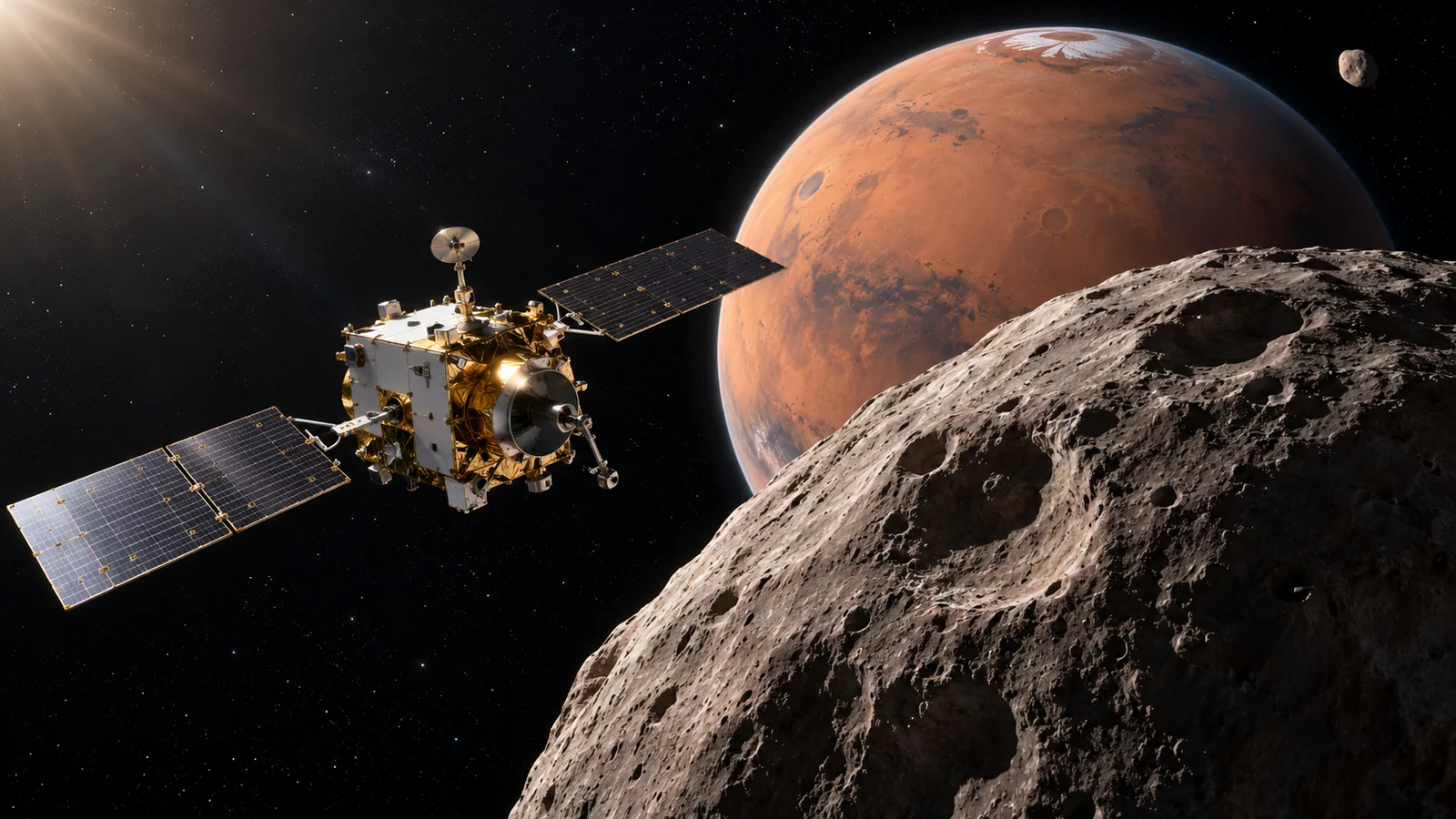
Japan’s MMX mission is now on its way to answer one of the most persistent questions in planetary science: where did Mars’s two small moons come from? The Martian Moons eXploration spacecraft launched successfully in October 2026 and is scheduled to enter the Martian system in 2027. Its defining objective is audacious but precise—collect at least 10 grams of material from Phobos and return the sealed sample to Earth in 2031.
If the mission succeeds, MMX will deliver the first laboratory sample from a Martian moon. Researchers will be able to test whether Phobos is a captured asteroid, the remains of a giant impact, or a product of material once orbiting early Mars. The answer could rewrite the history of the inner Solar System and improve the way future missions navigate and operate around small, low-gravity worlds.
MMX mission at a glance
| Mission element | Current plan |
|---|---|
| Lead agency | Japan Aerospace Exploration Agency (JAXA) |
| Launch | October 2026 |
| Mars-system arrival | 2027 |
| Primary target | Phobos, the larger Martian moon |
| Secondary target | Deimos observations and flybys |
| Planned sample | At least 10 grams of Phobos material |
| Surface scout | The Franco-German Idefix rover |
| Expected Earth return | 2031 |
These dates are mission targets rather than guarantees. Interplanetary operations depend on spacecraft health, navigation performance and the conditions engineers find after arrival. The authoritative place to follow schedule changes is the official JAXA MMX mission website.
Why Phobos and Deimos are scientific puzzles
Phobos and Deimos look modest beside Earth’s Moon. Both are dark, irregular bodies, and Phobos is only about 22 kilometers across at its widest dimension. Their appearance resembles primitive asteroids, which supports the idea that Mars captured them long ago. Yet capture is dynamically difficult. A passing asteroid would need to lose exactly the right amount of energy to settle into a stable, nearly circular orbit around Mars.
An alternative explanation starts with a major collision. A large object may have struck young Mars, throwing rock and vapor into orbit. A temporary disk could then have produced several moons, most of which later fell back to the planet, leaving Phobos and Deimos behind. A related model suggests that orbiting debris may have repeatedly formed and broken apart over billions of years. Orbital measurements alone cannot decisively choose among these histories.
That is why a returned sample matters. The minerals, elemental ratios and isotopic signatures inside a few grams of regolith can preserve evidence that remote instruments cannot resolve. Material resembling carbon-rich asteroids would favor capture. Material chemically related to Martian crust or mantle would strengthen an impact-origin model. The final interpretation may be more complicated—for example, indigenous Phobos material mixed with particles blasted off Mars by later impacts.
How the Phobos sample return will work
After reaching Mars, MMX will not enter a conventional tight orbit around Phobos. The moon’s gravity is too weak and the gravitational environment around Mars too complex for that simple picture. Instead, the spacecraft will use carefully designed quasi-satellite orbits that keep it near Phobos while it remains fundamentally in orbit around Mars. From those paths, cameras and spectrometers will map the surface, measure its composition and identify safe sampling areas.
Engineers must then bring a large spacecraft close to a rugged body whose gravity is roughly two-thousandths of Earth’s. The sampling operation is closer to a controlled touch-and-go than a familiar landing. Contact forces that seem small on Earth can push a vehicle away from Phobos, while loose dust can obscure sensors or contaminate mechanisms. MMX is designed to collect material at more than one site, improving the chance that scientists receive a representative sample rather than one unusual patch.
Once the sample is secured, the return module must survive the trip back to Earth and atmospheric entry. A controlled recovery will transfer the capsule into a tightly managed curation chain. The samples will be catalogued, protected from terrestrial contamination and allocated gradually to qualified research teams. The scientific return will therefore continue for decades, as new analytical tools become sensitive enough to revisit material preserved in storage.
What the Idefix rover will do on Phobos
Before the main spacecraft attempts its most demanding surface work, a small rover named Idefix is expected to descend to Phobos. Developed by France’s CNES and the German Aerospace Center, the rover will demonstrate movement in extremely weak gravity, photograph the terrain at close range and examine physical properties that orbital observations cannot reveal. Its findings can help mission controllers understand how cohesive, rough or dusty the surface really is.
Locomotion is a science experiment in its own right. On Earth, a wheel presses firmly against the ground; on Phobos, excessive acceleration could make a rover lose contact or tumble. Idefix must move slowly and deliberately while remaining stable on uncertain slopes. Successful operations would inform later explorers of asteroids, comets and other small moons. CNES provides additional technical context on its MMX project page.
The international instruments behind MMX
Although JAXA leads MMX, the payload reflects broad international cooperation. NASA is contributing the MEGANE gamma-ray and neutron spectrometer, designed to investigate the elemental composition of Phobos. NASA also supports a pneumatic sampling system and deep-space communications. European partners contribute the rover and scientific expertise, while other teams supply instruments for imaging, mineralogy, dust monitoring and the Martian environment.
This distributed approach is more than diplomatic symbolism. Returned-sample missions require expertise across propulsion, autonomous navigation, planetary protection, spectroscopy, geology and high-containment curation. Sharing instruments and tracking capacity reduces duplication and lets specialist teams focus on the measurements they understand best. NASA’s overview of its contributions is available through the agency’s MMX mission briefing.
What scientists can learn from 10 grams
Ten grams may sound trivial, but modern laboratories can make hundreds of measurements on far smaller quantities. Researchers can examine grains under electron microscopes, determine precise isotopic ratios, identify organic compounds, date mineral formation and measure exposure to cosmic radiation. Different techniques consume different amounts, so curators create a careful allocation plan and preserve untouched portions for future generations.
- Origin: chemical fingerprints can distinguish primitive asteroid material from rock derived from Mars.
- Age: radiometric dating can constrain when source materials formed and when major impacts occurred.
- Space weathering: altered grain surfaces reveal how radiation and micrometeorites transform airless bodies.
- Martian ejecta: impacts on Mars may have deposited tiny fragments on Phobos, creating an accidental archive of multiple Martian regions.
- Water and organics: sensitive analysis can test for volatile-bearing minerals and carbon compounds without assuming a biological origin.
The possibility of Martian ejecta is especially valuable. A rover on Mars samples one location, but Phobos may have swept up debris launched from widely separated parts of the planet over a long period. Even if those grains make up only a small fraction of the returned material, they could provide a diverse record of crust that no single surface mission could visit.
Why MMX matters for understanding habitable worlds
The moon’s origin is connected to a larger question: how did water and carbon-rich material reach the rocky planets? If Phobos is a captured primitive asteroid, its composition may reveal what kinds of small bodies migrated through the early inner Solar System. If it formed from a Martian impact, its minerals may instead record the violent evolution of a planet that once had rivers, lakes and a thicker atmosphere.
Neither outcome proves that life existed on Mars. MMX is not primarily a life-detection mission, and organic molecules are not automatically biological. Its value lies in reconstructing physical and chemical conditions that shaped potentially habitable environments. Scientists can combine MMX results with meteorites, asteroid samples and Mars rover data to build a more coherent timeline of planetary formation.
How MMX compares with other sample-return missions
Japan already demonstrated small-body sample return with Hayabusa and Hayabusa2, which brought material from asteroids Itokawa and Ryugu. NASA’s OSIRIS-REx returned a sample from Bennu in 2023. Those missions proved that pristine extraterrestrial grains can transform laboratory science. MMX builds on their heritage but adds the challenge of operating deep inside the Martian system and investigating a moon whose surface may include material from a nearby planet.
MMX should not be confused with proposed Mars Sample Return architectures designed to retrieve tubes collected by NASA’s Perseverance rover. Phobos material and carefully selected Martian rock answer different questions. One records the history of a small moon and possibly broad Martian ejecta; the other targets geologically documented sites inside Jezero Crater. Scientific value is complementary, not competitive.
The hardest engineering risks ahead
A successful launch is only the opening milestone. MMX must complete interplanetary navigation, brake into the Martian system, deploy its rover, select sampling zones and conduct close operations around a poorly understood surface. Communications delays mean the spacecraft needs autonomy when events unfold too quickly for controllers on Earth. Dust behavior, surface strength and illumination may differ from preflight models.
The return journey adds another chain of dependencies. Sampling hardware must retain material without compromising the seal, propulsion systems must perform after years in space, and the capsule must reach a safe recovery area on Earth. Mission teams plan alternatives because a partial success—such as detailed orbital mapping without a returned sample—could still produce important science. Nevertheless, the 2031 capsule return remains the result that would distinguish MMX historically.
What to watch between now and 2031
- Arrival and orbit insertion: confirmation that MMX has entered the Martian system safely.
- First global maps: sharper views of Phobos geology, boulders, grooves and candidate sampling regions.
- Idefix deployment: surface images and mobility results from the small rover.
- Sampling confirmation: evidence that the collection mechanisms operated as planned.
- Departure from Mars: the start of the sample capsule’s journey home.
- Earth recovery: safe retrieval and transfer into curation in 2031.
Readers should treat dramatic early interpretations cautiously. Images can reveal geology, but the origin debate may remain open until laboratories compare multiple independent chemical and isotopic measurements. Even then, a mixed sample could support a more complex history than either “captured asteroid” or “impact moon” alone.
Frequently asked questions
Has MMX already landed on Phobos?
No. The spacecraft launched in October 2026 and is traveling toward Mars. Arrival, detailed reconnaissance, rover deployment and sampling are later mission phases.
Is MMX bringing samples directly from Mars?
Its planned sample comes from Phobos. Some grains may have originated on Mars and reached the moon as impact ejecta, but that will have to be established through laboratory analysis.
When will the Phobos sample reach Earth?
JAXA’s current mission plan targets 2031. Interplanetary schedules can change in response to spacecraft performance and operational conditions.
The bottom line
The MMX mission turns a deceptively simple question—where did Mars’s moons come from?—into a carefully staged journey across hundreds of millions of kilometers. By combining orbital mapping, close surface reconnaissance and laboratory analysis of a returned Phobos sample, it can connect the history of a tiny moon to the evolution of Mars and the delivery of important materials across the young Solar System.
For more planetary science, explore our Solar System coverage and our feature on how X-ray observations reveal hidden stellar processes. The mission has already cleared its first public test with a successful launch; the decisive chapters—Phobos operations, sampling and Earth return—are still ahead.