
 Free Source Library — Exploring the extraordinary lives and enduring legacies of some of history’s most influential Muslim scholars reveals a tapestry of innovation, discovery, and cultural enrichment.
Unveiling the Golden Age of Islamic Scholarship
The period popularly known as the Islamic Golden Age, spanning roughly from the 8th to the 14th century, represents a pinnacle of intellectual achievement. Occurring against a backdrop of expansive empires such as the Abbasids, Umayyads, and later the Mamluks, this era blossomed into a vibrant hub of knowledge, innovation, and cultural exchange. Scholars from across the Islamic world—Persia, Arabia, North Africa, and beyond—transformed their societies through advancements in science, philosophy, medicine, and the arts. Their pioneering efforts not only fortified Islamic civilization but also became a vital bridge to the European Renaissance, leaving an indelible mark on global intellectual history. This deep dive aims to bring light to some of the most remarkable Muslim scholars—whose pursuits and discoveries continue to influence contemporary science and thought. Their stories echo as testaments to curiosity, perseverance, and the unwavering spirit of inquiry.
The Pioneering Minds of the Islamic Golden Age
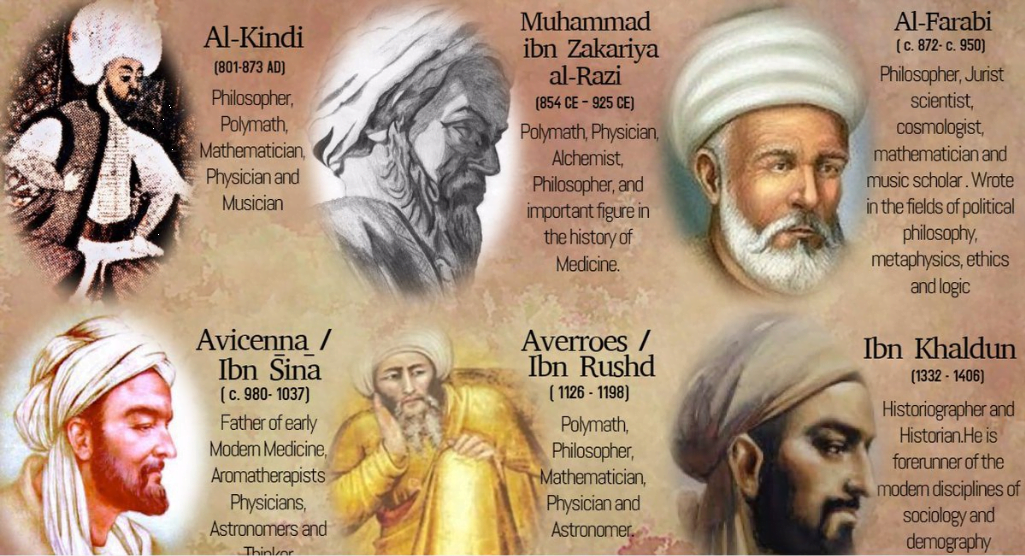
Ibn Sina (Avicenna): Medicine and Philosophy’s Titan
Early Life and Context
Born in 980 CE in Bukhara, a bustling center of learning in what is now Uzbekistan, Ibn Sina’s journey into the world of knowledge was precocious. Emerging from a background of modest means, he demonstrated prodigious talent early, mastering logic, medicine, and philosophy by the age of twenty. His education was broad, encompassing classical Greek, Persian, and Islamic sciences, which provided the foundation for his later groundbreaking works.
Medical Mastery and Lasting Contributions
Ibn Sina’s magnum opus, The Canon of Medicine, exemplifies a systematic approach that synthesizes classical knowledge with empirical observations. It was a comprehensive clinical text covering anatomy, pharmacology, pathology, and therapeutics, and became the definitive medical authority for centuries across Europe and the Islamic world. Its influence extended beyond theory—many of Ibn Sina’s insights anticipated modern medical practices, including the importance of clinical observation and diagnosis. He proposed foundational ideas about contagious diseases, the importance of sterilization, and the use of experimental methods in medicine. Modern medical curricula still reference his classifications of diseases and his emphasis on systematic diagnosis.
Philosophical and Scientific Impact
Beyond medicine, Ibn Sina authored influential philosophical treatises, particularly in metaphysics, ethics, and logic. His integration of Aristotelian philosophy with Islamic thought created a coherent philosophical system, which later European thinkers systematized. His works catalyzed debates on rationalism vs. faith, influencing Christianity’s Scholasticism and Jewish philosophy.
Ibn Rushd (Averroes): The Rationalist Philosopher
His Background and Intellectual Climate
Born in 1126 CE in Cordoba, a thriving cultural and intellectual hub in medieval Spain, Ibn Rushd inherited a rich tradition of classical learning. He was trained in law, medicine, and philosophy, and served as a judge and physician. His environment was one of synthesis—bridging Islamic, Christian, and Jewish traditions.
Re-Introduction of Aristotle and Philosophy
Ibn Rushd’s renowned commentaries on Aristotle’s works sought to reconcile reason with religious doctrine. His philosophy underscored the harmony between faith and reason, emphasizing that truth ultimately resides in the pursuit of knowledge through rational inquiry. His works sparked fierce debates and challenged dogmatic authorities, sometimes inviting persecution. Nonetheless, they profoundly influenced Western thought, especially during the European Renaissance, where his interpretations of Aristotle became pivotal in reintroducing classical philosophy to Europe.
Impact on Science and Law
In addition to philosophy, Ibn Rushd contributed to medicine and jurisprudence. His holistic worldview promoted a rational approach to understanding the universe, emphasizing that scientific investigation was compatible with religious belief—a concept that remains integral to scientific inquiry today.
Al-Khwarizmi: The Father of Algebra and Algorithmic Thought
Origins and the Spin of Ideas
Born around 780 CE in Khwarazm (present-day Uzbekistan), Al-Khwarizmi’s intellectual journey led him to Baghdad’s House of Wisdom, a renowned center for knowledge translation and scholarship. His works synthesized mathematical traditions from India, Greece, and Persia, creating innovative frameworks that transformed mathematical thinking.
The Birth of Algebra and Numerical Methods
His treatise, The Compendious Book on Calculation by Completion and Balancing, introduced systematic methods for solving linear and quadratic equations, laying the groundwork for algebra—a term derived from his Latinized name, “Algoritmi.” His emphasis on symbolic computation and step-by-step procedures marked a fundamental shift from rhetorical mathematics to a more rigorous, formal discipline. He also popularized the use of Hindu-Arabic numerals across the Islamic world and later Europe, replacing cumbersome Roman numerals. This numeral system was crucial for the development of modern mathematics and commerce.
Contributions to Trigonometry and Geography
Al-Khwarizmi’s work extended to astronomy, where he recalculated planetary positions and improved astronomical tables. His geographic works provided detailed maps and measurements, advancing the understanding of the world’s size and shape.
Ibn al-Haytham (Alhazen): The Father of Modern Optics
Early Innovations and Scientific Method
Born in 965 CE in Basra, Ibn al-Haytham distinguished himself with meticulous experimentation and observation. His systematic approach to science, emphasizing hypothesis testing and reproducibility, became the bedrock of the scientific method.
The Book of Optics
His seminal work, Kitab al-Manazir (Book of Optics), challenged the ancient Greek theories, such as the emission theory of vision, by demonstrating that vision results from light reflecting into the eyes. His experiments with lenses, refraction, and light intensity laid foundational principles that would be integral to optics for centuries. His work influenced later scientists like Kepler and Galileo, widening understanding of how light interacts with objects, and materially advancing the fields of physics and astronomy.
Broader Scientific and Mathematical Contributions
Ibn al-Haytham’s mathematical explorations helped analyze geometrical properties of light paths, and his investigations into the spectral qualities of sunlight anticipated later developments in spectroscopy and color theory.
Ibn Battuta: The Voyager of the Medieval World
Journey and Exploration
Born in 1304 CE in Tangier, Morocco, Ibn Battuta’s curiosity took him on epic journeys across Africa, Asia, and beyond. Over nearly 30 years, he traveled an estimated 75,000 miles, visiting over 40 modern countries, including India, China, Southeast Asia, the Middle East, and Sub-Saharan Africa.
The Rihla: A Window into Medieval Civilizations
His travelogue, The Rihla, documents not just his journeys but provides detailed accounts of the diverse cultures, customs, political systems, and religious practices he encountered. His writings serve as precious historical sources, reflecting the interconnectedness of medieval Eurasia.
Legacy of Exploration and Cultural Exchange
Ibn Battuta exemplifies the spirit of inquiry and the importance of cultural empathy. His methods of eyewitness reporting and recording societal customs helped shape ethnography, and his travels fostered diplomatic and commercial exchanges.
Al-Biruni: The Multidisciplinary Scholar
Multi-field Expertise and Methodology
Born in 973 CE in Khwarezm, Al-Biruni was a polymath whose work traversed astronomy, mathematics, geography, anthropology, and history. His rigorous approach integrated mathematical calculations with detailed observation.
Measuring the Earth and Understanding Cultures
Al-Biruni’s most famous achievement involved calculating Earth’s circumference with remarkable accuracy, using geometric methods. His endeavors to understand Indian culture led to detailed studies of religion, customs, and sciences, providing one of the earliest descriptions of Indian society for the Islamic world.
Impact on Science and Cultural Knowledge
His integration of sciences and humanities set a standard for multidisciplinary scholarship. His works continue to be referenced in modern anthropology, history, and science, especially for their methodological precision.
Omar Khayyam: The Poet-Scientist
Early Life and Dedication to Science
Born in Nishapur in 1048 CE, Khayyam was a mathematician and astronomer dedicated to understanding celestial movements. His work in re-calculating the solar year and refining the Jalali calendar was crucial for astronomical precision.
The Rubaiyat and Literary Impact
While his scientific work is noteworthy, Khayyam’s enduring fame rests on his poetry, particularly the “Rubaiyat,” a collection of quatrains. These poems delve into existential reflections, questioning fate, mortality, and the fleeting nature of life. His poetic voice resonates across cultures, inspiring translations and adaptations worldwide.
Blending Science and Literature
Khayyam exemplifies the harmony between scientific rigor and poetic insight, embodying a Renaissance ideal centuries before its European counterpart.
The Enduring Legacy and Influence of Muslim Scholars
The cumulative achievements of these scholars and their contemporaries transformed the trajectory of human knowledge. Their legacies can be summarized through several key impacts:
- Foundations for Modern Science: Methodical experimentation, empirical observation, and mathematical modeling pioneered during this era underpin contemporary scientific inquiry.
- Transmission of Knowledge: Their works were translated into Latin and other languages, becoming vital texts in medieval Europe and shaping the Renaissance’s intellectual awakening.
- Inspiration for Future Generations: Their curiosity and scholarly rigor continue to motivate scientists, philosophers, and writers today, emphasizing the importance of multidisciplinary inquiry.
- Cultural and Diplomatic Bridges: Their journeys and writings fostered a greater understanding across civilizations, contributing to a shared human heritage.
Practical Frameworks for Appreciating Their Contributions
Understanding their impact can be enhanced by engaging with practical methods:
- Studying Original Texts: Dive into translated works and commentaries to appreciate their methods and insights deeply.
- Comparative Analyses: Examine how their theories influenced European developments, such as algebra’s evolution or optical science.
- Case Studies: Review historical episodes—like the transmission of Arabic mathematical texts to Europe—to trace knowledge flow.
Common Challenges and Misconceptions
Despite their importance, the history of Muslim scholarship is often misunderstood or underrepresented. Some common issues include:
- Overgeneralization: Assuming a monolithic “Islamic Scientific Tradition” overlooks regional, cultural, and chronological nuances.
- Neglecting Non-Muslim Contributions: Recognizing the role of other civilizations in shaping collaborations and knowledge exchange remains vital.
- Eurocentric Bias: Historically, European narratives have marginalized contributions from the Islamic world; addressing this gap is essential for a balanced understanding.
Troubleshooting and Deeper Engagement
To fully appreciate these scholars’ enduring influence, consider the following approaches:
| Challenge | Solution | Recommended Resources |
|---|---|---|
| Lack of Access to Original Texts | Seek reliable translations and scholarly commentaries; participate in academic courses or online lectures. | Islamic Classics in Translation |
| Difficulty Connecting Historical Discoveries with Modern Science | Create timelines linking their innovations with contemporary scientific milestones. | Science Timeline of Islamic Contributions |
Frequently Asked Questions
How did Muslim scholars preserve and transmit ancient knowledge?
During the Golden Age, scholars translated Greek, Persian, and Indian texts into Arabic, creating hubs of research like Baghdad’s House of Wisdom. They critically analyzed, expanded, and documented this knowledge, which later spread to Europe through various routes, including Spain and Sicily.
What role did religion play in their scientific pursuits?
Islamic scholars generally saw no contradiction between faith and reason. Many believed that understanding the universe was a form of worship, motivating extensive research in natural sciences. Their work often sought to harmonize religious teachings with empirical observations.
Are their works still relevant today?
Absolutely. The principles of scientific methodology, advances in medicine, and mathematical techniques rooted in their studies continue to underpin modern science and technology. Their multidisciplinary approach remains a model for holistic inquiry.
Deepening the Connection: Examples and Case Scenarios
Case Scenario 1: Reintroducing Algebra in Europe
Imagine the transformative moment when European scholars, inspired by Al-Khwarizmi’s texts, begin to replace cumbersome Roman numerals with the Hindu-Arabic system. This shift enables complex calculations, leading to innovations in navigation, architecture, and engineering, culminating in the discoveries of the Age of Exploration.
Case Scenario 2: Scientific Method Development
Consider Ibn al-Haytham’s experiments with light—his insistence on reproducibility and evidence sets the stage for later scientific experiments by Galileo and Newton. This methodology becomes the cornerstone of modern physics, leading to breakthroughs in optics, astronomy, and beyond.
Comparative Summary Table: Key Contributions of Selected Muslim Scholars
| Scholar | Fields of Contribution | Core Innovations | Long-term Impact |
|---|---|---|---|
| Ib n Sina | Medicine, Philosophy, Science | Canonical medical encyclopedia, rationalist philosophy | Foundation of Western medicine and Scholastic philosophy |
| Ibn Rushd | Philosophy, Law, Medicine | Commentaries on Aristotle, rationalist integration of faith and reason | Influence on European Renaissance thinkers |
| Al-Khwarizmi | Mathematics, Astronomy, Geography | Algebra, algorithms, improved cartography | Modern mathematics, computer science roots |
| Ibn al-Haytham | Optics, Physics, Mathematics | Study of light and vision, scientific method | Foundation of experimental science and optics |
| Ibn Battuta | Travel, Anthropology, Geography | Detailed ethnographic travelogue | Historical understanding of medieval Islamic worlds |
| Al-Biruni | Geography, Astronomy, Anthropology | Earth’s circumference, cultural studies of India | Multidisciplinary scholarly standards |
| Omar Khayyam | Mathematics, Astronomy, Poetry | Refined astronomical calculations, poetic reflections | Influence on both science and literature |
Celebrating Their Legacy Today
The enduring influence of these scholars underscores a universal truth: the pursuit of knowledge transcends borders and epochs. Modern educational institutions increasingly recognize their contributions through dedicated courses, research centers, and cultural heritage initiatives. Contemporary scientists, philosophers, and writers draw inspiration from their methods—prioritizing curiosity, rigorous inquiry, and the integration of diverse fields. Promoting cross-cultural understanding, their stories exemplify the value of intellectual humility and collaborative progress.
Final Reflection
The lives of these eminent Muslim scholars exemplify a profound commitment to expanding human understanding. Their pioneering work demonstrates that curiosity combined with diligent study enriches society and bridges civilizations. Their stories encourage us to embrace an inclusive view of scientific progress, recognizing the countless contributions from cultures worldwide that continue to shape our shared future.
References
- Budapest University of Technology and Economics – Historical Contributions of Islamic Civilization
- Encyclopedia Britannica – Golden Age of Islamic Science and Culture