
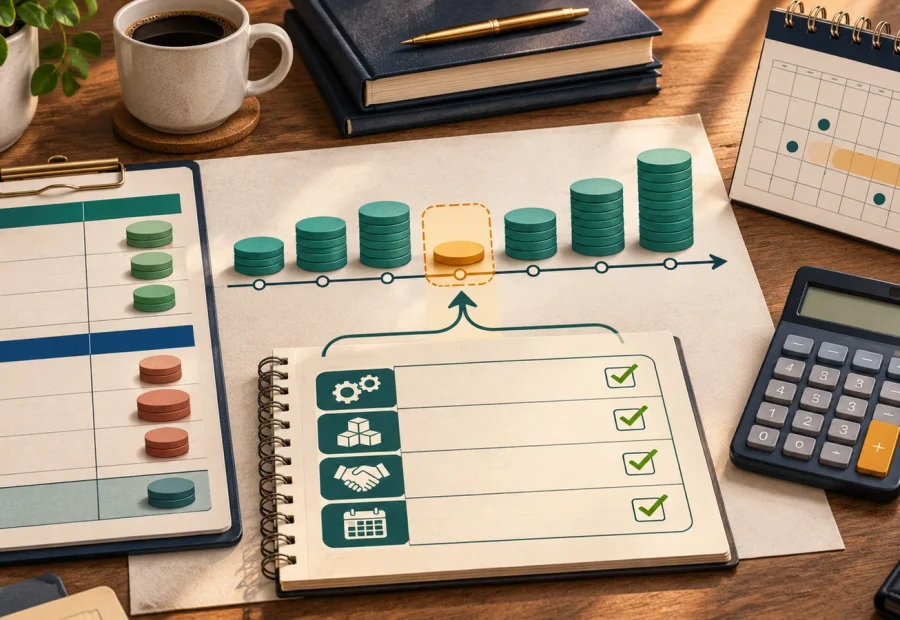
Cash deficit management is the process of identifying when available cash will be insufficient to meet obligations, finding the cause, protecting essential operations, and closing the gap through operational changes, financing, or an orderly restructuring. A profitable business can still experience a cash shortfall when customers pay after wages, tax, inventory, rent, or debt are due.
The most effective response begins before the bank balance reaches zero. A short-term cash forecast reveals the amount and timing of the gap, while a longer plan tests whether the underlying business can generate sustainable cash. This guide focuses on businesses; government budget deficits and personal household shortfalls require different frameworks.
This is general educational information, not individualized financial, legal, tax, or insolvency advice. Duties and creditor priorities vary by jurisdiction. A director who is unsure whether a company can pay debts when due should obtain qualified local advice promptly.
What is a cash deficit?
A cash deficit occurs when cash available during a period is less than the cash required for due payments and the minimum operating buffer. It can appear as a negative forecast closing balance, an exhausted credit facility, missed obligations, or dependence on delaying normal payments.
A simple forecast relationship is:
Closing cash = opening cash + cash receipts − cash payments
If the projected closing cash is below the minimum safe balance or borrowing limit, the business has a forecast shortfall. The size of the deficit is the amount required to restore that minimum, not merely the amount needed to reach zero.
Cash deficit is not the same as a loss
Profit is measured using accounting rules that recognize revenue and expenses, not only cash movements. A sale can increase profit before the customer pays. Buying inventory may use cash before the inventory becomes an expense. Loan principal uses cash but is not normally an operating expense; depreciation lowers accounting profit without an immediate cash payment.
This creates four possible situations:
- Profit and positive cash flow: the strongest combination, though future commitments still matter.
- Profit and negative cash flow: common during growth, inventory build-up, or slow collections.
- Loss and positive cash flow: possible temporarily after borrowing, asset sales, customer deposits, or delayed payments.
- Loss and negative cash flow: a warning that both economics and liquidity may need urgent correction.
For a deeper comparison, see Profit vs. Operating Cash Flow.
Liquidity, cash deficit, and insolvency
A temporary liquidity gap may be solved by collecting a known receivable, changing purchase timing, or using a committed credit line. Insolvency is a legal and financial condition whose tests vary. They may include inability to pay debts as they fall due, liabilities exceeding assets, or other statutory criteria.
Management should not assume every shortfall is temporary. If forecasts depend on uncertain sales, repeated emergency borrowing, unpaid tax, or permanent creditor extensions, the problem may be structural. Seeking advice early preserves more options than waiting for legal action or an unplanned shutdown.
Common causes of cash deficits
Slow customer payments
Revenue may look healthy while receivables age. Causes include unclear terms, late invoicing, billing errors, disputed work, weak follow-up, customer distress, or excessive concentration in one buyer.
Rapid growth
Growth often requires inventory, labor, marketing, equipment, and supplier payments before customer cash arrives. The faster the growth and the longer the operating cycle, the larger the working-capital requirement.
Low margins or incorrect pricing
Sales that fail to cover variable costs, overhead, tax, financing, returns, and owner compensation consume cash. Revenue growth cannot fix a negative contribution margin without changes in price, product mix, or cost.
Excess inventory
Cash tied up in slow, obsolete, seasonal, or inaccurate stock cannot pay current bills. Bulk discounts may be false savings when carrying cost, spoilage, financing, and markdowns are considered.
Large one-time or poorly timed spending
Equipment purchases, annual insurance, tax installments, deposits, repairs, and expansion can create predictable peaks. A profitable investment still needs financing matched to its useful life and cash-generation schedule.
Debt structure
Short repayment periods, variable interest, balloon payments, covenants, or borrowing in another currency can strain cash. Using short-term facilities for long-lived assets creates a maturity mismatch.
Seasonality and shocks
Weather, demand cycles, supply disruption, illness, customer failure, regulation, fraud, cyber incidents, and price increases can alter both timing and amount. A forecast should include plausible downside cases rather than one optimistic sales line.
Weak records and controls
A business may not know its bank position, payment calendar, tax liability, receivable age, inventory, or borrowing headroom. Errors, duplicate payments, unauthorized spending, and unbilled work then remain hidden until cash is critical.
Build a short-term cash forecast
A rolling 13-week forecast is widely used because it is detailed enough for immediate decisions and long enough to show payroll, tax, debt, rent, and supplier cycles. A severely stressed business may need daily detail for the first few weeks.
Step 1: verify opening cash
Reconcile every bank account. Separate unrestricted cash from client money, restricted grants, security deposits, or amounts legally unavailable for general use. Record undrawn facilities only if they are committed and all conditions can be met.
Step 2: forecast receipts by date
List expected collections from specific invoices, cash sales, subscriptions, refunds, asset sales, tax recoveries, financing, and owner contributions. Use realistic payment dates based on customer behavior. A sales forecast is not a receipts forecast.
Step 3: list payments by obligation
Include payroll, payroll taxes, sales or value-added tax, rent, utilities, suppliers, insurance, debt service, leases, refunds, maintenance, capital spending, owner draws, and fees. Record the legal due date and the operational consequence of nonpayment.
Step 4: calculate the weekly position
For each week, add receipts, subtract payments, and carry the closing balance forward. Compare it with the minimum buffer and facility limit. The earliest negative week is the action deadline; the lowest balance estimates the maximum funding need under that scenario.
Step 5: assign confidence levels
Separate contracted or highly probable receipts from speculative sales. Note payments whose amount is estimated. Build base, downside, and severe-but-plausible cases. Do not “solve” the model by inserting an unidentified loan or unrealistic collection.
Step 6: update forecast against actuals
Replace each completed week with actual receipts and payments, explain variances, and add a new week. Forecast accuracy improves when assumptions have named owners and differences lead to corrective action.
Immediate actions in the first 48 hours
- Confirm the facts: reconcile cash, facilities, overdue debts, commitments, and restricted funds.
- Freeze avoidable commitments: pause discretionary purchases, hiring, travel, and projects until reviewed.
- Protect critical operations: identify payments needed for safety, legal compliance, employees, essential supply, insurance, and revenue continuity.
- Accelerate valid billing: issue completed invoices, correct errors, obtain approvals, and contact overdue customers professionally.
- Communicate early: speak with lenders, advisers, key suppliers, landlords, and tax authorities before a payment is missed where appropriate.
- Establish authority: define who may approve payments, discounts, purchases, and new commitments during the response.
- Document decisions: retain forecasts, board minutes, advice, and reasons for prioritization.
Do not transfer assets, favor insiders, take deposits that cannot be fulfilled, or make selective creditor payments without understanding the law. Actions that seem helpful operationally may create director or company liability in distress.
Improve cash coming in
Invoice promptly and accurately
Send invoices as soon as the contractual milestone is complete. Include the purchase order, description, tax information, payment instructions, contact, and due date. Confirm the customer’s approval process before work begins.
Manage receivables by risk
Review an aging report and focus on large, old, disputed, or high-risk balances. Contact customers before due dates, resolve disputes quickly, and document payment promises. Escalation should follow the contract and applicable collection law.
Improve commercial terms
For new work, consider deposits, progress billing, shorter terms, card or direct-debit options, credit checks, and customer limits. Early-payment discounts have a real annualized cost, so compare them with borrowing and margin.
Review pricing and product mix
Calculate contribution by customer, product, and channel. Raise prices where value and contracts support it, reduce unprofitable customization, and direct capacity toward work that generates both margin and timely cash.
Sell surplus assets carefully
Unused inventory or equipment may release cash, but distress sales can destroy value or remove capacity needed for recovery. Check ownership, lender security, tax, warranty, and replacement consequences first.
Control cash going out
Reduce costs without damaging the cash engine
Eliminate unused subscriptions, duplicate services, waste, low-return advertising, excess space, and avoidable fees. Distinguish a true saving from a delayed expense. Cutting maintenance, quality control, cybersecurity, or the people who collect revenue may create a larger future deficit.
Manage inventory
Improve counts, reorder points, demand planning, supplier lead times, and slow-stock disposal. Negotiate smaller or more frequent deliveries where total cost supports it. Preserve safety stock for items whose absence would stop profitable operations.
Renegotiate commitments
Ask suppliers, landlords, lenders, or equipment providers about revised schedules before default. Present a credible forecast and proposal. An extension may solve timing but not economics; record fees, interest, security, personal guarantees, and covenant changes.
Match capital spending to financing
Delay nonessential projects, stage purchases, rent, lease, or finance long-lived assets over a suitable period. Compare full cost and flexibility, not only the first payment.
Financing a temporary cash gap
Possible sources include an overdraft or revolving line, term loan, invoice finance, asset-based lending, owner capital, new equity, customer deposits, supplier credit, or sale of noncore assets. Each changes risk, control, cost, and future cash.
Borrowing is appropriate only when the business can explain the cause of the gap and demonstrate repayment under realistic assumptions. Debt used to fund recurring losses postpones rather than solves the problem. Compare effective interest, fees, security, covenants, recourse, concentration limits, and the lender’s ability to reduce availability.
Invoice finance can accelerate cash from eligible receivables but may exclude disputed, aged, foreign, or concentrated accounts. Equity does not require scheduled repayment but dilutes ownership and can take time. Personal guarantees expose the guarantor and require independent consideration.
Measure the underlying cash cycle
- Days sales outstanding: how long customer cash is tied up in receivables.
- Days inventory outstanding: how long cash remains in inventory.
- Days payable outstanding: how long the business takes to pay suppliers.
- Cash conversion cycle: inventory days plus receivable days minus payable days.
- Operating cash flow: cash generated or consumed by core operations.
- Cash runway: available cash divided by expected net cash burn, useful only when burn is reasonably stable.
- Forecast variance: actual versus forecast receipts, payments, and closing cash.
Ratios are signals, not decisions. Extending supplier days by paying late may improve a formula while damaging supply, credit, and legal standing. A shorter cash cycle is valuable when achieved through better operations and agreed terms.
From crisis response to prevention
After the immediate gap closes, identify the root cause and change the system. Maintain a rolling forecast, monthly balance-sheet and cash-flow review, receivable and inventory ownership, spending approval, and a calendar of tax and annual payments. Set an appropriate liquidity buffer based on volatility, fixed costs, customer concentration, and financing access.
Stress-test the plan for slower collections, lower sales, supplier price increases, interest changes, and loss of a major customer. Pre-agree triggers: for example, when forecast headroom falls below a threshold, hiring pauses or the board reviews financing. Triggers turn warning data into action.
See Mastering Cash Flow Analysis for statement analysis and Seasonal Business Cash Flow Tips for cyclical planning.
Frequently asked questions
Can a profitable business have a cash deficit?
Yes. Receivables, inventory, loan principal, capital spending, tax timing, and rapid growth can consume cash before profit becomes available money.
What is the fastest way to fix a cash deficit?
There is no universal shortcut. Verify the forecast, collect valid receivables, stop avoidable commitments, communicate early, and choose financing or restructuring that matches the cause. A quick high-cost loan can worsen a structural problem.
Should every supplier be paid later?
No. Pay according to contracts and law unless a revised arrangement is agreed. Late payment can stop essential supply, remove discounts, trigger fees, damage credit, or create legal consequences. Prioritization in distress requires qualified advice.
How much cash reserve should a business hold?
The right buffer depends on fixed costs, seasonality, payment timing, access to committed finance, concentration, and risk. Build the target from severe-but-plausible forecast scenarios rather than a generic number of months.
When should a director seek insolvency advice?
Promptly when the company may be unable to pay debts when due, forecasts rely on uncertain rescue finance, statutory demands or legal action begin, payroll or taxes cannot be met, or the board is unsure about creditor duties. Local law controls the exact test.
Conclusion
Cash deficit management combines speed with evidence. Reconcile the current position, build a dated forecast, separate timing problems from unprofitable operations, protect essential obligations, and communicate before options disappear. Working-capital improvements and financing can bridge a genuine temporary gap; they cannot make recurring losses sustainable. The strongest outcome is not merely surviving one payment date, but installing the forecasting, pricing, collection, inventory, governance, and reserve practices that prevent the next crisis.