
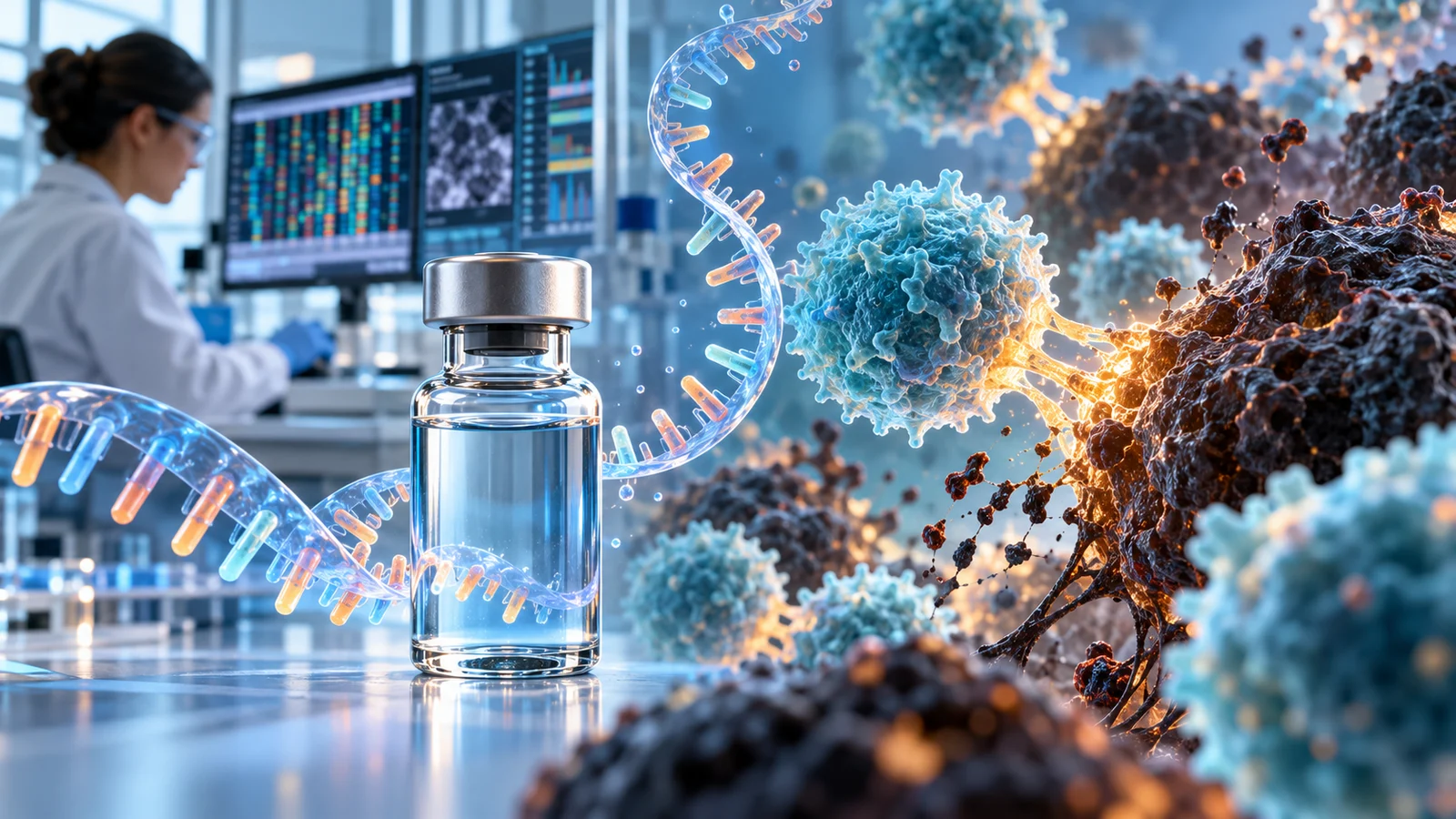
A personalized mRNA melanoma vaccine combined with pembrolizumab reduced the relative risk of cancer recurrence or death by 42% compared with pembrolizumab alone in a large Phase 3 trial. The headline is genuinely important, but it needs careful interpretation: the treatment is investigational, the study concerns a specific group of people after surgery for high-risk melanoma, and longer follow-up is still needed.
The candidate, known as intismeran autogene or mRNA-4157/V940, is individually designed from the genetic features of each patient’s tumor. It does not prevent melanoma in healthy people. Instead, it aims to train the immune system to recognize tumor-specific targets that may remain after visible cancer has been removed. This article explains the Phase 3 result, how the technology works, and the questions that must be answered before routine clinical use.
Phase 3 melanoma vaccine results at a glance
| Question | Reported finding |
|---|---|
| Who was studied? | 1,137 people with resected high-risk stage III or IV melanoma |
| Experimental group | Personalized mRNA vaccine plus pembrolizumab |
| Comparison group | Pembrolizumab alone |
| Main result | 42% relative reduction in recurrence or death risk |
| Two-year recurrence-free survival | About 82% versus 70% |
| Regulatory status | Investigational; not yet an approved melanoma treatment |
The peer-reviewed Phase 3 report is indexed in PubMed. Trial details and company-reported analyses are also summarized by Merck’s ESMO 2026 announcement. Percentages may be updated as follow-up matures, so readers should distinguish a conference or interim update from a final long-term outcome.
What “personalized mRNA melanoma vaccine” actually means
Most familiar vaccines teach the immune system to recognize a pathogen before it causes severe disease. A therapeutic cancer vaccine has a different job. It is given after cancer has developed, and in this trial after surgery, to strengthen immune recognition of malignant cells. “Personalized” means the product is manufactured separately for each patient rather than drawn from one identical batch used for everyone.
The process begins with tumor tissue and a normal sample, usually blood. Laboratory sequencing identifies mutations found in the cancer but not in healthy cells. Computational methods predict which mutated protein fragments—called neoantigens—are most likely to be displayed by that person’s tumor and noticed by T cells. A custom mRNA sequence encoding a selection of those targets is then produced and delivered in a lipid nanoparticle formulation.
After injection, cells briefly use the mRNA instructions to make the selected antigen fragments. Immune cells present those fragments and can expand T-cell populations able to recognize them. The mRNA does not enter the cell nucleus and does not alter a patient’s DNA. Like other mRNA, it is temporary and is broken down by normal cellular processes.
Why the vaccine is paired with pembrolizumab
Tumors can evade immune attack by exploiting biological checkpoints that normally prevent excessive inflammation. Pembrolizumab is a PD-1 checkpoint inhibitor: it blocks a signal that can restrain activated T cells. In simplified terms, the personalized vaccine attempts to show the immune system what to target, while pembrolizumab helps prevent the tumor from applying an immune brake.
Pembrolizumab alone is already an established adjuvant treatment in appropriate high-risk melanoma settings. That makes it an ethically and scientifically meaningful comparator. The Phase 3 question was not whether the personalized vaccine performed better than no treatment, but whether it added clinically useful protection on top of modern immunotherapy.
The combination also illustrates why “cancer vaccine” should not be interpreted as a replacement for surgery or every other therapy. Trial participants had their visible melanoma surgically removed and then received adjuvant treatment intended to reduce the chance that microscopic remaining disease would grow into a detectable recurrence.
Understanding the 42% risk reduction
A 42% relative risk reduction does not mean 42 out of every 100 patients were cured, and it does not mean each individual’s personal risk falls by exactly 42 percentage points. It describes the relative difference in the rate of recurrence or death between the two randomized groups over the period analyzed.
The reported two-year recurrence-free survival figures offer a more intuitive view: approximately 82% of participants in the combination group remained recurrence-free, compared with about 70% in the pembrolizumab-only group. That is an absolute difference of roughly 12 percentage points at that time point. Both statistics matter. Relative measures convey treatment effect; absolute measures help patients and clinicians judge the likely real-world magnitude.
Recurrence-free survival is also not identical to overall survival. Preventing or delaying recurrence is highly meaningful, but researchers must continue following participants to learn whether the strategy helps people live longer, whether benefits persist, and whether delayed recurrences alter the early separation between trial groups.
Who was included—and who was not
INTerpath-001 enrolled 1,137 participants with high-risk stage III or stage IV melanoma that had been completely resected. This population has no visible tumor after surgery but faces a substantial risk that undetected cells will cause the disease to return. The results therefore apply most directly to people who resemble the trial population and meet its clinical criteria.
The study does not establish effectiveness for early, low-risk melanoma, untreated metastatic disease, other cancer types, or prevention in people without cancer. It also does not show that an off-the-shelf mRNA product would have the same effect. Personalization is central: the vaccine targets mutations selected from each individual tumor.
Subgroup results can be interesting, but they need caution when participant numbers become small. A treatment may behave differently according to tumor mutation burden, stage, previous therapy or immune characteristics. Regulators and clinical guidelines generally assess the full evidence package, not a single favorable subgroup chart.
Safety: what the early evidence can and cannot tell us
Adding a therapy can add side effects, even when the mechanism is highly targeted. Personalized mRNA vaccines can cause injection-site reactions, fatigue, fever or chills associated with immune activation. Pembrolizumab can produce immune-related adverse events because activated immunity may inflame healthy organs, including the thyroid, lungs, bowel, liver or skin. Some reactions are mild; others require urgent treatment and immunosuppression.
The key safety question is not whether side effects occur, but whether the added benefits justify the added harms for the intended patients. Trial reports compare the frequency and severity of adverse events between groups, treatment discontinuations and serious events. Longer observation also matters because uncommon problems may only become apparent after more patients receive a product.
Anyone receiving checkpoint immunotherapy should follow the care team’s instructions and report new symptoms promptly. This article is educational and cannot determine whether a specific person should receive pembrolizumab, enter a clinical trial or change an existing treatment plan.
Why this Phase 3 milestone matters
Cancer-vaccine research has produced promising laboratory findings for decades, but translating them into randomized late-stage clinical benefit has been difficult. Tumors vary enormously, suppress immune activity and evolve under treatment. A positive Phase 3 result in melanoma provides evidence that a made-to-order neoantigen strategy can add value beyond a checkpoint inhibitor in a defined clinical setting.
It also validates a manufacturing model that links sequencing, computational target selection, rapid mRNA production and clinical delivery. That platform could be adapted to other cancers, although success in melanoma does not guarantee success elsewhere. Melanoma often carries many mutations and can be particularly responsive to immunotherapy; tumors with fewer visible immune targets may present a tougher problem.
Memorial Sloan Kettering Cancer Center, which helped lead the research, offers a useful clinical explanation of the program and its development in its melanoma mRNA vaccine overview.
The manufacturing challenge behind every dose
A conventional medicine can be manufactured in large standardized batches and shipped to many patients. A personalized vaccine requires a reliable chain for each individual: suitable tumor tissue, accurate sequencing, computational analysis, target selection, production, quality testing and delivery back to the treating center. Delays matter because adjuvant treatment follows a clinical timeline after surgery.
Quality control must be rigorous even when every product is unique. Manufacturers need to verify identity, purity and potency without turning the process into an impractically slow exercise. Hospitals also need systems to track a patient-specific medicine from biopsy to administration. Scaling from hundreds of trial participants to routine care across countries will test laboratory capacity and logistics as much as molecular biology.
Cost and access could determine the real impact
Personalization may bring clinical precision but also substantial expense. Sequencing, bioinformatics, custom manufacturing and checkpoint therapy all carry costs. Even if regulators authorize the combination, insurers and public health systems will evaluate pricing, recurrence prevented, quality of life and longer-term survival. The existence of an effective technology does not ensure equal access.
Geography could create another divide. Major cancer centers may have the tissue handling and infusion infrastructure required for individualized products, while rural and lower-resource regions may not. Developers will need robust shipping, decentralized collection and predictable turnaround times. Policymakers will need to decide whether access programs and value-based payment can prevent a promising treatment from becoming available only to a narrow group.
What happens before possible approval
- Complete evidence review: regulators examine efficacy, safety, manufacturing consistency and trial conduct.
- Longer follow-up: investigators continue measuring recurrence, distant metastasis, overall survival and delayed adverse events.
- Manufacturing inspection: individualized production systems must meet regulatory quality standards at scale.
- Label definition: any authorization would specify the eligible population, regimen, warnings and monitoring.
- Guideline and coverage decisions: professional societies and payers determine how the treatment fits existing care pathways.
Until those steps are complete, the vaccine should be described as investigational. Patients may encounter clinical trials, expanded-access discussions or enthusiastic social-media claims, but availability depends on location and formal protocols. No one should buy an unverified product marketed online as an equivalent “personalized cancer vaccine.”
Questions patients can ask an oncology team
- What is my melanoma stage and my estimated recurrence risk after surgery?
- Which adjuvant treatments are currently approved for my situation?
- What absolute benefit and side-effect risks apply to someone with my clinical features?
- Are suitable clinical trials available, and what costs or travel would participation involve?
- How would treatment affect the timing of scans, work, fertility plans or other medical conditions?
- Which symptoms during immunotherapy require same-day contact with the care team?
These questions help turn a dramatic headline into a decision grounded in individual risk and evidence. A melanoma specialist can interpret pathology, mutation status, previous treatment and overall health in ways a general article cannot.
Frequently asked questions
Is the personalized mRNA melanoma vaccine approved?
No. The Phase 3 results are an important milestone, but the product remains investigational while evidence and manufacturing data undergo further review.
Does it prevent melanoma?
No. It is a therapeutic vaccine studied after surgery in people already diagnosed with high-risk melanoma. Sun protection, skin checks and prompt assessment of suspicious lesions remain important prevention and early-detection measures.
Can one vaccine be shared by different patients?
Not in this personalized approach. Each product is designed from mutations identified in one person’s tumor, although the underlying manufacturing platform is standardized.
The bottom line
The Phase 3 result provides the strongest evidence yet that a personalized mRNA vaccine can improve recurrence-free outcomes when added to pembrolizumab after surgery for high-risk melanoma. The approximately 12-point difference in two-year recurrence-free survival is clinically meaningful and deserves attention. It is equally important to keep the boundaries clear: this is not a universal cancer cure, not a preventive vaccine, and not yet routine approved care.
Future updates on overall survival, durability, safety, manufacturing speed, price and equitable access will determine how transformative the platform becomes. For background, read our guide to understanding melanoma and browse more evidence-based reporting in our Cancer section.
Medical note: This article provides general education, not diagnosis or treatment advice. People with melanoma should discuss current approved options and clinical trials with a qualified oncology team.
