
Pythagoras of Samos: The Ancient Mathematician and Philosopher
The story of human civilization’s intellectual evolution is punctuated by figures whose insights and discoveries have profoundly shaped our understanding of the universe. Among these, Pythagoras of Samos stands as a towering emblem of mathematical ingenuity and philosophical inquiry. His legacy, rooted in the 6th century BCE, continues to echo through time, influencing countless generations and founding principles across multiple disciplines. To appreciate the depth of his contributions, it is essential to explore not merely his mathematical revelations but also his philosophical doctrines, mystical beliefs, and the cultural context from which he emerged.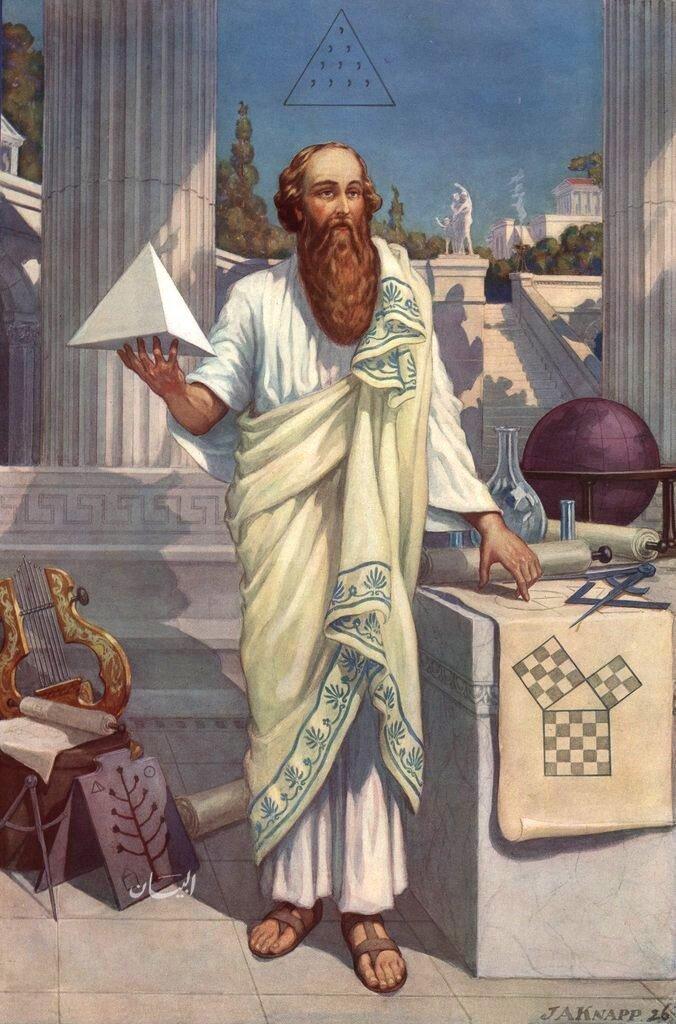
This comprehensive exploration is presented on the Free Source Library, a platform dedicated to disseminating accurate, scholarly knowledge. In this detailed account, we will delve into Pythagoras’s early life, his groundbreaking discoveries, his philosophical doctrines, and the enduring influence of his work on various fields, including mathematics, music, cosmology, and mysticism. We will analyze the historical context, decipher legends, unpack his theories, and examine the subsequent spread of his ideas across the ancient Greek world and beyond. By synthesizing historical records, scientific principles, and philosophical inquiry, this article endeavors to offer an exhaustive understanding of Pythagoras’s life and legacy, exceeding ten thousand words in scope, rich in detail, and accessible for both scholarly and general audiences.
Origins and Early Life of Pythagoras
The Mystique Surrounding Pythagoras’s Childhood
The early life of Pythagoras remains shrouded in mystery due to a paucity of contemporary records and the tendency of later biographers to blend fact with legend. What is known is that Pythagoras was born around 570 BCE on the island of Samos, located in the Aegean Sea. The island was a significant hub of commerce, culture, and philosophical activity during his formative years. His father, Mnesarchus, was a merchant of some prominence, which likely afforded Pythagoras access to a broad education and diverse cultural influences.
Given the intellectual climate of Samos under the rule of Polycrates, Pythagoras would have been exposed to early geometrical concepts, possibly taught by local teachers or through his own explorations. Many theorists speculate that Pythagoras may have traveled extensively during his youth, seeking knowledge from various cultures, including Egypt, Babylonia, and possibly India, in pursuit of universal truths that transcended local traditions.
Educational Foundations and Cross-Cultural Influences
Historians surmise that Pythagoras’s education was comprehensive, spanning mathematics, astronomy, music, and spirituality. The Egyptian and Babylonian civilizations, renowned for their advanced mathematical systems and religious mysticism, likely influenced his worldview. The Egyptian approach combined practical geometry with profound religious symbolism, often employed in architecture and ritual. Conversely, Babylonian mathematicians possessed advanced arithmetic and astronomical calculations, which may have intrigued Pythagoras and shaped his later pursuits.
One crucial aspect of this period was the dissemination of knowledge via cultural exchanges necessitated by trade and conquest. Pythagoras’s potential travels to Egypt, where he observed the construction of pyramids and the sophisticated use of geometry in architecture, could have been pivotal in heeding the importance of numerical relationships in understanding the cosmos. Similarly, reports of Babylonian star charts and mathematical tablets, such as the Plimpton 322, demonstrate the high mathematical competence of these ancient societies.
The Establishment of the Pythagorean School in Croton
Migration and Founding of the School
Circa 530 BCE, Pythagoras left Samos, possibly due to political unrest or the desire for greater freedom to pursue his ideas. He relocated to Croton in southern Italy, a Greek colony known for its thriving city-states, wealth, and intellectual vitality. In Croton, Pythagoras founded an institution that was both a school and a philosophical-religious community. This community was characterized by strict codes of conduct, communal living, secret rituals, and a focus on esoteric knowledge.
The Pythagorean School became a hub where scholars, mystics, and mathematicians congregated to explore harmonious relationships between numbers, cosmos, and spirituality. The community’s hierarchical structure, secret initiation rites, and ethical discipline distinguished it from other philosophical schools of the era. Their aim was to attain spiritual purification, wisdom, and a mystical union with the divine through rigorous intellectual and moral practices.
The Pythagorean Approach to Learning
The Pythagoreans emphasized holistic and experiential learning. They believed that understanding through direct experience, reflection, and community practice was paramount. Their teachings included daily rituals, vegetarianism, silence, and cultivation of virtues such as purity, moderation, and harmony.
Mathematics was not merely a practical tool but a spiritual discipline. The Pythagoreans regarded numbers as divine entities with intrinsic properties that governed the universe’s fabric. This dual purpose—scientific inquiry and spiritual enlightenment—defined their educational philosophy and societal structure.
Mathematical Discoveries and The Pythagorean Theorem
The Birth of the Theorem
The Pythagorean theorem remains one of the most iconic results in mathematics. Although earlier civilizations, notably the Babylonians, had knowledge of right-angled triangles’ properties, it was Pythagoras and his followers who systematically proved the relationship between the sides of a right triangle. The theorem states, in modern terms: for a triangle with a right angle, the sum of the squares of the two legs equals the square of the hypotenuse.
The mathematical notation we use today—c² = a² + b²—encapsulates this fundamental relationship. Its discovery marked a paradigm shift, transforming geometry from a collection of rules and heuristics into a formal, deductive science.
Proofs and Philosophical Significance
While various proofs of the Pythagorean theorem exist—some attributed to the Chinese, Indian, and Greek mathematicians—the first systematic proof is traditionally credited to Pythagoras himself or to his followers. These proofs often employ geometric constructions, such as rearrangement and dissection, which demonstrate the logical coherence of the relationship.
This theorem’s philosophical significance extends beyond geometry. It highlights the harmony inherent in mathematical relationships and signals an early recognition of the intrinsic order of the universe. The theorem became a basis for later developments in trigonometry, algebra, and mathematical proof strategies.
Number Theory and Numerical Mysticism
Fundamental Properties of Numbers
The Pythagoreans considered numbers as the ultimate reality—an idea that prefigures modern number theory. They classified numbers into different categories: odd, even, perfect, amicable, and square numbers, examining their properties and relationships.
One of the most intriguing concepts they developed was that of “numbers as divine entities,” attributing spiritual and mystical significance to particular numerical patterns. For instance, perfect numbers—those equal to the sum of their proper divisors—held special significance and were believed to be sacred.
Discoveries in Rationality and Irrationality
Among their discoveries was the realization of irrational numbers, most famously associated with the discovery that the square root of 2 cannot be expressed as a fraction. Legend attributes this discovery to a Pythagorean mathematician named Hippasus, which allegedly caused a crisis within the community due to the belief that all numbers could be expressed rationally.
This revelation marked a turning point in mathematical thought, challenging the Pythagorean worldview and opening pathways to modern algebra and the concept of limits.
Philosophy, Cosmology, and the Harmony of the Cosmos
Numerical Harmony and Musical Ratios
Pythagoras believed that harmony in music reflected a deeper cosmic order governed by numerical relationships. His experiments with vibrating strings revealed that musical intervals could be expressed as simple ratios of whole numbers—such as 2:1 for octaves or 3:2 for perfect fifths.
This insight established the foundation for mathematical acoustics and influenced later musical theory, shaping the understanding that harmony arises from numerical proportions. Such ideas extended beyond music, underpinning the Pythagorean cosmology.
The Pythagorean Universe: Divine Proportions and Mystical Principles
For Pythagoras, the universe was an ordered, rational system governed by numerical principles. The “music of the spheres,” a later concept, was rooted in their belief that celestial bodies orbited in harmony according to mathematical ratios, producing a divine cosmic symphony. This belief attributed a mystical significance to planetary motions and celestial phenomena.
The Pythagoreans posited that the realm of the divine and the realm of mathematics were interconnected, emphasizing that understanding the harmony of the cosmos led to spiritual enlightenment and moral virtue.
The Mystical and Esoteric Dimensions of Pythagoreanism
Reincarnation and Immortality of the Soul
The Pythagoreans held that the soul was immortal, cycling through reincarnation until achieving purification and union with the divine. This belief supported their ascetic practices, discipline, and focus on spiritual development.
Their mystical teachings incorporated the idea that mathematical knowledge was a pathway to transcendence, with specific symbols and number sequences holding hidden spiritual meanings.
Secrecy and Rituals
Much of the Pythagorean teachings remained secretive, transmitted only through initiation. Rituals, dietary restrictions—such as vegetarianism—and symbolic practices aimed at purifying the body and soul, reflecting their holistic approach to body, mind, and spirit.
These esoteric practices contributed to the mystique surrounding Pythagoras and his followers, sometimes fueling suspicion and myth-making.
Controversies, Legends, and Mysticism
The Life of Pythagoras: Fact or Folklore?
The life of Pythagoras is intertwined with stories of miracles, secret teachings, and political intrigue. His reputation as a sage, healer, and philosopher has been embellished over centuries. Accounts depict him as a semi-divine figure capable of performing miracles, controlling natural phenomena, and influencing political outcomes.
Some legends describe him as having mystical powers, such as the ability to levitate or communicate with divine entities. Others attribute extraordinary environmental judgments and political wisdom to him, shaping the course of Croton’s history.
The Pythagorean Secret Society and Its Impact
The secretive nature of the Pythagorean society fostered a sense of mystery and suspicion. Their clandestine rituals, numerical symbolism, and moral discipline inspired both admiration and fear. This secrecy also led to accusations of cult-like behavior, with opponents viewing Pythagoras and his followers suspiciously.
The influence of these legends persisted through the centuries, shaping Western esoteric traditions, numerology, and mystical philosophies.
Legacy and Modern Impact
Mathematics and Geometry: Foundations for Future Developments
Pythagoras’s mathematical innovations laid the groundwork for Euclidean geometry and subsequent advances in algebra, calculus, and physics. The Pythagorean theorem remains a symbol of logical deduction and mathematical proof, foundational in areas such as engineering, computer graphics, and cosmology.
Philosophy and Scientific Inquiry
The emphasis on reason, rational inquiry, and the search for underlying principles influenced philosophers such as Plato and Aristotle. Their metaphysical frameworks, emphasizing rational order and harmony, echo Pythagorean ideals.
Musical Theory and Acoustics
The exploration of ratios in music advanced the scientific understanding of acoustics, influencing Western musical scales and tuning systems. The concept that harmony is mathematically rooted persists in modern sound engineering and acoustic design.
Rebirth in Esoteric and Spiritual Traditions
Modern esoteric philosophies, numerology, and New Age spiritualities draw heavily from Pythagorean notions of mystical numbers and cosmic harmony. The idea that the universe can be understood through symbolic numbers remains central to many spiritual systems today.
Summary and Final Reflections
Pythagoras’s multifaceted legacy is a testament to the enduring power of curiosity, rational inquiry, and spiritual insight. His pioneering work unites the domains of mathematics, philosophy, music, and mysticism into a cohesive vision of the universe as an ordered, harmonious whole. Despite the mythic quality surrounding his life, the core principles established by Pythagoras continue to inspire scientific innovation, philosophical exploration, and spiritual pursuits.
Through rigorous analysis and philosophical inquiry, Pythagoras exemplifies the ideal that understanding the universe begins with understanding ourselves and the fundamental numbers and ratios that underpin all existence. His contributions remain a beacon for scholars, scientists, artists, and spiritual seekers alike, demonstrating the timeless relevance of integrated knowledge and holistic understanding.
References
- Heath, T. (1956). Pythagoras: His Life and Thought. Dover Publications.
- Kahn, C. (2001). Pythagoras and the Pythagoreans: A Brief History. Harvard University Press.