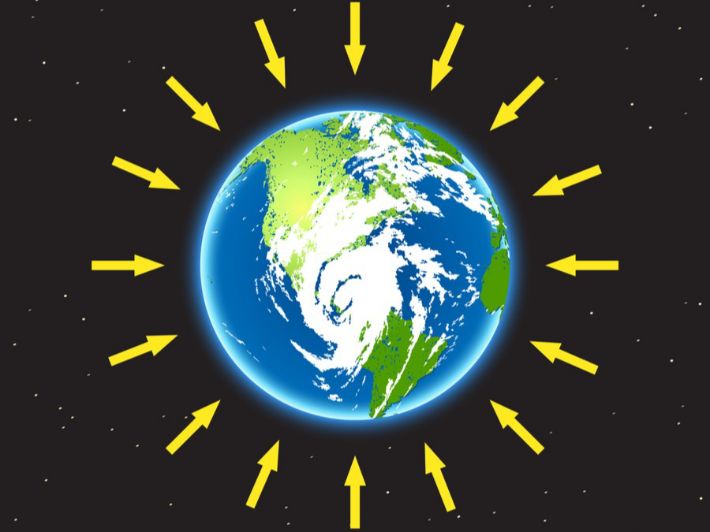
 Free Source Library — Exploring gravity reveals not only how objects are pulled toward each other but also how this fundamental force influences the universe at every scale, from tiny particles to vast galaxies.

Understanding Gravitational Force: The Foundation of Cosmic and Terrestrial Phenomena
The concept of gravitational force, commonly known as Earth’s gravity, is one of the most profound principles in physics. It governs the motion of celestial bodies, sustains our planet’s atmosphere, and shapes the very fabric of the universe. Despite its apparent simplicity, gravity’s intricacies run deep. To truly grasp its significance, we need to explore its definition, mathematical description, historical development, practical implications, and the pivotal role it plays in both everyday life and cosmic evolution.
Defining Gravitational Force and Its Mathematical Underpinnings
The Basic Concept of Gravitational Attraction
At its core, gravitational force is the attractive interaction between two objects based on their masses. Every object with mass exerts a gravitational pull on every other object with mass, regardless of the distance separating them. This interaction, though often weak at small scales, becomes overwhelmingly dominant at astronomical scales.
Newton’s Law of Universal Gravitation
Sir Isaac Newton formulated the first comprehensive mathematical description of gravity in the 17th century. His law states that the force between two point masses is directly proportional to the product of their masses and inversely proportional to the square of the distance between their centers:
F = G * (m₁ * m₂) / r²
| Parameter | Meaning | Typical Values/Notes |
|---|---|---|
| F | Gravitational force | Measured in newtons (N) |
| G | Gravitational constant | 6.67430×10⁻¹¹ m³ kg⁻¹ s⁻² |
| m₁, m₂ | Masses of the objects | In kilograms (kg) |
| r | Distance between centers | In meters (m) |
The Significance of the Gravitational Constant G
G is a fundamental physical constant that sets the scale for the strength of gravity. Its relatively small value ensures that gravity remains weak compared to other fundamental forces, but its long-range nature makes it crucial on cosmic scales.
Limitations and Approximations
Newton’s law works exceptionally well for most practical purposes—predicting satellite trajectories, planetary orbits, and tides. However, it does not account for phenomena near extremely massive objects like black holes or at very high velocities, where Einstein’s theory of general relativity becomes necessary.
The Historical Evolution of Gravity Theories
Newtonian Paradigm
Newton’s formulation of gravitation in the 17th century revolutionized physics. It provided a straightforward explanation for planetary motion, tides, and the falling of objects. His law implied instantaneous action at a distance, which, despite its success, raised questions about the underlying mechanism of gravity—an issue that persisted for centuries.
Einstein’s General Theory of Relativity
In the early 20th century, Albert Einstein introduced a revolutionary perspective—gravity as the curvature of spacetime. Instead of forces acting at a distance, mass and energy deform spacetime, and objects follow curved paths called geodesics. Einstein’s field equations relate the distribution of mass-energy to this curvature:
Rᵥᶜ - ½ gᵥᶜ R = (8πG / c⁴) Tᵥᶜ
where Rᵥᶜ is the Ricci curvature tensor, gᵥᶜ the metric tensor, R the scalar curvature, and Tᵥᶜ the energy-momentum tensor. This framework explains phenomena such as gravitational lensing and the dynamics of black holes more accurately than Newtonian physics.
Impact on Modern Cosmology
General relativity underpins our understanding of the universe’s large-scale structure, the expansion driven by dark energy, and the distribution of dark matter. The detection of gravitational waves—ripples in spacetime caused by merging black holes—has validated Einstein’s predictions and open new observational windows to the universe.
Practical Applications Spanning Multiple Disciplines
Orbital Mechanics and Satellite Technology
Predicting the orbits of planets, moons, and artificial satellites is based on understanding gravitational interactions. Precision navigation systems like GPS rely on relativistic corrections to maintain accuracy, accounting for both the Earth’s gravity and relative motion.
Space Exploration and Interplanetary Navigation
Spacecraft trajectory planning hinges on gravitational calculations. Gravitational slingshots—maneuvers that use a planet’s gravity to accelerate a spacecraft—maximize fuel efficiency, enabling missions like Voyager and New Horizons to reach distant worlds.
Geophysics and Earth Sciences
Gravity surveys reveal variations in Earth’s interior density, aiding in mineral exploration, oil and gas detection, and understanding tectonic processes. Techniques such as satellite gravimetry (e.g., GRACE satellite) have mapped changes in Earth’s gravity field over time, indicative of phenomena like glacial melting and groundwater depletion.
Astronomy and Cosmology
Gravity governs star formation, galaxy evolution, and the large-scale structure of the universe. It explains tidal interactions, galaxy collisions, and the dynamics of galaxy clusters. The discovery of dark matter, inferred from gravitational effects, remains one of modern science’s biggest mysteries.
Engineering and Everyday Life
Engineers must consider gravitational loads when designing bridges, skyscrapers, and vehicles. In sports, understanding projectile motion influenced by gravity is fundamental to aiming and trajectory analysis. Even in healthcare, gravity impacts blood circulation, bone density, and space medicine research into microgravity’s adverse effects.
Gravity’s Influences on Celestial Bodies and Cosmic Phenomena
Planetary and Lunar Mechanics
Gravity keeps planets orbiting their stars, moons orbiting planets, and drives tidal cycles. It stabilizes planetary rings and influences rotational speeds. For example, Earth’s tides are primarily caused by the Moon’s gravitational pull, with the Sun contributing a secondary effect.
Formation and Evolution of Stars and Planets
Moons, planets, and stars all originate from accretion under gravity’s influence. Dust particles coalesce into planetesimals, leading to protoplanets. Tidal forces induce heating in moons like Io, fueling volcanic activity and geological change.
Galaxies and Clusters
Galactic structures—spiral arms, bars, and halos—are shaped by gravitational interactions. Mergers between galaxies, driven by gravity, lead to new galaxy formations and influence morphological evolution. The distribution of dark matter halos around galaxies further affects their gravitational dynamics.
Black Holes and Extreme Gravity
Near black holes, gravitational forces intensify, creating event horizons—the point of no return. These extreme conditions offer laboratories for testing physics under intense gravity and understanding spacetime singularities.
Everyday Manifestations of Gravity and Their Variations
Objects’ Weight and Apparent Weightlessness
Objects’ weight is the force of gravity acting on their mass, which varies slightly with location due to changes in altitude and Earth’s shape. In astronauts’ microgravity environment aboard spacecraft, they experience free fall, creating a sensation of weightlessness.
Gravity’s Role in Weather and Climate
Gravity drives atmospheric circulation by maintaining air pressure gradients. It influences ocean currents, contributing to climate regulation. Variations in gravity due to mass redistributions (like melting ice sheets) can affect Earth’s gravitational field and, consequently, climate patterns.
Geological Processes and Surface Features
Gravity induces erosion, sediment transport, and mountain formation. Rivers carve valleys, and landslides occur under gravitational pull. The formation of geological features is fundamentally linked to gravitational processes over geological timescales.
Variations and Anomalies in Gravitational Force
Factors Affecting Gravitational Strength
- Mass and Distance: Larger masses exert greater pulls; proximity amplifies gravity.
- Altitude and Depth: Higher altitudes slightly reduce gravity; deeper underground increases it.
- Latitude Effects: Due to Earth’s rotation, gravity is slightly weaker at the equator than at the poles.
- Planetary Differences: Gravity varies across planets; Mars’s gravity is roughly 38% of Earth’s, while Jupiter’s is about 2.5 times stronger.
Microgravity and Weightlessness in Space
When objects are in free fall, as in orbit, they experience microgravity conditions. This environment allows scientists to study biological processes, fluid dynamics, and materials science free from Earth’s gravitational constraints.
Gravity Anomalies and Their Detection
Localized deviations from expected gravity values happen due to subsurface features or variations in crustal density. Geophysical surveys identify mineral deposits, oil reserves, or structural weaknesses, crucial for resource exploration.
Understanding and Managing Anomalies
| Cause | Example | Implication |
|---|---|---|
| Mass distribution irregularities | Mantle plumes or dense mineral deposits | Resource exploration, geological mapping |
| Topographical features | Mountains, trenches | Geophysical survey adjustments |
| Subsurface structures | Cavities, voids | hazard assessment, construction planning |
Modern Research Frontiers and Future Directions
Detection of Gravitational Waves
The discovery of gravitational waves, first observed by LIGO in 2015, confirmed Einstein’s predictions. Ongoing advancements aim to detect signals from phenomena like black hole mergers, neutron star collisions, and potentially signals from the early universe, shedding light on cosmic origins.
Gravity and Quantum Mechanics
The quest for a unified theory that reconciles gravity with quantum mechanics continues. Approaches like string theory and loop quantum gravity seek to describe gravity at the smallest scales, potentially revealing new physics beyond current models.
Space-Based Observatories and Missions
- LISA (Laser Interferometer Space Antenna): A planned space observatory to detect low-frequency gravitational waves.
- GRACE Follow-On: Satellites that monitor Earth’s gravity field with high precision, tracking changes due to mass redistribution.
- Future Missions: Missions targeting dark matter, dark energy, and tests of gravity in extraterrestrial environments.
Astrobiological Impacts
Understanding gravity’s role in planetary habitability, atmospheric retention, and biological processes is vital in assessing exoplanet environments, especially as missions seek signs of extraterrestrial life.
Conclusion: The Persistent Influence of Gravity
Gravity remains one of the most fundamental forces shaping the universe. Its manifestations range from the gentle pull holding us on Earth to the violent mergers of black holes emitting ripples in spacetime. As research advances, our comprehension deepens, paving the way for new discoveries that may redefine our understanding of the cosmos itself.
References
- NASA’s Gravity Research: https://example.com/resource
- ESA’s gravitational wave studies: https://example.com/resource