
 Free Source Library — The Umayyad Caliphate stands as one of the most influential and expansive empires in early Islamic history, leaving a multifaceted legacy that shaped subsequent civilizations across regions and centuries. Tracing its rise, governance, cultural achievements, and decline reveals insights into the foundations of Islamic civilization and its enduring contributions to architecture, science, governance, and culture. To fully appreciate the scope of the Umayyad impact, it is necessary to explore its origins, major accomplishments, administrative systems, cultural developments, and the socio-political transformations it initiated.
Origins and Rise of the Umayyad Caliphate
Foundational Background and Early Leadership
The Umayyad Caliphate emerged from the cosmopolitan and influential Quraysh tribe of Mecca, known for their merchant traditions and complex social hierarchy. Following the death of the fourth caliph, Ali ibn Abi Talib, and subsequent internal conflicts, the Umayyad family seized power under Muawiya ibn Abi Sufyan in 661 CE, marking the beginning of a dynastic rule that would shape Islamic history for nearly a century. Muawiya’s ascendancy shifted the Muslim political system from a community-based leadership—characterized during the Rashidun Caliphate—to a hereditary monarchy. This change was significant, representing a transition from the early, more egalitarian caliphate models to a centralized state managed by a ruling family. While this hereditary succession allowed for stability, it also sparked dissent among factions loyal to the Rashidun ideals and caused ongoing political tensions.
Expansion and Consolidation: Military Campaigns
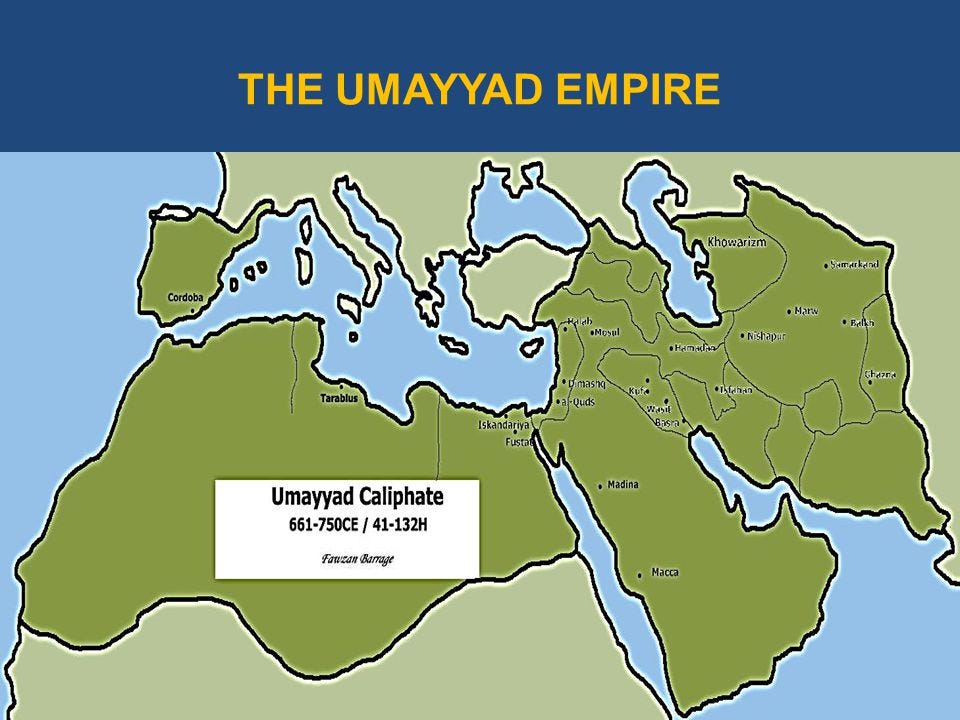
The early years of the Umayyad rule were characterized by vigorous military campaigns aimed at consolidating established territories and expanding into new lands. The Umayyads inherited a rapidly growing Islamic state that had begun to conquer territories from the Byzantine and Sassanian empires. Under Muawiya and his successors, military expansion intensified, culminating in vast territorial acquisitions that included:
- Levant and parts of Anatolia
- North Africa, including Egypt, Libya, and Tunisia
- Trans-Saharan regions and sub-Saharan Africa
- Iberian Peninsula (Al-Andalus)
- Central Asia, pushing into regions of modern-day Afghanistan and Pakistan
These conquests not only expanded the geographical boundaries of the caliphate but also facilitated cultural exchange and religious dissemination. The military successes, supported by sophisticated logistics and strategic diplomacy, helped establish Islam across diverse populations.
Administrative and Governance Innovations
Centralization and Provincial Governance
A fundamental aspect of Umayyad governance was the establishment of a centralized yet regionally administered structure. The caliphate was divided into provinces, each overseen by appointed governors known as *walis*. These governors wielded significant authority, overseeing military, judicial, and financial administration within their territories, with instructions stemming from the caliph’s court in Damascus. This administrative model served to:
- Streamline tax collection, creating a more efficient revenue system
- Ensure political stability through local governance
- Facilitate regional development programs
The bureaucracy was supported by an evolving civil service that incorporated local elites, which helped integrate diverse cultural groups into the administrative framework while maintaining loyalty to the central caliphate.
Taxes, Military, and Economy
The Umayyad economic system relied heavily on taxation. Taxes such as *kharaj* (land tax) and *jizya* (tax on non-Muslims) provided vital revenue. Military service was often tied to taxation policies, with soldiers given stipends sourced from the treasury. The administration was keen on promoting economic activity through infrastructure development, trade facilitation, and agricultural reforms. Key improvements included: – The standardization of currency, which facilitated trade across vast distances – Development of regional markets and trade hubs – Establishment of a postal system to improve communication The caliphate’s economic prosperity was underpinned by its control over significant trade routes connecting Asia, Africa, and Europe. This network enabled the exchange of spices, textiles, precious metals, and ideas, fostering economic resilience.
Cultural and Architectural Achievements
Architectural Marvels: The Icons of Umayyad Innovation
The Umayyad era left a luminous mark on Islamic architecture, blending Byzantine, Persian, and local styles into unique structures that served religious, political, and cultural functions.
- The Great Mosque of Damascus: Often called the Umayyad Mosque, this edifice epitomizes Islamic architectural grandeur with its expansive courtyard, intricate mosaics, and towering minarets. Its design integrates Roman basilica principles and Sassanian motifs, exemplifying a cultural synthesis that symbolizes the empire’s imperial ambitions.
- The Dome of the Rock: Located in Jerusalem, it is one of the oldest surviving Islamic monuments. Its octagonal shape, mosaics, and gilded dome represent early Islamic architectural aesthetics and religious symbolism.
- Palaces and Fortresses: Structures across cities like Cordoba and Aleppo featured courtyards, stucco decoration, calligraphy, and tile work, demonstrating mastery in craftsmanship and urban planning.
The Artistic and Cultural Landscape
Under Umayyad patronage, arts and culture flourished, characterized by: – Artistic patronage that led to sophisticated mosaics, ceramics, and metalwork – Development of calligraphy, which became an essential aspect of Islamic art – The proliferation of poetry, music, and storytelling in court and public gatherings This thriving cultural scene fostered a shared identity among diverse peoples and laid the foundation for subsequent Islamic cultural achievements.
Language and Science: The Transmission of Knowledge
Arabic: The Lingua Franca of the Caliphate
While originally a spoken language among Arabs, Arabic became the administrative and scholarly language of the empire. The widespread adoption of Arabic facilitated administrative efficiency and cultural cohesion. Additionally, the language’s development assisted in the dissemination of scientific, philosophical, and literary texts, often through translation into Arabic. This process was further advanced during the Abbasid period, but its roots—beginnings—are set during the Umayyad dynasty.
Origins of Islamic Scientific Inquiry
The Umayyad period saw the initial patronage that supported scientific pursuits, including astronomy, medicine, and mathematics. Scholars engaged in translating and preserving knowledge from Greek, Persian, and Indian sources. While the major intellectual movements flourished under the Abbasids, the groundwork was laid with:
- Establishment of translation centers
- Patronage of scholars; e.g., the development of calendar calculations and astronomical observations
- Preservation of ancient texts that later influenced medieval European science
Religion and Society: Shaping Islamic Cultures
Promoting Islamic Orthodoxy and Expansion
The Umayyads worked to solidify Islamic doctrine, often promoting a Sunni orthodoxy with less emphasis on the theological debates that dominated later periods. They emphasized the importance of *Sharia* law, religious rituals, and community cohesion. The caliphate’s expansion—via military conquest and peaceful propagation—brought diverse peoples under Islamic influence, necessitating adaptations to local customs and religious practices to foster acceptance.
Sociopolitical Tensions and Dissent
Although the Umayyad caliphs promoted a unified Islamic identity, social stratification and social tensions emerged, largely due to disparities between Arab conquerors and converted populations, as well as socio-economic inequalities. Often viewed as a period of Arab dominance, dissenting groups—such as the supporters of Ali—became critical of Umayyad rule, culminating in internal conflicts and rebellions.
Trade, Economy, and Urban Development
Trade Routes and Commercial Hubs
The Islamic empire under the Umayyads became a hub connecting the East and West through established trade routes. Key trade centers included Damascus, Cordoba, Kufa, and Kairouan. Trade goods spanned: – Spices, silks, and precious stones from Asia – Textiles, ceramics, and metals from the Mediterranean – Agricultural products like dates, grains, and cotton These commercial activities created wealth, funded infrastructure, and fostered cultural exchanges.
Urban Planning and Infrastructure
Cities flourished during the Umayyad period, featuring: – Well-planned streets and marketplaces – Water management systems such as qanats and aqueducts – Public facilities like baths, schools, and libraries These developments fostered urban life and cultural vibrancy.
Challenges, Decline, and Legacy
Internal Strife and External Threats
Despite impressive accomplishments, the Umayyad empire faced persistent challenges: – Political intrigue and unrest, especially among non-Arab Muslims – Religious dissent, particularly from supporters of Ali and Shia factions – External military threats from the Byzantines and internal rebellions The culmination of these pressures led to the Abbasid overthrow in 750 CE.
The Enduring Legacy
Although the Umayyad caliphate was overthrown, its legacy persisted through: – The architectural monuments that remain cultural symbols – The spread and standardization of the Arabic language – Foundations laid in governance and urban infrastructure – Contributions to arts, science, and the diffusion of Islamic culture Furthermore, the Umayyad dynasty continued to thrive in al-Andalus (Spain), where it established a new Umayyad caliphate, preserving its cultural and political influence for centuries.
Comparative Overview of Key Aspects
| Aspect | Contributions & Features |
|---|---|
| Territorial Extent | From Iberia to India, vast multi-ethnic empire |
| Governance | Centralized administration, provincial governors, standardized taxation |
| Architecture | Monumental mosques, palaces, fortresses blending diverse styles |
| Culture & Arts | Calligraphy, mosaics, poetry, music patronage |
| Economy | Trade routes, urban markets, agricultural development |
| Science & Knowledge | Foundation for translation movement, early scientific inquiry |
| Religion & Society | Islamic orthodoxy, social stratification, religious tolerance adaptations |