Vatican City is the world’s smallest sovereign state by land area and resident population, but the familiar fact becomes more interesting when measured carefully. Its territory is about 0.44 square kilometers—44 hectares or roughly 109 acres—inside Rome. Walking past its walls can take minutes; understanding what is inside those walls takes longer.
This article focuses on geography and statistics: area, border, population, density, land use, and comparison with other small states. For government, citizenship, diplomacy, and daily administration, read our separate guide: Vatican City explained.
Key numbers
- Area: about 0.44 km², 44 hectares, or 109 acres
- Location: a landlocked enclave within Rome, Italy
- Residents: 882 in official statistics updated to December 31, 2024
- Citizens: 673 on the current official population page
- Citizens living inside the walls: 458, including 120 Swiss Guards
- Border: roughly 3.2 kilometers, much of it marked by walls
What does 0.44 square kilometers mean?
A square kilometer is one million square meters, so Vatican City covers roughly 440,000 square meters. Area conversions are approximate because published values round and because cadastral, mapped, and treaty descriptions do not always reduce to one perfectly identical decimal.
For intuition, 44 hectares is smaller than many university campuses, large airports, and urban parks. It is far smaller than Central Park in New York or Hyde Park in London. Such comparisons are illustrative, not exact, because parks and campuses have irregular boundaries and sources use different areas.
Do not compare the state with St. Peter’s Square alone. The square is only one prominent public space within a territory that also includes gardens, museums, offices, residences, courtyards, religious buildings, infrastructure, and service areas.
The boundary inside Rome
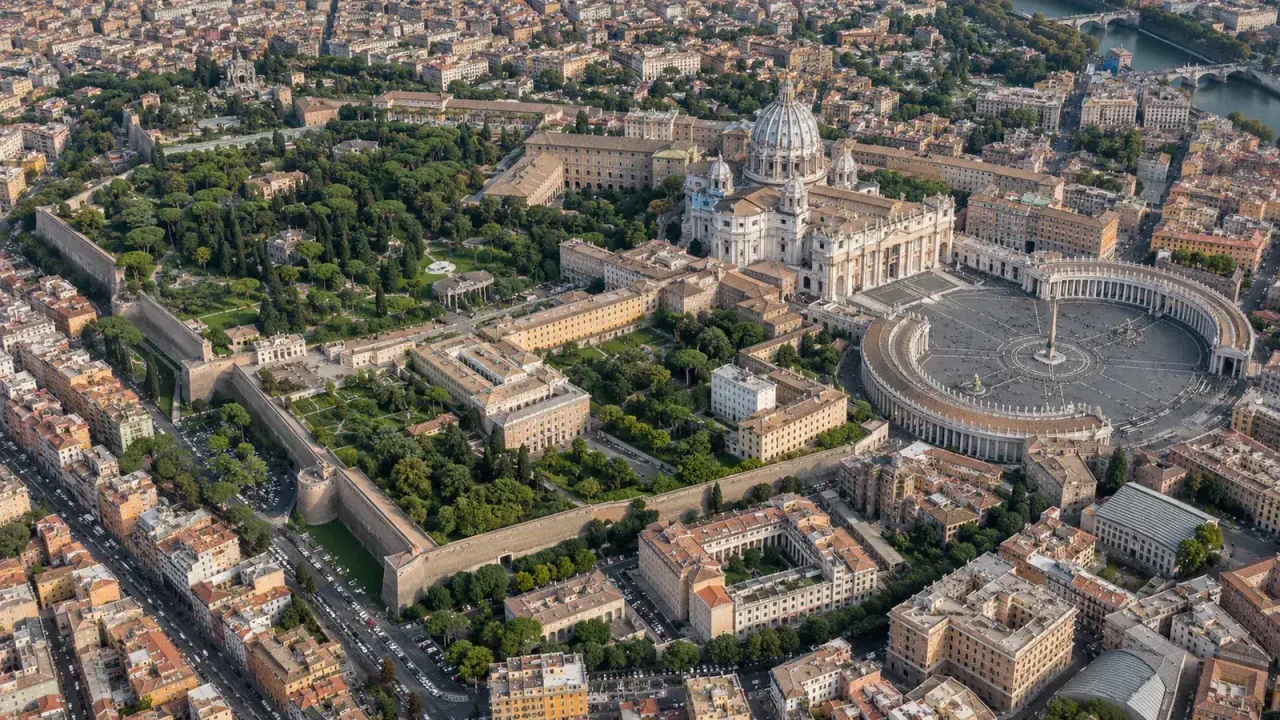
Vatican City lies west of the Tiber within the urban fabric of Rome. Much of the boundary follows walls, while the edge around St. Peter’s Square is visually open and managed through treaty and security arrangements. Crossing the line does not resemble arriving at a large national frontier with highways and immigration halls.
Italy surrounds the state completely, making it an enclave. San Marino and Lesotho are also sovereign states entirely surrounded by one country, but both are vastly larger. An enclave describes the geographic relationship; it does not make Vatican City politically part of Italy.
Is every Vatican-linked property inside Vatican City?
No. The Holy See owns or uses buildings in Rome and elsewhere that receive extraterritorial privileges under the Lateran agreements. The major basilicas outside Vatican City and the papal complex at Castel Gandolfo are examples associated with the Holy See.
Extraterritorial status is not the same as adding land to Vatican City’s 0.44 square kilometers. These properties remain geographically outside the state’s compact boundary while enjoying defined immunities or protections. Adding their areas to claim a larger country would mix different legal categories.
Resident population versus citizens
The official state page lists 882 residents, citizens and noncitizens combined, in data updated to December 31, 2024. It also says the state has 673 citizens, only 458 of whom live inside the walls. These numbers look counterintuitive until the categories are separated.
Some Vatican citizens serve as diplomats or officials abroad. Some residents inside Vatican City are not citizens. Citizenship is linked primarily to office and service rather than birthplace, and it often ends when that role ends. Therefore:
- Citizen does not always mean resident.
- Resident does not always mean citizen.
- People present during the day are not automatically residents.
- Museum visitors and pilgrims are not population.
How dense is Vatican City?
If 882 residents are divided by 0.44 square kilometers, the crude density is about 2,000 residents per square kilometer. That is not extraordinarily high for an urban area. The surprising result occurs because a large share of the territory consists of gardens, museums, religious structures, plazas, and institutional space rather than apartment neighborhoods.
Density rankings can shift depending on the population date and exact area used. More importantly, residential density is not the same as daytime intensity. Tens of thousands of visitors can pass through St. Peter’s Square and the Vatican Museums on busy days, creating crowding that the resident-density statistic does not capture.
Land use inside a microstate
The territory includes:
- St. Peter’s Basilica and Square
- The Apostolic Palace and institutional offices
- The Vatican Museums and collections
- The Vatican Gardens, which occupy a substantial share of the state
- Residences, guest accommodations, and religious houses
- Postal, communications, security, health, maintenance, and service facilities
- Rail and vehicle access used for limited operational purposes
A state this small uses vertical space, controlled access, mixed-use buildings, and close coordination with Rome. It does not need regional roads or provincial governments because there are no provinces, municipalities, or rural settlements within it.
The Vatican Gardens
Gardens cover a large portion of the western territory, making the state greener and less residentially dense than its urban location suggests. They include formal landscapes, wooded areas, fountains, sculptures, devotional sites, and utility or institutional zones.
Public access is controlled, commonly through guided tours. The gardens are working institutional grounds and protected cultural landscape, not an ordinary city park open from every side.
St. Peter’s Square and crowd capacity
The elliptical square designed by Gian Lorenzo Bernini creates a monumental gathering space framed by colonnades. Crowds for papal audiences, major liturgies, and special events can vastly outnumber residents.
Published crowd figures should be treated cautiously unless they specify method and area. “Capacity” changes with barriers, emergency lanes, staging, security zones, and whether adjacent Via della Conciliazione is included. Photographs cannot produce a precise count without calibration.
The smallest state, but not the smallest territory in every category
Vatican City is the smallest internationally recognized sovereign state by area. That does not mean it is the smallest geographic entity called a country in every informal list; dependent territories, micronations without broad recognition, and administrative districts follow different categories.
Monaco is the next-smallest sovereign state and is several times larger, with a much larger residential population. Nauru, Tuvalu, San Marino, and Liechtenstein are also microstates but have different geographies, economies, and citizenship models. “Microstate” has no single universal area cutoff.
Why the territory can be independent
Modern statehood does not require a minimum area or population. Vatican City has a defined territory, government, legal order, and capacity for international relations within its particular structure. The Lateran Treaty recognized its sovereignty to secure the independence of the Holy See.
The Holy See, rather than Vatican City State alone, conducts most diplomacy. This unusual arrangement means territory is functionally important but not the main measure of international presence.
Transport in 44 hectares
Most movement is on foot. Roads serve official, resident, delivery, and emergency traffic. The short Vatican railway connects to the Italian network and is used selectively for freight and special passenger journeys rather than as an everyday national commuter system.
Visitors arrive through Rome’s streets and public transport. There is no commercial airport. A heliport supports official and emergency movements. Compactness reduces travel distance while increasing the importance of access scheduling, security, and crowd management.
Utilities and environmental constraints
Water, energy, waste, communications, and emergency systems operate through a mix of Vatican infrastructure and connections with Italy. Historic structures, archaeological sensitivity, art conservation, and crowds constrain construction and maintenance.
The state has pursued solar energy and efficiency initiatives, but environmental claims should be tied to specific projects and dates. A tiny territory may have low absolute emissions while hosting energy-intensive museums, media, climate control, and visitor activity.
Mapping and measurement
Digital map outlines can create false precision. Border lines have width, walls have thickness, and sources may round the total. For ordinary educational use, 0.44 km² or 44 hectares is appropriate. For legal or cadastral work, use treaty documents and official geographic data rather than tracing an online basemap.
Population density should pair area and population from compatible dates and definitions. Reporting six decimal places from rounded inputs does not improve accuracy.
Five common misconceptions
- “Everyone in Vatican City is a priest.” Residents include clergy, religious, security personnel, officials, employees, and family members.
- “Everyone there is a citizen.” Residents and citizens are overlapping but different groups.
- “The Vatican Museums are a separate country.” They are institutions within Vatican territory and governance.
- “Every basilica in Rome belongs territorially to Vatican City.” Some properties have extraterritorial status but are outside the state boundary.
- “The small population means the place is empty.” Visitors and commuters create intense daytime use.
Why tiny populations require statistical caution
In a population of 882, a change of nine residents is about 1%. In a country of tens of millions, the same numerical change would be invisible. Percentage headlines about Vatican births, deaths, citizenship, or occupations can therefore sound dramatic even when they describe only a handful of people.
Rates based on very small denominators fluctuate sharply and can raise privacy concerns. Publishing a detailed table by age, job, nationality, and residence might make individuals identifiable. The official source appropriately provides a limited summary rather than the granular demographic tables expected from a large national statistics office.
Comparisons also need a common reference date. The area is stable, but citizen and resident counts change with appointments, diplomatic service, permissions, and deaths. Density computed with a current citizen count, an older resident count, and a rounded area is only an illustration. It should not be ranked to several decimal places.
A scale comparison with other microstates
| State | Approximate area | What makes the comparison different |
|---|---|---|
| Vatican City | 0.44 km² | Institutional enclave; fewer than 1,000 residents |
| Monaco | about 2.1 km² | Dense residential and commercial city-state on the coast |
| Nauru | about 21 km² | Pacific island state with natural land and settlements |
| Tuvalu | about 26 km² | Dispersed low-lying islands and atolls |
| San Marino | about 61 km² | Mountainous enclave with multiple settlements |
The table shows why “small country” is not one urban condition. Coastline, topography, settlement, economic base, political history, and citizenship system matter more than rank alone.
Frequently asked questions
Can you walk across Vatican City?
Its maximum dimensions are small enough that a straight crossing would take minutes, but access restrictions, buildings, walls, and gardens prevent an unrestricted route.
Is St. Peter’s Basilica the whole country?
No. It is a major part of the territory, alongside the square, museums, gardens, offices, residences, and infrastructure.
Why does the population number change?
Appointments, diplomatic postings, residence permissions, deaths, and administrative updates change a very small population. Even a few people create a visible percentage shift.
Does Vatican City have neighborhoods?
Not in the ordinary municipal sense. Areas have distinct functions, but the state has no local districts comparable to a large city’s neighborhoods.
Bottom line
Vatican City compresses a sovereign state into about 44 hectares. Its walls contain monumental public spaces, extensive gardens, global cultural collections, government, residences, security, and technical services. With 882 residents in the official December 2024 data, it is the smallest state by both area and resident population—but its daily human presence and international role are far larger than those figures suggest.
Sources
- Vatican City State: Geography
- Vatican City State: Population
- Vatican City State: Extraterritoriality
Data and evidence reviewed: October 16, 2026.