
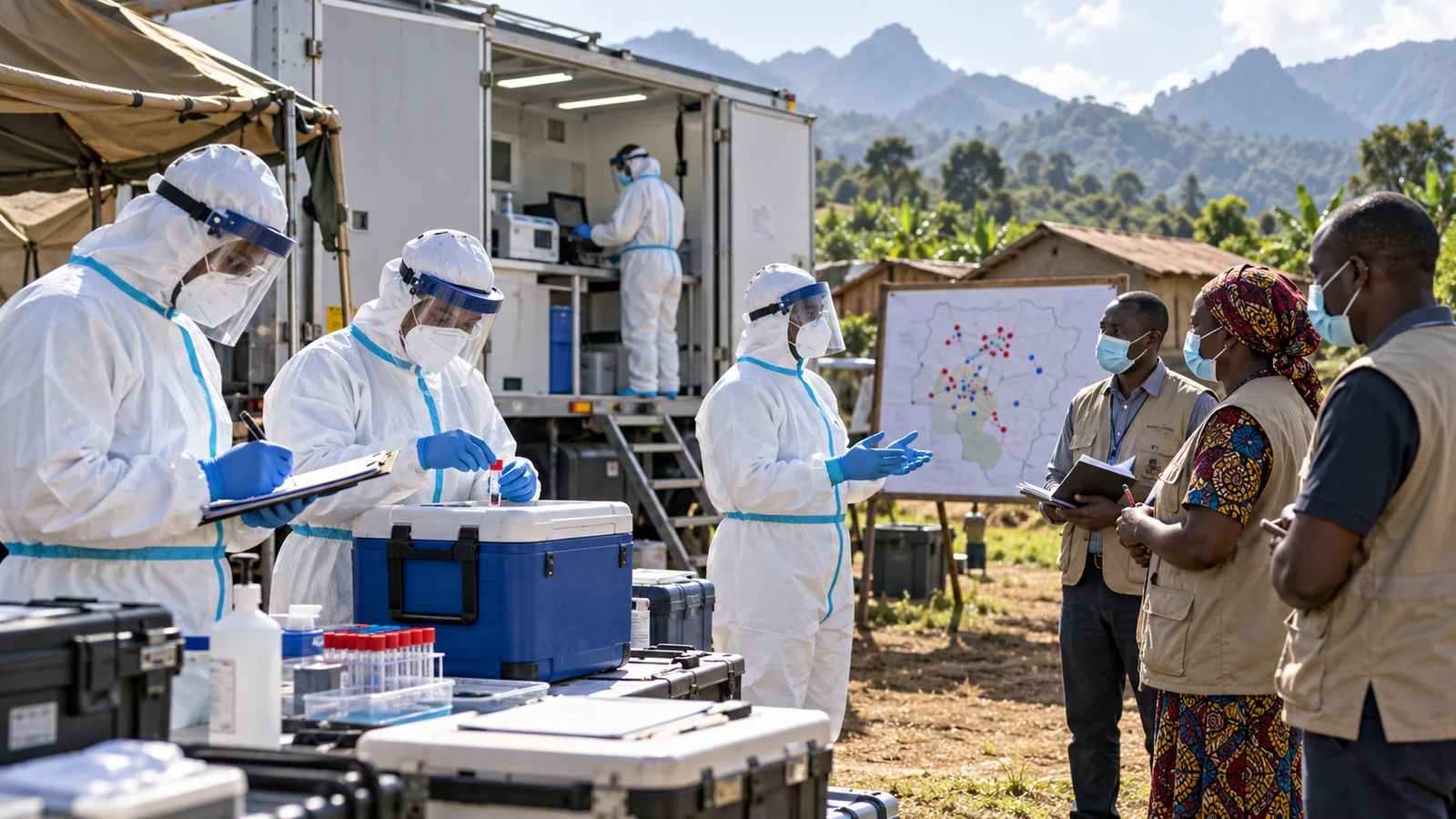
The 2026 Bundibugyo Ebola outbreak remains a serious regional health emergency, but the World Health Organization’s latest assessment does not support panic or broad travel restrictions. In its October 23 update, WHO reported sustained transmission in the Democratic Republic of the Congo, linked cases in Kenya and one imported case in Nigeria. The organization assessed the global public-health risk as low while emphasizing intensive surveillance, contact tracing, clinical care and cross-border coordination.
As of October 20, authorities had recorded 9,704 confirmed cases and 4,687 deaths in the Democratic Republic of the Congo. Kenya had reported nine cases, including one death, in a linked cluster; no wider community transmission had been identified there at the time of the WHO report. Numbers can change quickly during an outbreak, so readers should use dated official updates rather than screenshots or recycled social-media posts.
Bundibugyo Ebola outbreak 2026: key facts
| Indicator | WHO update dated October 23, 2026 |
|---|---|
| Main affected country | Democratic Republic of the Congo |
| DRC confirmed cases | 9,704 as of October 20 |
| DRC reported deaths | 4,687 as of October 20 |
| Kenya | Nine linked cases, including one death |
| Nigeria | One imported case reported |
| Global risk assessment | Low |
| WHO travel advice | No general travel or trade restrictions recommended |
The primary source for these figures and the risk assessment is WHO’s Disease Outbreak News report of October 23, 2026. “Low global risk” does not mean no risk. It means WHO judged widespread international transmission unlikely based on the evidence available at publication, while risk remained much higher in directly affected areas.
What is Bundibugyo virus disease?
Bundibugyo virus is one of the ebolaviruses known to cause severe disease in humans. It was first identified during an outbreak in Uganda in 2007. The illness belongs to the broader category of Ebola virus disease, but the species matters because vaccines, antibody treatments and diagnostic performance are not automatically interchangeable across ebolaviruses.
Early symptoms can resemble many common infections: fever, profound weakness, muscle pain, headache and sore throat. Vomiting, diarrhea, rash and impaired liver or kidney function may follow. Bleeding can occur, but it is not present in every patient and should not be treated as the defining sign. Laboratory testing is required because symptoms alone cannot reliably distinguish Bundibugyo virus disease from malaria, typhoid fever and other illnesses.
The incubation period—the time from infection to symptoms—is generally two to 21 days. People are not considered contagious before symptoms begin. Once ill, however, an infected person’s blood and other body fluids can contain virus, making rapid isolation, protected care and identification of contacts essential.
How Bundibugyo Ebola spreads
Transmission occurs through direct contact with the blood or body fluids of a symptomatic infected person, or with contaminated objects such as needles, medical equipment, clothing and bedding. Virus can enter through broken skin or mucous membranes in the eyes, nose or mouth. Caring for a sick relative without protective measures and preparing a body for burial can create particularly high exposure.
Ebola does not spread as easily as respiratory viruses that move efficiently through ordinary shared air. Casual proximity to a person without symptoms is not the main transmission route. Clear communication about this distinction protects the public while reducing stigma toward travelers, survivors, health workers and communities associated with an outbreak.
Sexual transmission from some survivors can occur because virus may persist in certain body fluids after recovery. Health authorities provide survivor programs, testing guidance and risk-reduction advice. Survivors should be supported rather than blamed; participation in follow-up care protects families and helps researchers understand persistence.
Why the DRC outbreak became so large
Outbreak size reflects far more than the biology of a virus. Delayed detection allows transmission chains to grow before response teams understand the pattern. Health facilities can amplify infection if staff lack protective equipment, safe triage space or rapid diagnostics. Population movement across trading routes and borders can carry symptomatic people or exposed contacts into new districts.
Conflict and insecurity can restrict access, interrupt laboratory transport and place both residents and responders in danger. Mistrust grows when communities receive contradictory information or see health measures imposed without explanation. Families may hide illness if isolation appears to mean abandonment or if treatment centers are far away. Effective control therefore depends on credible local leaders and dignified care, not only technical orders.
A sustained outbreak also strains routine medicine. Staff and supplies are redirected, vaccination programs may pause, and people may avoid clinics out of fear. Preventable deaths from malaria, childbirth complications and other conditions can rise. Response planning must keep essential health services operating while separating suspected Ebola cases safely.
What the Kenya and Nigeria cases mean
Cases in another country do not automatically mean uncontrolled national spread. An imported case is a person infected elsewhere and diagnosed after travel. Public-health teams reconstruct the journey, identify anyone who had relevant contact after symptoms began, monitor those contacts for 21 days and test new suspected cases rapidly.
WHO reported nine linked cases in Kenya, including one death, and stated that broader community transmission had not been detected there at the time. Nigeria reported one imported case. Those findings justify urgent response and transparent updates, but not claims that every traveler or every city is exposed. The situation can change, which is why official national and WHO notices should be checked for the newest locations and dates.
Cross-border cooperation is crucial. Passenger information, laboratory results and contact lists need to move faster than rumors. Neighboring districts should align case definitions and referral procedures so a patient is not lost between systems. Screening at transport hubs can support detection, but it cannot replace community surveillance because someone in the incubation period may have no fever or symptoms.
How contact tracing breaks transmission chains
A contact is someone who had a defined exposure to an infected person, usually during the symptomatic period or through contaminated materials. Trained teams assess the nature and timing of exposure, record reliable ways to communicate and check the person regularly for 21 days. Monitoring is not the same as assuming a contact is infected.
If a contact develops compatible symptoms, teams can arrange safe transport and testing before the person exposes many others. Speed is the key. A complete contact list created days late is less useful than a rapid list that local teams update as interviews improve. Digital tools can help, but privacy, consent and offline alternatives remain important in areas with weak connectivity.
Community trust determines whether people answer calls, report symptoms and name contacts. Support such as food, job protection, mental-health care and safe transportation makes monitoring feasible. Punitive quarantine or public identification can drive exposed people away from health services and undermine control.
Treatment and supportive care
WHO stated in its October update that no approved vaccine or specific treatment was available for Bundibugyo virus disease. Products proven against another ebolavirus should not be assumed effective without evidence. The TUMAINI vaccine trial launched on October 23 represents an important research response, but a clinical trial is not the same as an approved vaccination program.
Supportive care can still save lives. Patients may need oral or intravenous fluids, correction of electrolyte abnormalities, oxygen, blood-pressure support, treatment of secondary infections, nutrition and careful management of organ complications. Outcomes tend to improve when patients reach a capable treatment unit early.
Infection prevention protects health workers and other patients. Facilities require triage, hand hygiene, appropriate personal protective equipment, safe injection practices, environmental cleaning, waste management and trained observers for putting on and removing protective gear. Exhausted workers need rotations and psychosocial support because small mistakes can have severe consequences.
What the TUMAINI vaccine trial could establish
An outbreak trial can evaluate whether a candidate vaccine is safe and generates useful protection under real conditions. Researchers may use ring-vaccination strategies that enroll contacts and contacts of contacts around confirmed cases, depending on the protocol. Ethical review, informed consent, cold-chain reliability and independent safety monitoring remain essential even during an emergency.
Trial launch does not guarantee success. Investigators must determine how quickly immunity develops, how long it lasts, whether protection extends across age groups and whether rare adverse events occur. If case numbers decline, demonstrating effectiveness can become statistically difficult—an outcome that is good for the public but challenging for research.
Travel advice without panic
WHO did not recommend general restrictions on travel or trade in the October 23 report. Broad bans can disrupt essential supplies, harm economies and discourage countries from reporting outbreaks promptly. Airlines and border authorities may apply targeted health measures, and national guidance can change, so travelers should check official notices close to departure.
- Avoid direct contact with blood or body fluids of anyone who is ill.
- Do not handle items that may be contaminated with body fluids.
- Avoid contact with bodies and do not participate in unsafe burial preparation.
- Follow local instructions around health facilities and outbreak zones.
- Know how to contact public-health authorities at your destination and after returning.
- Do not stigmatize people based on nationality, occupation or travel history.
A traveler who develops fever or compatible symptoms within 21 days of a possible exposure should contact local public-health authorities immediately and explain the exposure and travel history. Do not arrive unannounced at a crowded clinic or use public transport to seek care; authorities can arrange an appropriate assessment route that protects others.
How to recognize reliable outbreak information
- Look for a publication date and the date through which case data were collected.
- Prefer WHO and national health-ministry reports over unattributed graphics.
- Separate confirmed, probable and suspected cases rather than adding them indiscriminately.
- Check whether a risk assessment is local, regional or global.
- Be cautious when old outbreak photographs are reused as current evidence.
- Do not share names or addresses of patients and contacts.
Case totals may be revised when duplicate records are removed or laboratory results change classification. A correction is not automatically evidence of concealment; transparent surveillance systems routinely update datasets as investigations mature.
Frequently asked questions
Is Bundibugyo Ebola airborne?
Routine person-to-person transmission occurs through direct contact with infected body fluids or contaminated materials after symptoms begin. It does not spread through ordinary shared air as efficiently as measles or influenza.
Can someone transmit the virus before symptoms?
WHO guidance indicates that people become infectious after they develop symptoms. Monitoring exposed contacts for the full 21-day incubation window allows rapid action if illness begins.
Is there a vaccine?
As of the WHO update, no vaccine was approved specifically for Bundibugyo virus disease. The TUMAINI clinical trial is evaluating a candidate during the outbreak; participation and access follow the trial protocol.
Should people cancel all travel to Africa?
No. Africa is a vast continent, and risk is not uniform. WHO did not recommend general travel or trade restrictions. Travelers should use location-specific official guidance and consider their itinerary and activities.
The bottom line
The Bundibugyo Ebola outbreak demands sustained international support because transmission in the Democratic Republic of the Congo remains substantial and cross-border cases have occurred. At the same time, accurate risk communication matters: WHO’s global assessment was low, Kenya had not shown wider community spread at the report date, and blanket travel bans were not recommended.
The most effective response is familiar but demanding—rapid diagnosis, dignified isolation and care, complete contact tracing, protected health workers, safe burials, trusted community partnership and transparent research. Read our broader guide to understanding Ebola virus disease, our feature on hantavirus and global public-health challenges, or browse the Medicine and Health section.
Health note: This article provides general public-health information, not personal medical advice. Anyone with a possible exposure or symptoms should contact local public-health authorities immediately and follow their instructions.
