
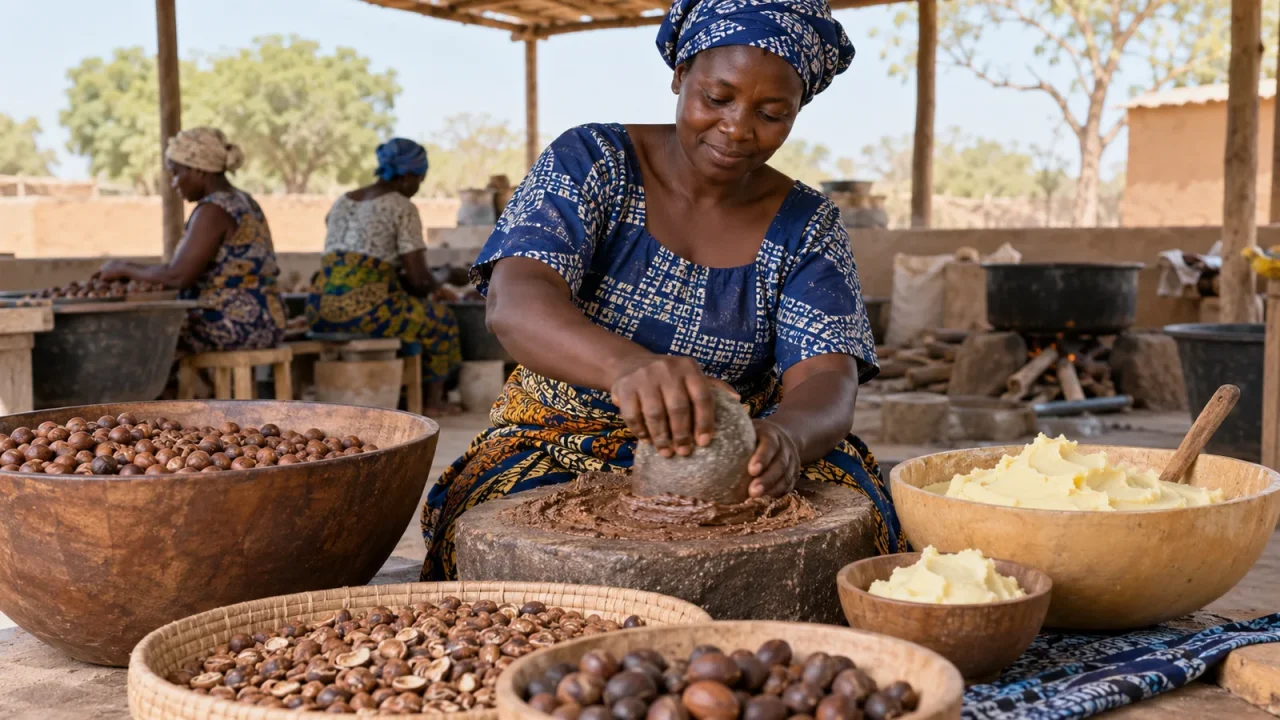
Shea butter begins with the fruit of Vitellaria paradoxa, a tree native to the savanna belt of sub-Saharan Africa. The creamy fat is used locally in cooking and skin care and internationally in cosmetics, soap, and confectionery. The finished product may look simple, but its quality reflects dozens of decisions made during collection, drying, storage, extraction, refining, and transport.
This guide explains how shea butter is made without erasing the people and landscapes behind it. Traditional processing is skilled work, often performed by women’s groups. Mechanical presses and industrial refining change labor, yield, color, odor, and market destination, but they do not create shea’s value from nothing; that value begins with trees, fruit, and careful postharvest handling.
The process in brief
- Ripe fruit is collected after falling naturally.
- Pulp is removed and the nuts are cleaned.
- Nuts are boiled or parboiled, then dried.
- Shells are cracked and kernels sorted.
- Kernels are crushed and often roasted.
- The material is milled into a paste.
- Fat is released by kneading with water or by mechanical pressing.
- Crude butter is clarified, filtered, cooled, packed, and sometimes refined.
The shea tree and its range
Shea grows across a broad African belt from West Africa into East Africa. The tree thrives in parkland systems where farming and naturally occurring trees coexist. It grows slowly and can take many years to bear substantial fruit, which makes mature trees a long-term ecological and economic asset rather than a crop that can be replaced in one season.
Two subspecies are commonly discussed: Vitellaria paradoxa subsp. paradoxa in West Africa and subsp. nilotica farther east. Butter characteristics vary with genetics, climate, soils, harvest, and processing. Country name alone cannot predict every batch.
1. Collecting ripe fruit
Ripe shea fruit generally falls from the tree and is collected from the ground. Harvesters sort out damaged, immature, moldy, or contaminated fruit. Timing matters: delays can encourage fermentation, insect damage, and changes in the kernel that later increase free fatty acids or off-odors.
The sweet pulp is edible and is removed to expose the nut. It may be eaten, washed away, or processed according to local practice. Clean collection containers and separation from soil, fuel, chemicals, and animals help protect quality.
2. Treating and drying the nuts
Nuts are commonly boiled or parboiled to stop germination and enzymatic activity, loosen remaining pulp, and prepare them for drying. Practices vary: some systems smoke, roast, or use other heat treatments. Process control matters because excessive heat or smoke can darken kernels and create strong flavors or odors.
Drying reduces moisture for safer storage. Nuts may be sun-dried on clean raised surfaces or tarpaulins rather than directly on soil. They must be turned and protected from rain and nighttime humidity. Incomplete drying encourages mold and hydrolytic rancidity; excessive or contaminated drying can also damage quality.
3. Shelling and sorting kernels
The hard outer shell is cracked to release the kernel. Manual shelling uses stones, mortars, or simple tools; mechanical crackers increase throughput. Workers sort out blackened, moldy, insect-damaged, or rancid kernels. This stage has a strong effect on color, odor, and chemical quality.
Kernels may be stored before extraction. Dry, ventilated storage and clean bags help prevent moisture uptake and contamination. Traceability by harvest area, group, and lot can support quality control and buyer confidence.
4. Crushing and roasting
Traditional extraction usually crushes kernels into smaller pieces and roasts them. Roasting reduces moisture, develops aroma and color, and helps rupture oil-bearing cells. Uneven roasting produces mixed results: under-roasted pieces release fat poorly, while scorching creates bitterness, dark color, smoke contamination, and degraded oil.
Fuel efficiency and ventilation are important. Open fires expose processors to smoke and consume wood. Improved roasters, chimneys, controlled heat, and alternative fuels can reduce exposure and improve consistency when they fit local needs and maintenance capacity.
5. Milling into paste
Roasted pieces are ground into a dense brown paste. Historically, pounding in a mortar required significant labor. Motorized mills save time and produce a more uniform particle size, but equipment must be cleaned between lots and protected from lubricants, metal fragments, and previous material.
Fine grinding increases the surface area and releases fat more effectively during the next stage. The paste may be warmed to keep the fat fluid, but uncontrolled high temperature can damage quality.
6. Kneading and churning with water
In a widely used traditional method, warm water is gradually added while the paste is kneaded or churned. The mixture changes texture and color as fat droplets separate and form an emulsion. Continued agitation allows the lighter fat-rich portion to rise, while heavier solids and water remain below.
This is skilled sensory work. Processors judge temperature, water amount, rhythm, texture, color, and when separation is ready. Too much water increases fuel use later; too little or incorrect temperature reduces recovery. Calling the method “primitive” ignores its technical knowledge, even when equipment improvements can reduce labor.
7. Washing and separating the fat
The floating fat is collected and may be washed repeatedly with clean water to remove brown solids. It is then heated so residual water evaporates and remaining impurities settle or can be filtered. Boiling must be controlled: incomplete water removal shortens shelf life, while prolonged overheating darkens butter and accelerates oxidation.
The clarified liquid fat is filtered through clean cloth or suitable filters into clean containers. As it cools, it becomes an ivory, beige, yellow, or sometimes greener solid depending on source and process.
8. Mechanical pressing
Mechanical systems condition crushed kernels and use a screw or hydraulic press to express oil. Pressing reduces kneading labor and can increase throughput. Some small-scale designs are manually operated; industrial lines use controlled heating and powered expellers.
Pressing does not eliminate preparation. Kernel moisture, temperature, particle size, and equipment condition affect yield and quality. Press cake retains some fat and may have other uses if safe and economically feasible. Maintenance, spare parts, energy, ownership, and access determine whether a press benefits producers over time.
9. Refining shea butter
Crude or unrefined butter retains more natural color and aroma. Industrial buyers may refine it through degumming, neutralization, bleaching with adsorbent earth, filtration, and deodorization under vacuum. Refining produces a pale, low-odor fat with more standardized properties for cosmetics or food manufacture.
“Unrefined” is not automatically superior for every use, and “refined” is not automatically toxic. The relevant questions are identity, contaminant control, oxidation, microbial quality, intended use, and whether processing is performed under appropriate standards. Refining may remove some minor compounds along with undesirable odor, color, or free fatty acids.
Fractionation and specialized ingredients
Shea butter contains several fatty acids and a relatively high proportion of nonsaponifiable compounds compared with many oils. Manufacturers can separate it into higher-melting stearin and lower-melting olein fractions. Stearin has applications in confectionery fats and structured cosmetic products; olein is softer and more fluid.
Fractionation changes physical behavior rather than creating a different botanical source. Ingredient names and local food regulations determine how products must be declared.
What determines quality?
- Free fatty acids: high levels can indicate hydrolysis from delayed processing, moisture, or poor storage.
- Peroxide value: reflects primary oxidation products; light, heat, oxygen, and metals accelerate oxidation.
- Moisture and impurities: residual water and solids reduce stability.
- Odor and color: influenced by kernels, smoke, roasting, clarification, and oxidation.
- Contaminants: soil, microbes, pesticides, mineral oil, smoke compounds, metals, or adulterants require control.
- Traceability: lot identity makes testing, corrective action, and fair purchasing more credible.
A smooth texture or pale color alone does not prove purity. Laboratory specifications and supply-chain controls are more informative than social-media tests such as melting a spoonful or judging graininess.
Why shea butter can become grainy
Shea fat can crystallize in different forms. If it partially melts and cools slowly or unevenly, some fractions crystallize into noticeable grains. This is usually a texture issue rather than proof of contamination. Controlled melting and cooling can restore smoothness, though repeated heat exposure can promote oxidation.
Storage and shelf life
Store shea butter in clean, airtight, light-resistant packaging in a cool, dry place. Use clean utensils and avoid introducing water. Rancid odor, major color change, mold, or contamination means the product should be discarded. A manufacturer’s shelf life depends on testing, packaging, antioxidants, and storage—not a universal internet date.
People, labor, and value
FAO materials document shea processing as an important income source for rural women. Yet the highest retail price does not guarantee that collectors and processors receive a fair share. Value chains may include collectors, local processors, traders, exporters, refiners, brands, and retailers, each with different bargaining power.
Responsible sourcing should look beyond a “women’s empowerment” label. Useful evidence includes transparent pricing, long-term purchasing relationships, group governance, safe working conditions, prefinancing that does not create dependency, quality training, local processing value, and independently verified claims.
Sustainability and tree regeneration
Shea parklands support livelihoods and biodiversity, but mature trees face pressure from land conversion, fuelwood demand, shortened fallows, fire, and climate stress. Protecting existing trees is not enough if young trees never survive to replace them. Regeneration, land rights, farming incentives, and locally led management are part of a durable supply chain.
Efficient processing can reduce fuel and water use, but a machine is not automatically sustainable. It must be repairable, appropriately scaled, safe, and economically controlled by the people expected to use it.
How to read a shea product label
The cosmetic ingredient name is commonly Butyrospermum Parkii (Shea) Butter. A short ingredient list helps identify whether you are buying pure butter or a formulated cream. “Raw,” “natural,” “organic,” “fair trade,” and “unrefined” are different claims; ask what standard or certification supports each one.
For food use, buy a product specifically produced and labeled for consumption under relevant local regulation. Cosmetic-grade packaging is not proof of food-grade controls.
Frequently asked questions
Is yellow shea butter more authentic?
Color varies by kernels, location, roasting, plant additives in some traditions, filtration, and refining. Color alone cannot verify identity or quality.
Is unrefined shea butter always better?
No. It retains aroma and minor constituents, while refined butter offers consistency and lower odor. Quality, freshness, contamination control, and intended use matter more than a single label.
Can shea butter trigger allergy?
Allergic reactions appear uncommon but are possible. Stop use if swelling, hives, wheezing, or severe irritation occurs and seek medical care for serious symptoms.
Does shea butter lighten skin?
Shea is an emollient, not a proven skin-bleaching agent. Avoid unregulated lightening mixtures that may contain potent steroids, mercury, or hydroquinone without medical oversight.
Bottom line
Shea butter is the result of a long chain: ripe fruit, protected trees, careful nuts, controlled heat, fine milling, skilled separation or pressing, clean clarification, testing, and storage. Understanding that chain makes it easier to judge quality and harder for a brand to reduce the product to a vague “natural” story. Good shea respects both chemistry and the people whose work makes it possible.
Sources
- FAO: Minor oil crops—Shea nut
- FAO: Shea trade and sustainable forest management
- FAO: Mechanical pressing for shea butter production
Evidence reviewed: October 16, 2026.