
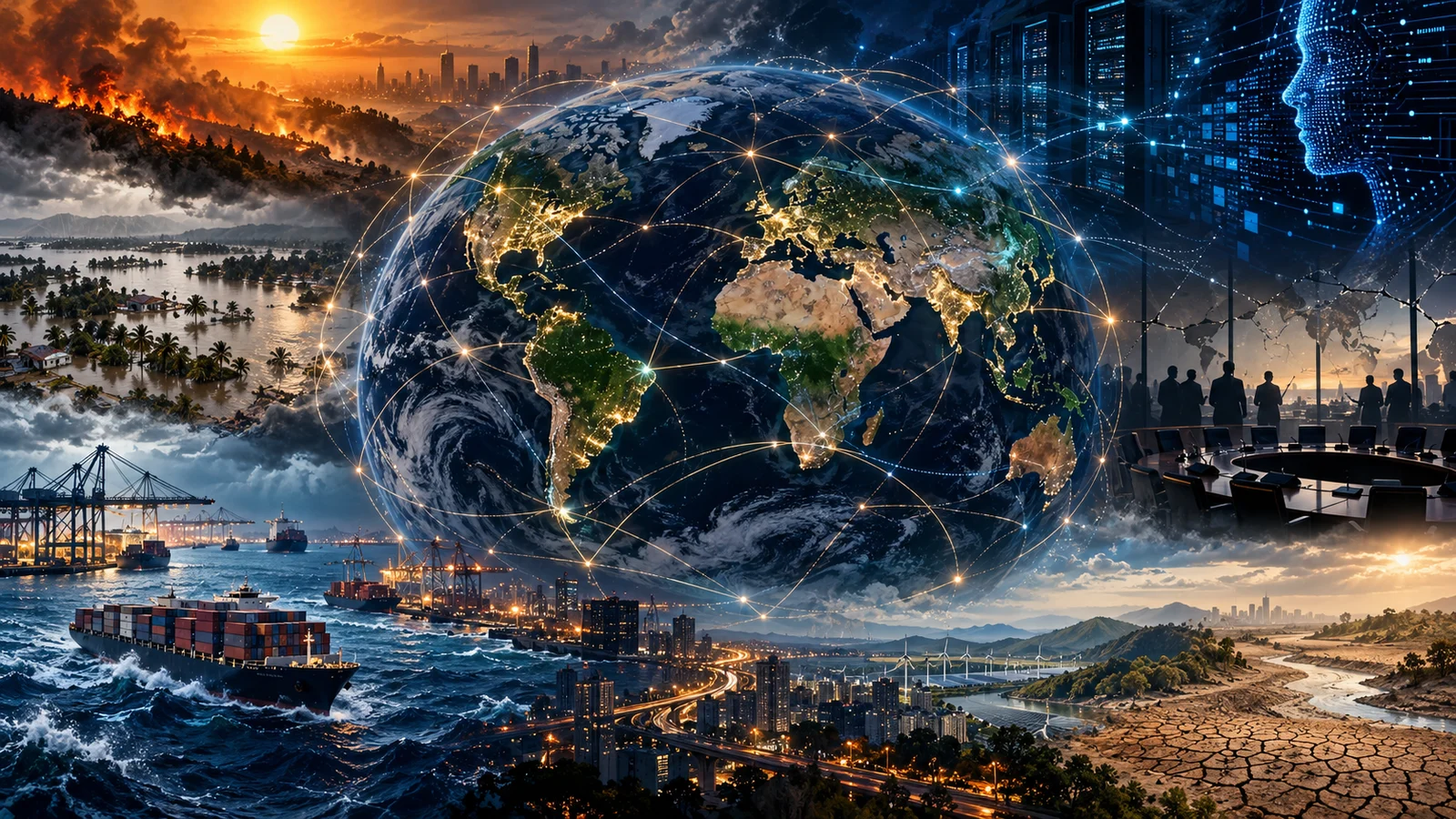
The UN Global Risk Report 2026 describes a world in which conflict, climate disruption, artificial intelligence and economic instability are no longer separate problems. They interact, amplify one another and increasingly outrun the institutions meant to manage them. Among more than 1,300 stakeholders across 155 countries, 36% expected a large-scale interstate war within one year, while climate inaction remained the highest-ranked overall risk.
The report is not a prediction that any one catastrophe will happen on a fixed date. It is a structured assessment of 28 global risks, combining perceptions about likelihood, severity, preparedness and cooperation. Its central message is practical: governments and institutions understand many of the threats, but fragmented decision-making and inadequate investment are weakening the world’s ability to reduce them.
UN Global Risk Report 2026: key findings
- More than 1,300 stakeholders from 155 countries contributed to the assessment.
- The report evaluates 28 risks across environmental, technological, geopolitical, economic and social domains.
- Thirty-six percent of respondents saw a large-scale interstate war as likely within one year; concern rose substantially over a seven-year horizon.
- Failure to curb greenhouse-gas emissions and adapt to climate change ranked as the leading overall risk.
- Concern about artificial intelligence and other frontier technologies increased sharply.
- Respondents generally preferred international cooperation, but many judged current funding and institutional capacity inadequate.
The full publication and its methodology are available from the United Nations Global Risk Report hub. Readers should consult the report itself when comparing rankings because short summaries can blur distinctions between near-term likelihood, long-term severity and the capacity to respond.
What the report measures—and what it does not
Risk rankings are often mistaken for forecasts. A forecast attempts to estimate a specific outcome under defined assumptions; a global risk survey captures informed judgments from a broad group at a particular moment. Respondents may weigh recent crises heavily, and experts from different regions can experience the same risk in very different ways. The value lies less in a precise league table than in patterns across likelihood, impact and readiness.
The report’s global reach helps reveal shared concerns, but it cannot eliminate uncertainty. Cyber incidents are underreported, climate impacts vary geographically, AI capabilities change rapidly and armed-conflict decisions are deliberately opaque. The resulting scores should guide questions and resource allocation, not create false certainty.
Another important distinction is between a hazard and systemic risk. A flood is a hazard; it becomes a wider systemic crisis when it disables power, destroys crops, displaces communities, spreads disease and strains public finances. The report emphasizes these connections because modern infrastructure and markets transmit shocks across borders rapidly.
Why interstate war moved to the foreground
The finding that 36% of participants expected a large-scale interstate war within one year is alarming, but it needs context. It represents respondents’ assessment of likelihood, not an official UN probability model. The figure reflects an environment marked by unresolved wars, military modernization, nuclear signaling, contested borders and weakening trust between major powers.
Conflict has effects far beyond a battlefield. It can interrupt grain and fuel shipments, damage digital cables and ports, redirect public budgets, generate displacement and make cooperation on health or climate harder. Even countries distant from fighting may experience higher food prices, insurance costs, shipping delays or pressure on humanitarian systems.
Escalation risks also grow when communications fail. Misread military exercises, automated warning systems, cyber operations and manipulated media can shorten decision time. Practical risk reduction therefore includes reliable diplomatic channels, crisis hotlines, arms-control mechanisms, civilian protection and agreements that keep essential trade and communications functioning during political disputes.
Climate inaction remains the highest overall risk
Geopolitical crises dominate daily headlines, yet the report still places failure to curb emissions and adapt to climate change at the top overall. That ranking reflects climate change’s breadth and persistence. Heat, drought, wildfire, flooding and sea-level rise affect health, agriculture, water, energy systems, ecosystems, migration and government budgets at the same time.
Mitigation and adaptation solve different parts of the problem. Mitigation reduces future warming by cutting greenhouse-gas emissions and protecting carbon sinks. Adaptation reduces damage already becoming unavoidable through heat-resilient buildings, early-warning systems, water management, flood protection and climate-ready health services. Neglecting either side increases long-term costs.
Climate risk also illustrates unequal exposure. Communities that contributed least to historical emissions often have the least fiscal space to rebuild after a disaster. Small island states, arid regions and informal urban settlements can face severe losses even when global averages appear manageable. That is why climate finance, insurance design and access to resilient infrastructure are integral to risk management rather than charitable additions.
AI and frontier technology are rising faster than governance
Artificial intelligence moved higher in the 2026 risk picture because capabilities and adoption have expanded faster than many regulatory systems. The risk is not one single scenario. It includes fraud at scale, convincing synthetic media, discrimination in automated decisions, privacy loss, insecure AI agents, labor-market disruption and the concentration of computational power in a small number of organizations.
AI can also reduce risk. Models can improve weather forecasts, detect disease patterns, optimize energy networks and translate crisis information. The policy challenge is to preserve those benefits while creating meaningful accountability. That requires testing high-impact systems, documenting limitations, protecting personal data, enabling independent evaluation and retaining human responsibility for consequential decisions.
International coordination matters because software crosses borders. If safety rules differ dramatically, developers may relocate risky activity while harmful outputs remain globally accessible. Yet a single rigid framework could be outdated quickly. A workable approach combines common principles—transparency, security, human rights and incident reporting—with sector-specific rules for medicine, finance, education, employment and defense.
Misinformation connects technological and political risk
Synthetic media can turn an old governance problem into a faster, cheaper one. Fabricated audio, video and documents may be used to impersonate officials, inflame tensions or manipulate markets. The harm does not require everyone to believe a fake. A flood of uncertain material can produce the “liar’s dividend,” in which genuine evidence is dismissed as artificial.
Resilience requires more than deleting content after it spreads. Public institutions need rapid authentication channels, newsrooms need verification capacity, political campaigns need clear disclosure rules, and citizens need simple ways to confirm urgent claims. Provenance technology can help, but it will not replace trusted institutions and transparent correction practices.
Economic fragility can turn shocks into crises
High debt, unequal growth and limited fiscal space shape every other risk. A wealthy state may absorb a disaster through insurance and borrowing; a heavily indebted country may be forced to cut health or education spending precisely when people need support. Inflation and unemployment can then weaken social trust and intensify political polarization.
Supply chains are another transmission route. Firms improved resilience after pandemic-era disruption, but efficiency pressures still encourage concentration in a handful of ports, suppliers or semiconductor facilities. Conflict, extreme weather or cyberattack at one critical node can delay manufacturing worldwide. Diversification, strategic inventories and interoperable logistics are therefore risk investments, not merely extra costs.
The preparedness gap is the report’s most actionable warning
Identifying threats is not the same as being prepared. The report found widespread concern that financing is inadequate and that capacity to reduce many risks has deteriorated. This gap appears when governments announce strategies without budgets, collect data without sharing it, or build emergency plans that are never tested under realistic conditions.
Preparedness is difficult to defend politically because success often looks like nothing happened. A reinforced bridge that remains open during a flood does not generate the drama of a rescue. A secure hospital network rarely makes news. Nonetheless, prevention usually costs less than unmanaged crisis response and protects more people.
- Fund capabilities, not only plans: staffing, maintenance and exercises determine whether a strategy works.
- Map interdependence: identify where power, communications, transport, water and finance rely on the same vulnerable nodes.
- Publish measurable targets: transparent milestones allow legislatures, auditors and communities to track progress.
- Include local knowledge: municipalities and frontline organizations often see weaknesses before national institutions do.
- Design for failure: backup systems and manual procedures matter when digital or physical networks go down.
Why cooperation remains rational even in a divided world
Survey respondents broadly supported international cooperation because no country can isolate itself from climate, pandemics, cyber incidents or financial contagion. Cooperation does not require governments to agree on every political issue. Narrow arrangements can protect shared interests: disease surveillance, disaster warnings, maritime safety, nuclear-risk reduction and technical standards.
Successful agreements often begin with verifiable, limited commitments. States may share storm data even while competing economically, or establish incident hotlines without resolving a territorial dispute. These mechanisms reduce misunderstanding and preserve a foundation for wider action. The UN Secretary-General’s launch remarks emphasize the need to move from risk awareness to collective response; the official briefing transcript provides the full context.
What governments can do in the next 12 months
- Create a national risk register that identifies cascading impacts and assigns clear ownership.
- Stress-test critical infrastructure against compound events, such as a heatwave occurring during a cyberattack.
- Protect independent science, statistics and public communication from political manipulation.
- Maintain diplomatic and military de-escalation channels during periods of tension.
- Set minimum security and audit requirements for high-impact AI systems.
- Finance climate adaptation where current exposure and social vulnerability are greatest.
- Track whether resilience spending reaches local institutions responsible for delivery.
The point is not to solve all 28 risks at once. It is to prioritize interventions that reduce several risks together. Reliable electricity supports hospitals, communications and heat adaptation. Trusted public information improves responses to conflict, disease and disasters. Strong social protection prevents temporary shocks from becoming lasting poverty.
What businesses and institutions should take from the report
Companies should examine dependencies beyond direct suppliers. A manufacturer may have two vendors that both rely on the same port, cloud provider or mineral processor. Universities and hospitals should test continuity plans for prolonged power, network or supply disruption. Financial institutions should evaluate whether climate, geopolitical and cyber risks are correlated rather than independent.
Boards also need indicators that lead rather than lag. Insurance claims describe harm after it occurs; rising water stress, employee heat exposure, software vulnerabilities and shipping concentration can signal danger earlier. Risk reporting should connect these indicators to decisions, capital investment and accountability rather than becoming an annual compliance document.
How readers can interpret frightening risk headlines
- Check whether a number describes likelihood, severity, perception or observed events.
- Note the time horizon: one-year and ten-year assessments answer different questions.
- Read the methodology and sample before treating survey results as a precise forecast.
- Look for absolute values, not only percentage increases.
- Separate global rankings from the risks most relevant to your region or organization.
- Ask which interventions have evidence behind them and who is responsible for delivery.
Frequently asked questions
Does the UN report predict a world war in 2026?
No. It reports that 36% of surveyed stakeholders considered a large-scale interstate war likely within one year. That is a serious perception indicator, not a deterministic forecast.
What is the top global risk?
Failure to reduce greenhouse-gas emissions and adapt to climate change ranked first overall, while rankings vary by time horizon and dimension.
Why is AI included with war and climate?
AI can affect information integrity, cybersecurity, employment, public services and military decisions. It can also help manage risks, which makes governance and responsible deployment essential.
The bottom line
The UN Global Risk Report 2026 is most useful as a map of interdependence. War can disrupt food and energy; climate disasters can deepen debt; AI can accelerate both scientific response and manipulation; weak institutions can magnify all of them. The report’s bleakest finding is not that danger exists, but that preparedness and financing are failing to keep pace.
That conclusion leaves room for action. Resilient infrastructure, credible institutions, responsible technology rules and practical cross-border agreements can reduce several threats at once. Continue with our analysis of the Strait of Hormuz and global trade security, or browse more international reporting in AroundWorld.
