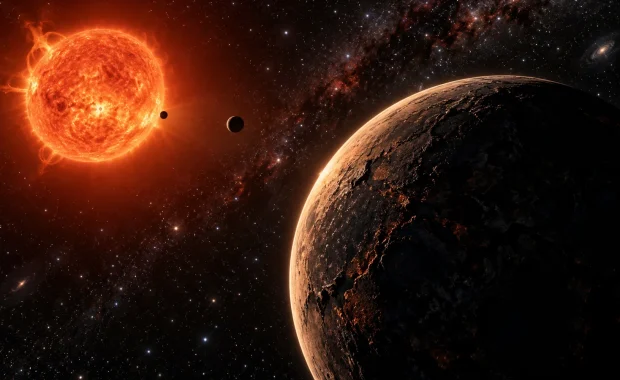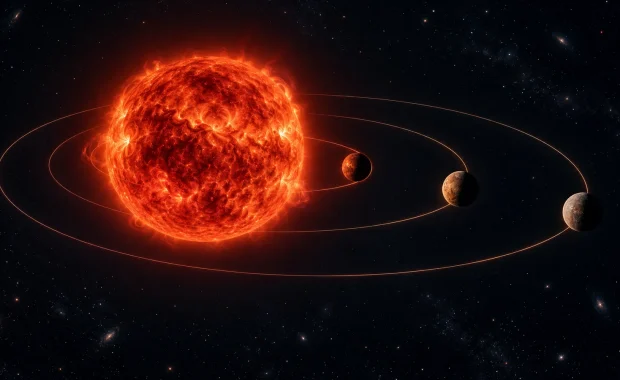

The universe, with its boundless expanse, continues to unveil its secrets through relentless scientific inquiry and technological advancements. Among the most captivating discoveries of recent decades are exoplanets—planets orbiting stars beyond our solar system. These distant worlds serve as natural laboratories for understanding planetary formation, evolution, and the potential for extraterrestrial life. As the search for habitable environments extends beyond the confines of Earth, one particular exoplanet, K2-373 b, has garnered significant attention within the astronomical community. Situated approximately 749 light-years away from Earth, K2-373 b exemplifies a Super-Earth—a class of planets that are larger than Earth but smaller than Neptune—offering crucial insights into the diversity of planetary systems in our galaxy. This comprehensive exploration of K2-373 b, published on the esteemed platform Free Source Library (freesourcelibrary.com), aims to present an in-depth analysis of its discovery, physical and orbital characteristics, environmental implications, and its significance for future exoplanet research.
Discovery and Observational Techniques
The detection of K2-373 b was made possible through the use of the Kepler Space Telescope, an iconic instrument launched by NASA with the primary goal of identifying Earth-like planets orbiting distant stars. Following the original mission, which concluded in 2018, the spacecraft was repurposed for the K2 mission, extending its observational capabilities and allowing astronomers to survey new regions of the Milky Way. The K2 mission’s strategy involved targeting specific fields along the ecliptic plane, monitoring thousands of stars simultaneously for periodic dips in brightness indicative of planetary transits.
The transit method, a cornerstone technique in exoplanet detection, relies on precise photometric observations to identify minute decreases in stellar luminosity. When a planet passes in front of its host star, it blocks a fraction of the star’s light, resulting in a temporary dip detectable by highly sensitive instruments aboard the space telescope. Repeated transits at regular intervals confirm the planetary nature of the object and allow researchers to infer key parameters such as orbital period, size, and, with supplementary data, mass and density.
In the case of K2-373 b, the transit signals were observed consistently over multiple observation cycles. The periodicity of approximately 11 days indicated a close-in orbit, signifying the planet’s proximity to its parent star. The depth and shape of the transit curves provided initial estimates of the planet’s radius, which, combined with follow-up spectroscopic observations, facilitated the derivation of its mass. Such detailed characterization underscores the importance of combining photometry with spectrometry to accurately determine exoplanet properties.
Physical Characteristics of K2-373 b
Mass, Radius, and Composition
K2-373 b’s physical parameters place it firmly within the Super-Earth category, with a mass approximately 4.9 times that of Earth. Its radius, about 2.061 times Earth’s radius, indicates a significantly larger planetary body. These measurements suggest that the planet is predominantly rocky but may possess a substantial atmosphere or a different internal composition compared to terrestrial planets in our solar system.
The mass-to-radius ratio hints at possible internal structures. For example, a higher mass relative to size could imply a denser, iron-rich core, whereas a lower density might suggest the presence of volatiles or a thick gaseous envelope. The density calculations, derived from the combined transit and radial velocity data, suggest that K2-373 b is likely to have a rocky core with potential atmospheric layers, though definitive conclusions await further observational data.
Understanding the composition of Super-Earths like K2-373 b is central to unraveling planetary formation processes. The planet’s size and mass suggest it could have formed through core accretion within the protoplanetary disk, accumulating material from the surrounding nebula. Its size also raises questions about the boundary between rocky planets and mini-Neptunes, as the presence of a thick atmosphere could significantly influence surface conditions.
Atmospheric Conditions and Potential Habitability
The atmospheric properties of K2-373 b remain largely speculative at this stage. Given its proximity to its star and the resulting high temperatures, its atmosphere, if present, is likely subjected to intense stellar irradiation. A thick, greenhouse-gas-rich atmosphere could lead to extreme surface heating, akin to the runaway greenhouse effect observed on Venus. Conversely, a tenuous atmosphere might mean the planet’s surface is exposed to harsh radiation, making habitability unlikely.
Future observations, particularly those involving transmission spectroscopy during transits, may reveal the presence of atmospheric constituents such as water vapor, carbon dioxide, methane, or other molecules of interest. Detection of these compounds could provide clues about the planet’s potential for supporting life or, at least, its geological and chemical activity.
Orbital Dynamics and Environmental Conditions
Orbit and Distance from the Host Star
K2-373 b completes an orbit in roughly 11 days, a period significantly shorter than Earth’s 365 days. Such a rapid orbit indicates a close-in position around its parent star, which is a star of relatively low luminosity, with a magnitude of approximately 10.47. The short orbital period suggests the planet is located within a few hundredths of an astronomical unit from its star, exposing it to intense stellar radiation and gravitational forces.
The orbital eccentricity of 0.0 indicates a near-perfect circular orbit, which stabilizes environmental conditions over the planet’s annual cycle. This stability could influence the climate and geological processes, although the high temperature environment resulting from proximity to the star likely dominates the planetary conditions.
Star Characteristics and Influence
The host star of K2-373 b is a faint, relatively dim star with a low luminosity. Its brightness, not sufficient for naked-eye visibility from Earth, requires telescopic observation for detailed study. The star’s spectral type and activity levels influence the planet’s atmospheric retention, surface temperature, and potential habitability.
Low stellar brightness typically correlates with lower energy output, which might suggest a cooler environment for planets at greater distances. However, K2-373 b’s close orbit compensates for this, resulting in high surface temperatures that could be inhospitable for life as we know it. The star’s activity, including flares and stellar winds, could also strip planetary atmospheres, further complicating habitability prospects.
Implications for Exoplanet Science and Future Research Directions
Understanding Planet Formation and Evolution
The discovery of K2-373 b enriches our understanding of planetary formation mechanisms, particularly within close-in orbits around low-luminosity stars. Its size and mass provide evidence supporting core accretion models, where planetesimals coalesce into larger bodies within the protoplanetary disk. The planet’s characteristics also contribute to the ongoing debate regarding the transition between rocky Super-Earths and gaseous mini-Neptunes, which has profound implications for theories of atmospheric evolution and retention.
Moreover, the data from K2-373 b can inform models of planetary migration. Its close proximity to its star raises questions about whether it formed in situ or migrated inward during the early stages of the system’s evolution. Understanding these processes helps clarify the dynamics of planetary system architectures and the factors influencing habitability zones.
Assessing Habitability and the Search for Life
Although K2-373 b’s environmental conditions seem inhospitable, studying such planets broadens our perspective on the range of possible planetary environments. Future missions equipped with advanced spectrometers, such as the James Webb Space Telescope (JWST), are poised to analyze exoplanet atmospheres with unprecedented precision. Detecting molecules associated with biological processes, such as methane or oxygen, could revolutionize our understanding of life’s potential beyond Earth.
While K2-373 b itself may not be a prime candidate for habitability, its study offers valuable data points for refining criteria for life-supporting planets. Identifying the atmospheric composition, surface conditions, and geological activity of similar Super-Earths will help delineate the boundaries of the habitable zone and inform target selection for future exploratory missions.
Technological Advances and Observational Strategies
The ongoing development of telescopic instrumentation, data processing algorithms, and observational techniques is crucial for advancing exoplanet research. Ground-based observatories equipped with high-resolution spectrometers complement space telescopes by providing detailed atmospheric data. Innovative methods such as direct imaging, coronagraphy, and starshade technology aim to overcome the challenges posed by stellar glare and enable the visualization of exoplanets directly.
In addition, machine learning algorithms and big data analytics are increasingly employed to sift through vast datasets, identify subtle transit signals, and model planetary atmospheres. These technological strides are essential for characterizing planets like K2-373 b, especially given the faintness of their host stars and the subtlety of the signals involved.
Data and Comparative Analysis
| Parameter | K2-373 b | Earth | Neptune |
|---|---|---|---|
| Mass | 4.9 Earth masses | 1 Earth mass | 17.15 Earth masses |
| Radius | 2.061 Earth radii | 1 Earth radius | 3.88 Earth radii |
| Orbital Period | ~11 days | 365 days | ~165 days |
| Orbital Distance (Est.) | Likely <0.1 AU | 1 AU | ~0.3 AU |
| Orbital Eccentricity | 0.0 (circular) | 0.0167 | 0.009 |
| Host Star Magnitude | 10.47 | -26.74 (Sun) | -6.91 (Sun) |
This comparative table underscores the distinctiveness of K2-373 b in terms of size, orbital dynamics, and host star characteristics, emphasizing its importance as a case study in exoplanetary sciences.
Challenges and Limitations
The study of K2-373 b faces several challenges, primarily due to the faintness of its host star and its close-in orbit. The weak stellar signal complicates the detection of atmospheric molecules and the precise measurement of planetary parameters. Furthermore, the high levels of stellar activity, including flares and radiation bursts, can interfere with observational data, introducing noise and uncertainties.
Another limitation involves the current technological constraints. While space-based observatories like JWST promise significant improvements, the direct imaging of such distant, faint planets remains difficult. Additionally, the temporal scope of observations is limited, preventing long-term monitoring of atmospheric and geological evolution.
Future Prospects and Missions
Upcoming missions and technological innovations are poised to revolutionize our understanding of planets like K2-373 b. The James Webb Space Telescope, scheduled for operational deployment, will provide high-resolution spectroscopic data capable of detecting atmospheric signatures with unprecedented sensitivity. This will significantly enhance our ability to analyze exoplanet atmospheres and assess their potential habitability.
Additionally, planned ground-based observatories, such as the Extremely Large Telescope (ELT) and the Thirty Meter Telescope (TMT), will complement space-based efforts by offering high-precision radial velocity measurements and direct imaging capabilities. These instruments will enable detailed characterization of exoplanets orbiting faint stars, expanding the catalog of known worlds and refining models of planetary system formation.
Conclusion: The Significance of K2-373 b in Exoplanetary Science
K2-373 b exemplifies the diversity and complexity of planetary systems beyond our own, challenging existing theories and inspiring new research avenues. Its discovery underscores the importance of space-based transit surveys and the continuous development of observational technologies. While its environment may be inhospitable for life as we know it, studying K2-373 b enriches our understanding of planetary formation, atmospheric dynamics, and the potential habitability of distant worlds.
As we push the boundaries of exploration, K2-373 b stands as a testament to human curiosity and the enduring quest to comprehend our place in the cosmos. The ongoing pursuit of knowledge about such distant planets not only broadens our scientific horizons but also deepens our appreciation for the intricate tapestry of the universe. With each new discovery, we move closer to answering fundamental questions about the origins of planets, the prevalence of life, and the future of humanity among the stars.