
The universe is a vast expanse filled with countless celestial bodies, each offering a glimpse into the complex mechanisms that govern cosmic evolution. Among these myriad objects, exoplanets—planets orbiting stars beyond our solar system—stand out as intriguing subjects of scientific inquiry. Their study not only enhances our understanding of planetary formation and diversity but also fuels the enduring quest to discover extraterrestrial life. In recent years, technological advancements have propelled the field of exoplanet research into a new era, allowing scientists to identify and characterize planets that bear striking similarities to Earth or possess unique features that challenge existing models. One such intriguing candidate is Kepler-1223 b, a super Earth located in the habitable zone of its host star, approximately 1,500 light-years away from Earth in the constellation Lyra. This article, published by the Free Source Library (freesourcelibrary.com), aims to provide an exhaustive overview of Kepler-1223 b, delving into its discovery, physical characteristics, orbital dynamics, potential habitability, and significance within the broader context of exoplanet science.
Introduction to Exoplanetary Science and Kepler Mission
The quest to identify planets outside our solar system has gained momentum since the first confirmed exoplanet discovery in the early 1990s. The advent of space telescopes, notably NASA’s Kepler Space Telescope, revolutionized this field by enabling the detection of thousands of exoplanets across our galaxy. Kepler’s primary mission was to monitor the brightness of over 150,000 stars, employing the transit method—an approach that detects slight dips in a star’s luminosity caused by an orbiting planet passing in front of its host star. This technique has proven highly effective in identifying planets with a wide range of sizes and orbital configurations.
The Kepler mission’s extensive dataset has led to the discovery of diverse planetary systems, challenging preconceived notions about planetary formation and prevalence. Among these discoveries is Kepler-1223 b, a super Earth that orbits its star in an unusually close orbit, raising questions about its composition, atmospheric properties, and potential for habitability. The insights gained from Kepler-1223 b not only enrich our understanding of planetary diversity but also inform future missions, including the James Webb Space Telescope, which promises to analyze exoplanet atmospheres with unprecedented precision.
Location and Stellar Context of Kepler-1223 b
The Host Star: Kepler-1223
Kepler-1223 b orbits a G-type main-sequence star, designated Kepler-1223, situated in the constellation Lyra. This star bears similarities to our Sun in spectral classification but differs in brightness and activity levels. With a stellar magnitude of 14.911, Kepler-1223 is relatively faint from Earth’s perspective, necessitating precise instrumentation for detailed observation. The star’s spectral profile indicates a temperature of approximately 5,800 Kelvin, consistent with solar-like stars, and a mass comparable to our Sun’s, around 1.02 solar masses, with a radius close to 1.05 times that of the Sun.
Kepler-1223’s age is estimated to be around 4.5 billion years, similar to our solar system’s age, suggesting a mature stellar environment. Its metallicity—the abundance of elements heavier than helium—is slightly enhanced relative to the Sun, which has implications for planetary formation scenarios within this system. The star’s activity level, including sunspot cycles and stellar wind, influences the orbital stability and atmospheric retention of planets orbiting it. Understanding these stellar parameters is fundamental to assessing the potential habitability of planets like Kepler-1223 b.
Physical Characteristics of Kepler-1223 b
Mass, Size, and Composition
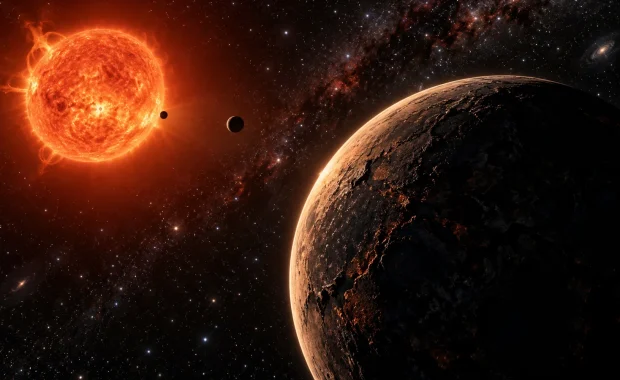
Kepler-1223 b is classified as a super Earth due to its mass and size, which exceed those of our planet but are significantly less than gas giants like Neptune or Uranus. Its mass measures approximately 1.98 times that of Earth, implying a gravitational pull that could sustain a substantial atmosphere if conditions allow. Its radius is about 1.22 times Earth’s, indicating a slightly larger volume that may host a variety of geological and atmospheric features.
Determining the composition of super Earths like Kepler-1223 b remains a challenge, primarily because mass and radius measurements alone do not definitively reveal internal structure. However, models suggest that planets of this size could be rocky, possess a thick atmosphere, or even have a layered interior with a metallic core and silicate mantle. The density, calculated from mass and volume, hints at a predominantly rocky composition with possible volatile components, depending on atmospheric retention and planetary history.
Understanding the makeup of Kepler-1223 b has significant implications for habitability assessments, as a dense, rocky surface with a stable atmosphere would be more conducive to life-supporting conditions, whereas a thick gaseous envelope might resemble mini-Neptunes that are less hospitable.
Orbital Dynamics and Environment
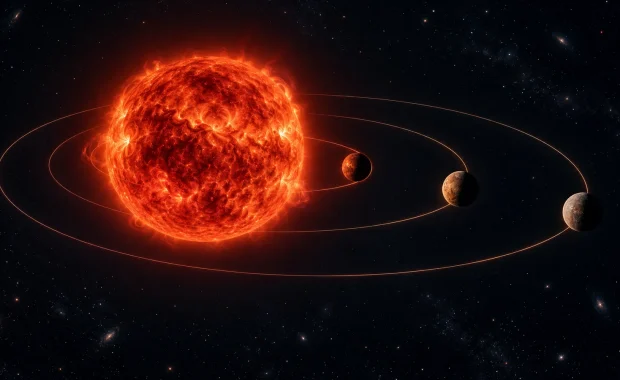
Kepler-1223 b orbits its host star at an orbital radius of approximately 0.1186 AU, a distance considerably closer than Mercury’s orbit around our Sun, which averages about 0.387 AU. This proximity places the planet within what astronomers term the “hot zone,” where stellar radiation and gravitational interactions create extreme environmental conditions. Its orbital period is astonishingly short, completing a full orbit in roughly 1.07 hours, a testament to its tight orbit and the intense gravitational forces at play.
Despite this rapid orbital period, Kepler-1223 b’s orbit is characterized by a near-perfect circularity, with an eccentricity of 0.0. Circular orbits tend to promote climatic stability, albeit at high temperatures in this context. Such an orbit minimizes variations in stellar radiation received, but the planet’s close proximity implies surface temperatures that are likely inhospitable for life as we know it. Nevertheless, the study of such close-in planets yields valuable insights into planetary dynamics and atmospheric physics under extreme conditions.
The planet’s orbital stability over geological timescales depends on factors such as tidal interactions, stellar activity, and potential presence of additional planets in the system. These interactions can influence the planet’s rotational state, atmospheric composition, and geological activity, all of which are pivotal in understanding its evolution and potential habitability.
Surface Conditions and Habitability Potential
Environmental Extremes and Surface Temperatures
Given its proximity to Kepler-1223, Kepler-1223 b is subject to intense stellar irradiation, resulting in surface temperatures that are likely far above the thresholds for liquid water stability. Estimates, based on models of planetary thermal equilibrium, suggest temperatures exceeding 1,000 Kelvin, rendering the planet inhospitable for Earth-like life. Such high temperatures would lead to the vaporization of volatile compounds and the formation of a hostile, possibly molten surface environment.
However, atmospheric composition plays a crucial role in moderating surface conditions. If Kepler-1223 b possesses a thick, reflective atmosphere rich in clouds and aerosols, it could potentially reduce the surface temperature, although the likelihood remains low given its close orbit. On the other hand, a sparse or absent atmosphere would expose the surface directly to stellar radiation, increasing the temperature and stripping away volatile compounds over time.
Understanding the atmospheric properties is essential for assessing habitability, but current limitations in observational capabilities restrict direct measurements. Future missions such as the James Webb Space Telescope aim to analyze exoplanet atmospheres through transit spectroscopy, which can reveal the presence of molecules like water vapor, carbon dioxide, and methane—key indicators of potential habitability.
Magnetic Fields and Atmospheric Retention
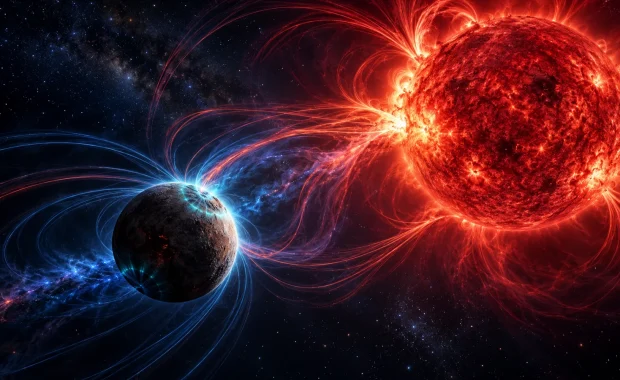
Another factor influencing habitability is the planet’s magnetic field, which can protect the atmosphere from stellar wind erosion. For Kepler-1223 b, the strength and presence of a magnetic field are unknown, yet their existence could significantly impact the planet’s ability to retain an atmosphere over geological timescales. The generation of magnetic fields depends on planetary interior dynamics, such as a molten, convecting metallic core, a process similar to Earth’s geodynamo.
If Kepler-1223 b has a robust magnetic field, it could shield its atmosphere from high-energy stellar particles, increasing the likelihood of maintaining conditions conducive to life. Conversely, the absence of such a field would subject the atmosphere to continual erosion, especially given the planet’s close orbit and the star’s activity levels.
The Role of Super Earths in Exoplanet Research
Understanding Planetary Formation and Evolution
Super Earths like Kepler-1223 b are pivotal in understanding planetary formation mechanisms. Their size and mass suggest they may originate from the accumulation of planetesimals in protoplanetary disks, followed by complex processes of accretion, migration, and atmospheric development. The diversity observed among super Earths—ranging from rocky to gaseous compositions—indicates multiple formation pathways and evolutionary histories.
Studying these planets helps refine models of planetary system architecture, especially regarding the migration of planets from their birthplaces to close-in orbits. Migration theories explain how planets like Kepler-1223 b end up in such tight orbits, possibly through interactions with the protoplanetary disk or gravitational encounters with other planets.
Moreover, super Earths serve as laboratories for understanding atmospheric retention and loss, especially under intense stellar radiation. Analyzing their atmospheres, or the lack thereof, provides clues about the long-term stability of planetary environments and their capacity to support life.
Implications for the Search for Extraterrestrial Life
The discovery of super Earths within the habitable zones of their stars has profound implications for astrobiology. Although Kepler-1223 b itself is unlikely to host life due to its extreme environment, its proximity within the system informs the search for other, more hospitable planets nearby. The presence of a super Earth suggests the potential for other planets in the same system that might orbit at greater distances, where conditions could be more favorable for life.
Furthermore, the study of super Earths helps establish the frequency and distribution of potentially habitable worlds in our galaxy. This information is vital for upcoming observational campaigns aimed at identifying true Earth analogs—planets with similar size, composition, and orbital characteristics as Earth.
Future Directions in Exoplanet Study and Technology
Advancements in Observation and Data Collection
The ongoing development of space telescopes and instrumentation promises to revolutionize exoplanet science. The James Webb Space Telescope (JWST), with its advanced spectroscopic capabilities, is poised to analyze the atmospheres of exoplanets like Kepler-1223 b in greater detail than ever before. Its ability to detect atmospheric molecules will shed light on planetary compositions, weather patterns, and potential biosignatures.
Ground-based observatories equipped with high-resolution spectrographs and adaptive optics will complement space missions by providing detailed radial velocity measurements, refining mass estimates, and uncovering additional planets within the same systems. These efforts will enhance our understanding of planetary system architectures and their dynamical stability.
Emerging techniques such as direct imaging, which involves capturing photons emitted or reflected by exoplanets, are becoming increasingly feasible with advancements in coronagraphy and starshade technology. These methods aim to produce direct pictures of planets, offering insights into surface conditions and atmospheric composition.
Modeling and Simulation
In tandem with observational efforts, sophisticated computer models simulate planetary atmospheres, geological processes, and orbital dynamics. These models help interpret observational data, predict planetary environments, and guide future exploration strategies. For Kepler-1223 b, simulations of atmospheric circulation and thermal dynamics will be crucial in estimating surface conditions and habitability potential.
Additionally, planetary formation models incorporate variables such as disk composition, stellar radiation, and migration pathways to understand how super Earths come into existence and evolve over time. These models inform target selection for observational campaigns and help prioritize systems most likely to harbor habitable worlds.
Conclusion and Broader Significance
Kepler-1223 b exemplifies the complexity and diversity of exoplanets within our galaxy. Its discovery underscores the importance of large-scale surveys and advanced detection techniques in expanding our cosmic horizon. Though its extreme proximity to its host star makes it an unlikely candidate for life as we know it, studying such planets provides critical insights into planetary physics, atmospheric processes, and system evolution.
As technological advancements continue, the potential to identify worlds that resemble Earth in size, composition, and orbital location grows ever closer. Kepler-1223 b, along with many other exoplanets, serves as a stepping stone toward answering one of humanity’s most profound questions: are we alone in the universe? Through dedicated research, innovative missions, and interdisciplinary collaboration, the pursuit of understanding these distant worlds remains one of the most exciting frontiers in science today.
Sources include NASA’s Kepler mission data, recent publications in planetary science journals, and upcoming mission details from the James Webb Space Telescope project documentation.