Many “slime without glue” recipes online quietly substitute another adhesive, use harsh detergent, or show a texture that only lasts long enough for a video. A better approach is to be honest about the result. Without polyvinyl-acetate school glue and a borate activator, you can still make satisfying stretchy, squishy, or flowing materials—but each behaves differently from classic glue slime.
This guide gives four reliable options: cornstarch oobleck, psyllium gel, chia sensory gel, and a soft marshmallow dough. The first three are intended for play and science observation, not eating; the last uses food ingredients but should still be treated as an activity rather than a snack. Adult supervision, allergy awareness, clean surfaces, and age-appropriate handling matter for every recipe.
Choose the texture you want
- Oobleck: flows slowly but becomes firm under sudden force; best for science play.
- Psyllium gel: stretchy and cohesive after heating; closest to a soft gel slime.
- Chia gel: cool, slippery, textured sensory play; simple but not stretchy.
- Marshmallow dough: soft, pullable, and moldable; contains sugar and requires heat.
Safety before the mixing starts
“Homemade” does not automatically mean harmless. Classic slime recipes may contain borax, boric acid, contact-lens solution, glue, laundry detergent, shaving cream, fragrance, or colorants. Poison Control notes that high borax concentrations can irritate or burn skin and that swallowing slime can cause gastrointestinal symptoms. Use a recipe with known ingredients, supervise children, and stop if redness, burning, coughing, or eye irritation occurs.
Do not allow slime play for a child who still mouths materials unless every ingredient and texture is appropriate and a caregiver is directly supervising. Small add-ins such as beads, glitter, foam balls, and charms are choking hazards and create microplastic waste. Skip them. Wash hands before and after play, cover cuts, and keep mixtures away from pets.
Food-based ingredients do not make a used play mixture safe to eat. Hands, tables, containers, and repeated handling introduce contamination. If accidental ingestion, eye exposure, or a concerning reaction occurs, contact your local poison center or medical service with the ingredient list.
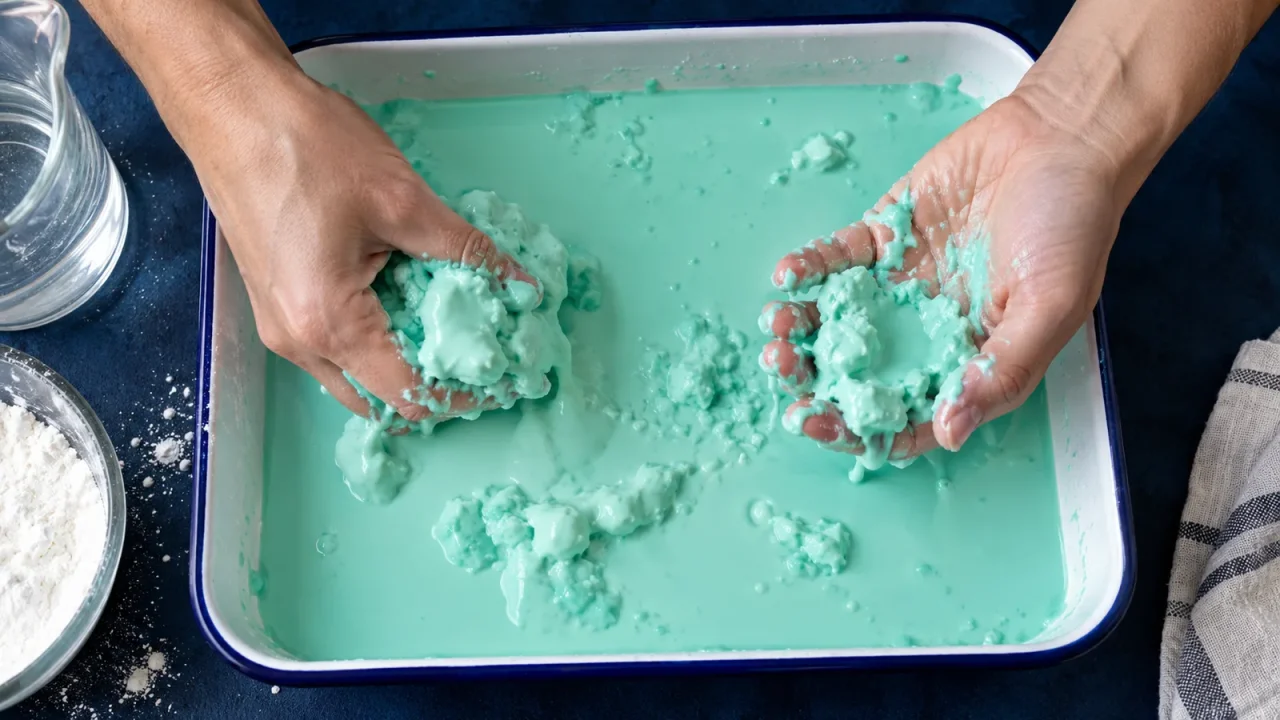
Recipe 1: Cornstarch oobleck
What you need
- 2 cups cornstarch
- About 1 cup room-temperature water
- A wide bowl or tray
- Optional food coloring added to the water
Method
- Put the cornstarch in the bowl.
- Add about three-quarters of the water and mix slowly with a spoon or hands.
- Add the remaining water a tablespoon at a time until the mixture flows when tilted but feels firm when squeezed or tapped.
- Test it: roll it quickly into a ball, then stop moving and watch it slump.
The useful starting ratio is roughly two parts cornstarch to one part water by volume, but humidity and measuring style change the final amount. If it splashes like milk, add cornstarch. If it cracks and never flows, add water a teaspoon at a time.
The science
Oobleck is a suspension of cornstarch particles in water and a classic shear-thickening non-Newtonian fluid. Under slow movement, particles can shift past one another and the mixture flows. Under sudden force, the particles crowd together and resist movement. The American Chemical Society uses cornstarch and water to demonstrate how a material can act more liquid-like or solid-like depending on how force is applied.
It is not a polymer slime in the same sense as glue-and-borate slime. That distinction is part of the lesson, not a failure. Ask which actions make it hard, whether temperature changes the behavior, and how long a ball lasts when pressure stops.
Recipe 2: Psyllium-husk gel
What you need
- 1 tablespoon plain psyllium husk powder
- 1 cup water
- A large microwave-safe bowl or small saucepan
- Optional food coloring
Method
- Whisk psyllium into water before heating.
- On a stovetop, heat gently while stirring until thick and glossy. In a microwave, use short intervals in an oversized bowl, stirring between them; the mixture can foam rapidly.
- Stop when it forms a cohesive gel that pulls from the side.
- Cool completely before anyone touches it. Spread it on a plate to speed cooling and test the center yourself.
Heating time depends on equipment and batch size. Never hand a child a bowl straight from the microwave; thick gels can hold heat and cause burns. If the cooled gel tears immediately, it may need slightly more heating. If it is rubbery, shorten the heating time in the next batch or knead in a few drops of water after cooling.
The science
Psyllium husk contains soluble fiber that binds water and forms a viscous network. Heating speeds hydration and changes how the hydrated chains interact. The result stretches because the gel distributes force across that network, but it will not have the snap and elasticity of cross-linked glue slime.
Recipe 3: Chia sensory gel
What you need
- 1/4 cup chia seeds
- 1 to 1 1/4 cups water
- A lidded container
- Optional food coloring
Method
- Stir the seeds and water thoroughly.
- Wait 10 minutes, stir again to break clumps, then refrigerate for several hours or overnight.
- Add a little water if the gel is too dense. Use it in a shallow tray with scoops or large age-appropriate tools.
Chia seeds form a mucilage coating as they hydrate. The result is slippery and cohesive rather than stretchy. It works well for observing hydration and texture, but seeds scatter easily. Keep the activity contained and never wash a large mass down the drain.
Although chia is a food, this mixture becomes a sensory material once handled. Discard it after play, especially if it has been warm. Avoid it for anyone with a relevant allergy or swallowing risk.
Recipe 4: Marshmallow sensory dough
What you need
- 1 cup marshmallows
- 1 teaspoon neutral cooking oil
- 2–4 tablespoons cornstarch or powdered sugar
- A microwave-safe bowl or double boiler
Method
- Warm the marshmallows and oil in very short intervals until softened. An adult should handle all heating.
- Stir until smooth, then let it cool until safe to touch.
- Knead in cornstarch or powdered sugar one tablespoon at a time until the mixture is pullable and less sticky.
- Use on a clean mat and discard after the activity.
This is closer to stretchy dough than flowing slime. Too much powder makes it crumbly; too little leaves it sticky. Oil reduces sticking but excess creates a greasy film. It contains substantial sugar and may include gelatin, so check dietary, religious, and allergy needs. Hot melted sugar can burn badly; cooling is non-negotiable.
Why many viral glue-free recipes fail
Shampoo and salt
Some shampoos thicken temporarily with salt because surfactant structures reorganize, but different formulas respond differently. Too much salt can thin the mixture again, and concentrated fragranced shampoo may irritate skin or eyes. It is unreliable and not our preferred children’s activity.
Dish soap and toothpaste
This combination often produces scented paste, not slime. Both products are formulated for specific uses, and prolonged skin contact or accidental eye exposure is unnecessary. “Household product” is not the same as “sensory-play ingredient.”
Contact-lens solution
Many contact solutions contain boric acid or borates and function as activators when combined with glue and baking soda. A recipe using them is not truly borate-free just because the word “borax” is absent.
Freezer tricks
Cooling shampoo or soap can temporarily increase viscosity, but it returns to its original behavior as it warms. A short edited video may hide that limitation.
Troubleshooting by texture
| Problem | Likely cause | Try this |
|---|---|---|
| Oobleck is watery | Too much water | Add cornstarch a spoonful at a time. |
| Oobleck is dry and cracked | Too little water | Add water by the teaspoon. |
| Psyllium gel tears | Under-hydrated or under-heated | Heat slightly longer next time; let it cool fully. |
| Psyllium gel is rubbery | Overheated | Use shorter intervals or slightly more water. |
| Chia gel has dry clumps | Not stirred during early hydration | Stir after 10 minutes, then chill again. |
| Marshmallow dough is sticky | Too little dry ingredient | Knead in a small amount gradually. |
Color without a permanent mess
Use only a drop or two of food coloring and mix it into water before adding dry ingredients. Highly concentrated color can stain hands, grout, wood, clothing, and porous stone. Test the activity surface first. Natural colors such as cocoa or turmeric also stain and are not automatically allergy-free.
Glitter is difficult to contain and persists in waterways; it also creates an ingestion hazard. Color, texture, scoops, and simple experiments provide enough interest without it.
Storage and disposal
Oobleck is best used fresh. Let it dry, scrape it into household waste or compost only if local rules and ingredients allow, then wash the thin residue. Do not pour a bowl of cornstarch mixture down a drain. Psyllium and chia gels also swell with water and belong in household waste, not plumbing.
Refrigerating a mixture slows but does not stop microbial growth. Discard anything with odor, mold, separation that does not remix, or contamination from a sick child. For group settings, use individual portions rather than one shared tub.
Set up the activity space
Use a rimmed tray on a washable floor or table, keep water and paper towels nearby, and put sleeves up before color is opened. Measure ingredients into separate containers so the child can participate without reaching into bulk packages. For a classroom or party, label each batch with its ingredients and keep allergy information available. Clean the surface before and after the activity; a craft mat used for slime should not return to food preparation until it has been washed appropriately.
Let children choose color or which test to run, but keep adults responsible for heat, storage, and disposal. A clear end routine—mixture into waste, tools into a wash basin, hands washed with soap—prevents the activity from becoming a plumbing or hygiene problem.
Turn play into an experiment
Ask one testable question at a time. Does oobleck resist a fast spoon more than a slow one? Does a small change in the cornstarch-to-water ratio change how long a ball holds? Does warm versus cool psyllium gel stretch differently after both samples are safe to touch? Record amounts, change one variable, and describe observations without deciding in advance what “should” happen.
This transforms a recipe into a lesson about suspensions, viscosity, polymers, measurement, and fair testing. A failed texture becomes data rather than wasted effort.
Frequently asked questions
Which recipe feels most like classic slime?
Heated psyllium gel is usually the most cohesive and stretchy. Oobleck is more dramatic scientifically but behaves like a shear-thickening suspension rather than elastic slime.
Is glue-free slime edible?
Not automatically. Even food ingredients become contaminated during play, and some recipes use nonfood products. Treat all sensory mixtures as not for eating unless you are preparing a food under normal kitchen hygiene for immediate consumption.
Can toddlers make these recipes?
Only with direct adult supervision and a recipe appropriate to the child’s tendency to mouth objects. Adults must handle all heating. Skip small add-ins entirely.
How long does homemade slime last?
These fresh mixtures are best treated as single-session activities. Chilled storage may extend some gels briefly, but discard at the first sign of contamination and never prioritize saving a batch over hygiene.
Bottom line
Good slime without glue begins with an honest texture goal. Use oobleck for surprising physics, psyllium for a stretchy gel, chia for contained sensory play, or marshmallow dough for a warm-prepared, moldable material. Measure, supervise, avoid harsh product cocktails, protect skin and eyes, and dispose of swollen mixtures outside the drain.
Sources
- ACS Polymers Au: Safer and Greener Polymer Demonstrations for STEM Outreach
- American Chemical Society: Cornstarch and water activity
- Poison Control: Homemade slime safety
Evidence reviewed: October 16, 2026.